• The Canon Rumors Forum has officially been shut down as of July 10, 2026.

    All data will be deleted on September 16, 2026.

    the ad free experience will return by July 17, 2026.

Tamron 35mm VC vs. Canon 35mm II

I sold my Canon 35mm II, the one with the Blue Goo, and bought in the new Tamron 35mm with VC.

The quick impressions, with both fresh in my mind (although I didn't have them side-by-side)....

- The VC on the Tammy gives me what I feel is about 2 stops of stabilization. That's the key benefit (aside from $1100 of additional cash) from the Canon.
- In exchange for the two stops, you get some significant color aberration, with fringing in the corners. This is only in some shots with extreme contrast. To give you some perspective, shooting a page of black and white text won't show it, but shoot a scene with metallic highlights blown in the corners, and it'll be readily apparent. It's not in many images, and cleaned up nicely in post.
- Other Tammy benefits include huge weight and size reductions over the Canon.
- The image quality is really remarkably good. It is better than my Sigma 18-35 Art at 35mm, and that is really saying something.
- The lens did not require any calibration (dumb luck), and I don't believe the 35 is compatible with the new Tamron dock, although perhaps a future firmware release will change that.

All-in-all, I'm very, very pleased so far. I prefer the Tammy over the Canon for the weight and length; the quality is on par (probably slightly softer in some peeping fashion); and the VC is heaven-sent when you're taking pictures outdoors at 8 p.m.

Looking forward to the 85mm version.

Why You Should Stick with Your Canon DSLR and Forget Sony FF Mirrorless

A lot of Canon users are being tempted to shoot with a Sony FF mirrorless due to the ability to adapt Canon lenses, and lured by the thought that the grass might be greener on the Sony mirrorless side of the fence. It isn't. Before you accuse me of being a Sony hater, I should also say I have cross posted much of this on the Sony Alpha Forum and the A mount crowd are applauding.

There is a big fad for Sony FF mirrorless at the moment, and it is like watching lemmings following each other over the cliff. I am allowed to say this because I am a Sony FF mirrorless owner because I too was suckered into following the mindless herd over the cliff. It was a big mistake. How could I have been so foolish?

This is a controversial claim, so let's go through the reasons for this bold statement. The simple question hanging over the full frame Sony FE mount system is this: what is the point of professional grade full frame mirrorless?

The first answer you will hear to this question is that full frame mirrorless is more compact. For example Maki Kimio of Sony stated in an interview:

AP: Can you summarise the benefit of choosing an Alpha 7-series camera over a DSLR in a single sentence?

KM: Size. It’s all about size – it’s smaller and lighter. That’s the main reason of choosing our products.

Let's examine this allegation. I direct readers to camerasize.com where this comparison comes from:

http://camerasize.com/compact/#624.515,596.286,377.56,ha,t
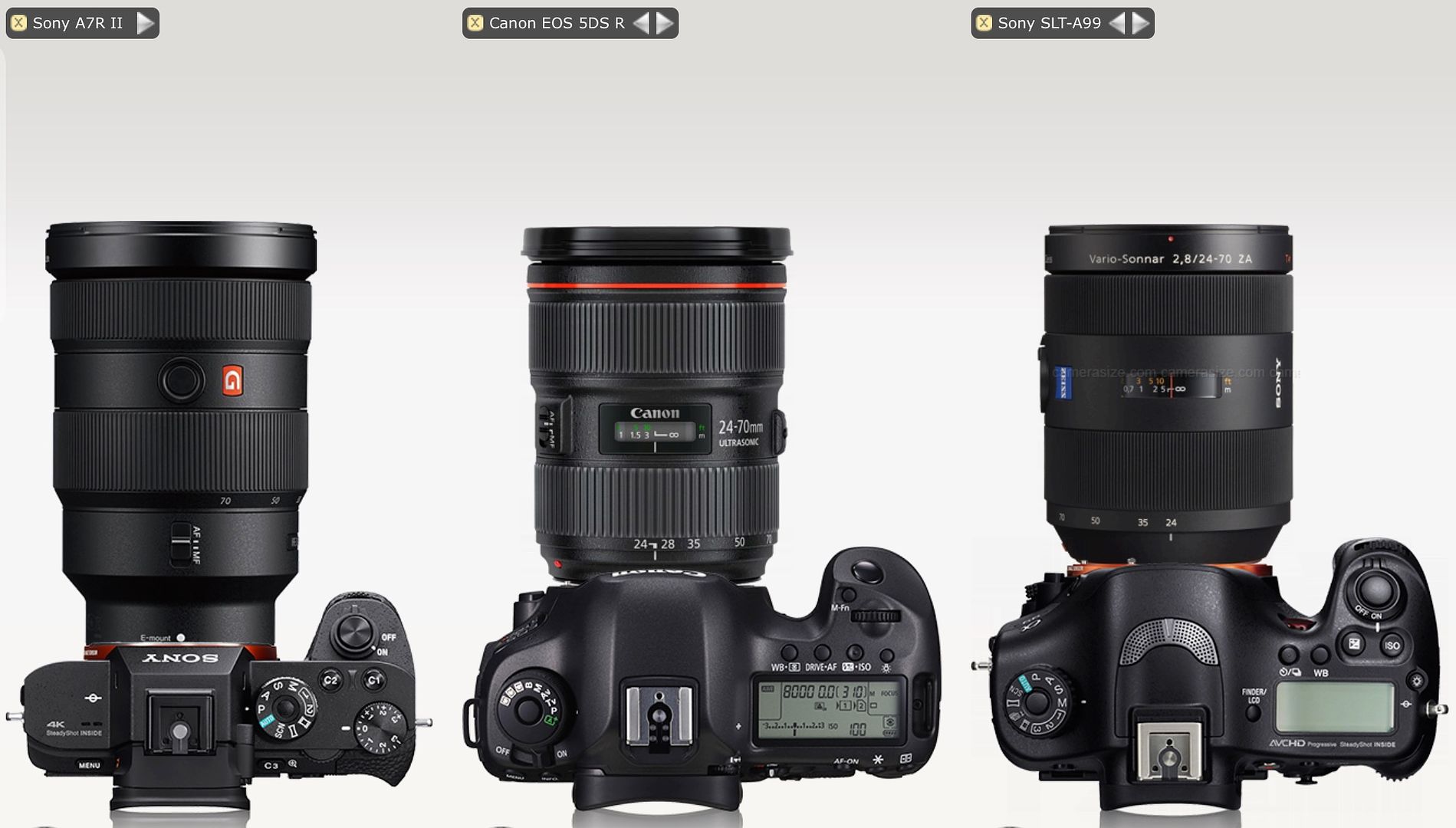


It shows the Sony a7RII, Canon 5Ds, and Sony a99 with a native 24-70mm f/2.8 lens mounted. As you can see, the total lengths are the same. Sony has failed to overcome the laws of physics. If you take something from the camera body, you have to give it back to the lens, and by the same amount. So you have a choice: either buy one big body and lots of small lenses, or one small body and lots of big lenses. The former is economical and the latter is more expensive. The more lenses you carry on you, the worse the size disadvantage for mirrorless becomes.

In many cases, Sony FF mirrorless works out bigger:

http://camerasize.com/compact/#624.516,377.63,ha,t
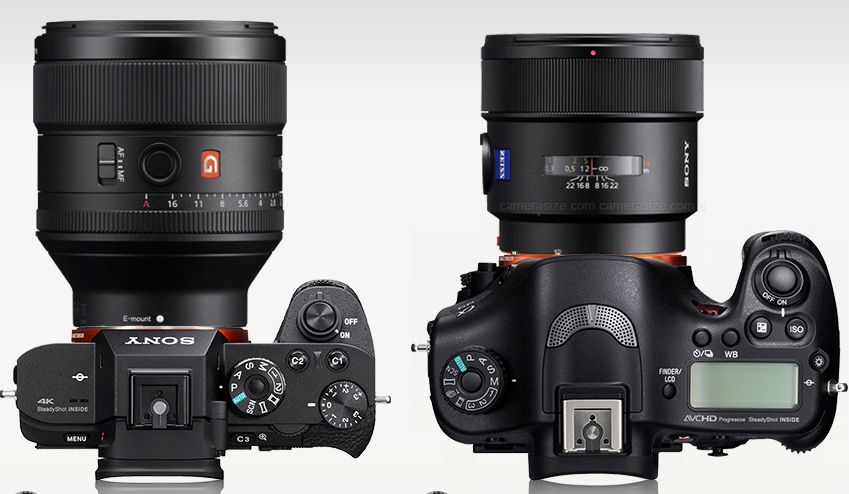


This shows the a7RII with the new 85mm f/1.4 GM lens vs the a99 with the Sony-Zeiss 85mm f/1.4 lens. This time, FF mirrorless works out BIGGER than the rival DSLT model. The same thing happens when you compare it with a Canon DSLR:
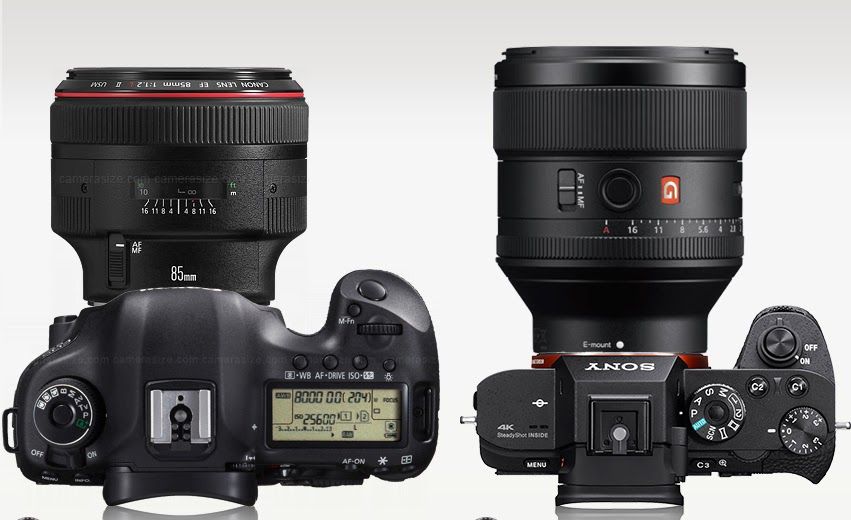


Here the a7RII with the 85mm f/1.4 lens is bigger than the Canon 5DsR with the 85mm f/1.2 lens, despite the latter being half a stop faster.

The only time mirrorless works out more compact is when shooting with pancake lenses:
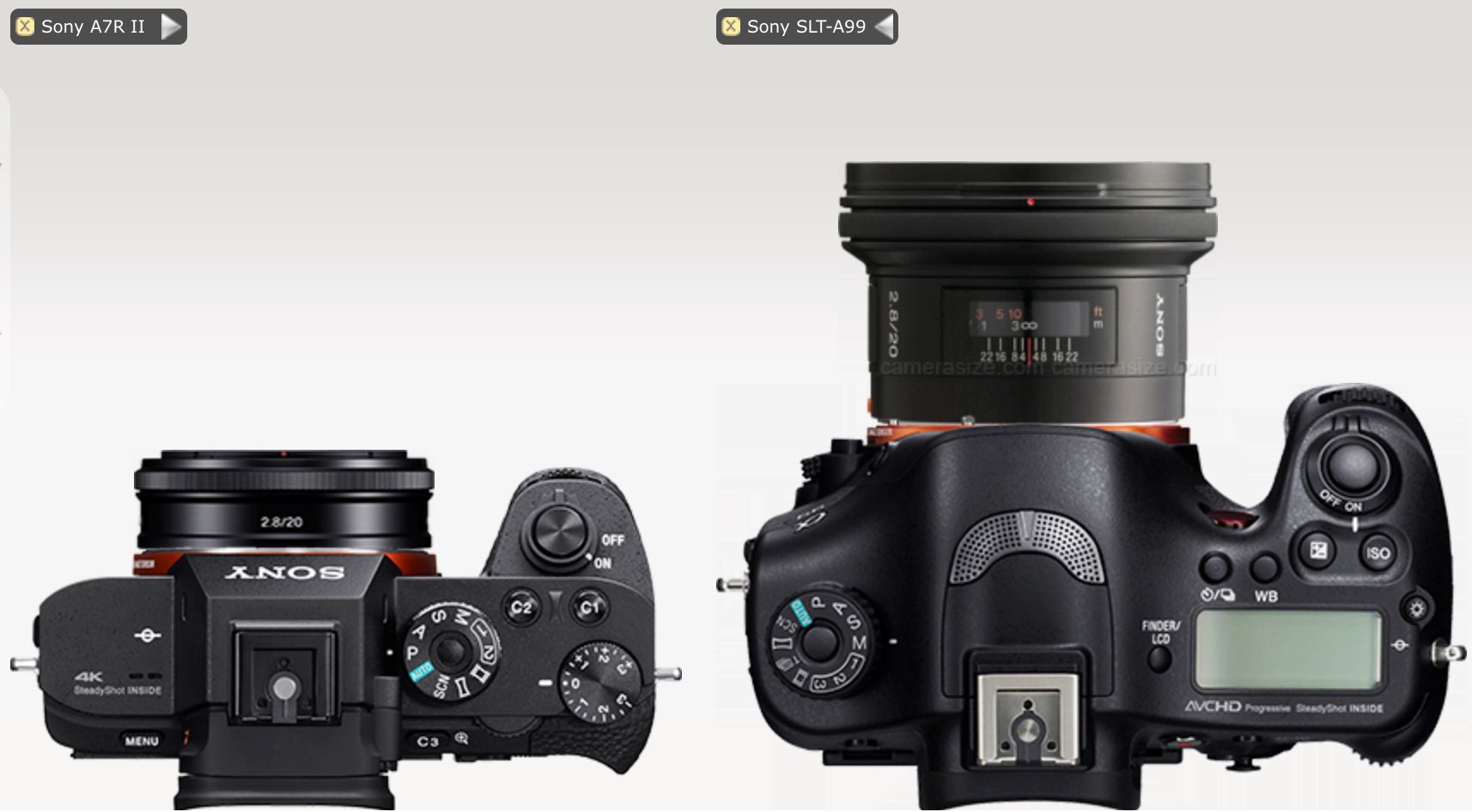


Here, the a7RII and a99 are shown with a 20mm f/2.0 lens. This was probably the original design intention of full frame mirrorless, but it became so irrationally popular that Sony started to develop more professional lenses for the system.

Sony and Zeiss seem to be peddling the revelation of the obvious that slow lenses make for more compactness as though this were some spectacular technological innovation. It seems that f/1.8 is the default maximum diameter for nearly all FE mount FF primes, with only a couple of exceptions. The absurdity is that the 85mm f/1.8 Zeiss Batis gives you the same shallow depth of field as the APS-C Fuji XF 56mm f/1.2. What is the point of shooting full frame if you can't get more subject isolation than you can from APS-C? The only reason to limit aperture to f/1.8 is to make the lens more compact. But look at this:
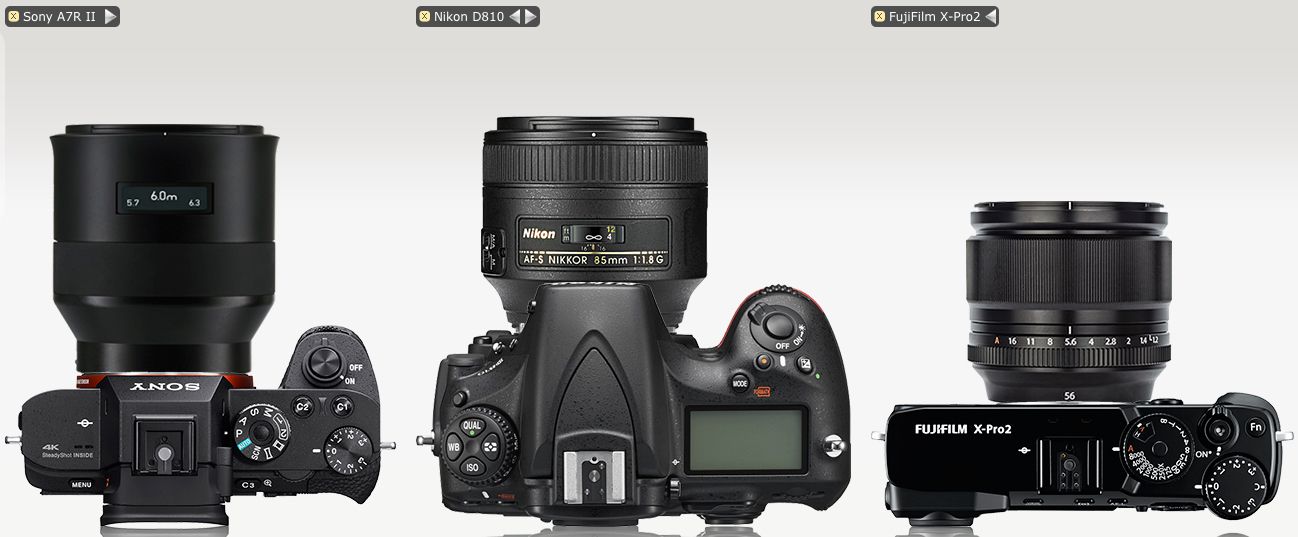


Shown are the Sony a7RII with the Zeiss 85mm f/1.8 Batis, the Nikon D810 with the 85mm f/1.8, and the Fuji X-Pro2 with the 56mm f/1.2 lens. In terms of compactness, the APS-C Fuji is streets ahead. At maximum aperture all of these set-ups give you the same shallow depth of field.

If compactness really was your priority, you would be better off choosing the Fuji with the 56mm f/1.2, which also allows you to shoot faster in low light. The Sony makes up for the slowness of the lens with IBIS, but this won't help you stop action in low light. It makes no sense to limit the aperture speed on FF lenses merely for the sake of making a system more compact.

Even with a 50mm f/1.8 lens, there is questionable size benefit from shooting with a mirrorless:
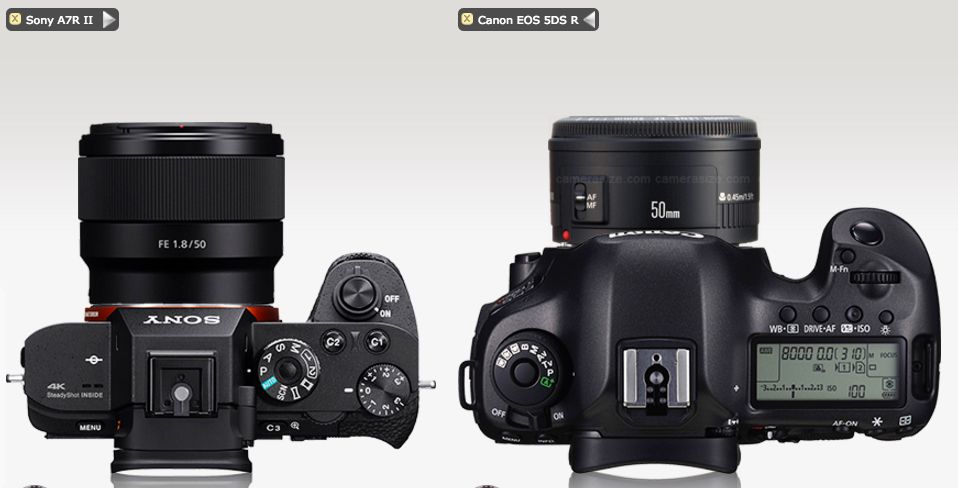


Here the a7RII is shown with the new 50mm f/1.8 and the 5DsR with the 50mm f/1.8 lens. If you carry multiple focal lengths around with you at once, then professional full frame mirrorless has a marked size disadvantage. Want a more compact professional camera system?—buy a DSLR!

Now that the realisation has slowly begun to sink in that once the lens size in taken into account size advantage is largely lost, there is talk from increasingly desperate people now begging for a "24-70mm f/2.0 FE mount lens that is more compact (sic) than the f/4.0 version". But the public have deluded themselves into thinking that Sony and Zeiss can collaborate to rewrite the laws of physics.

The next answer you will hear is that a FF mirrorless is still lighter and the width of the body might be a bit smaller. However, that is only because Sony put such a miniscule battery in their FF mirrorless bodies that you end up having to carry multiple batteries that negate any size advantage. You could make DLSR batteries smaller too, and they would still have better battery life than a mirrorless. The larger bodies found of DSLRs is more to improve ergonomics and could be made smaller if there were demand for this.

So once again we find ourselves back to the original question. Other than as an enthusiast's compact walkabout system for shooting with a single pancake lens: what is the point of professional full frame mirrorless? It certainly isn't certainly isn't because it is more compact used with professional grade lenses.

The next answer you will hear is that full frame mirrorless is better because of IBIS. That's like saying that Sony mirrorless is better because of the steak knives that they throw in. IBIS is hardly any more a unique technical feature inherent to the design of mirrorless cameras than either wifi or steak knives. Pentax have just incorporated IBIS into their K-1 DSLR, and Sony could have put IBIS into their A mount DSLT system. So IBIS gives full frame mirrorless no inherent technical advantage over other systems, but people are suckered in by the offer of steak knives.

But Houston, we have a problem. There is also a major flaw with Sony E mount IBIS. The Sigma CEO has been quoted as expressing serious concern for the narrowness of the E mount diameter: "...the diameter is very small and makes it difficult to design high quality FF lenses ... it almost looks like E-mount was designed for APS-C more than FF".

We know that a narrow mount diameter is a big no-no with IBIS:

TAKASHI UENO: First of all, our XF mount is not compatible with IBIS. You may be thinking that our mount size is similar to competitors’ and why Fujifilm cannot do it. The answer is simple: for the sake of image quality. IBIS has both advantages and disadvantages. IBIS moves the sensor in the mount to stabilize the image. To secure the amount of light at any position, the diameter of mount must cover the wider image circle considering the margin of sensor movement. The diameter of our mount was designed for the image circle without IBIS. It means the amount of light at the corners is reduced when the sensor is shifted. We could correct it digitally, but we don’t want to do it: we don’t want to compromise our image quality.

TOMASH: Why didn’t you design a mount in a size, which would allow implementing the IBIS?

TAKASHI UENO: To cover the larger image circle, not only mount size (and body size), but also lens size must be bigger.

http://fujilove.com/our-highest-priority-is-always-image-quality-interview-with-takashi-ueno-and-shusuke-kozaki-from-fujifilm-japan/

If you want IBIS, you have to design the mount in advance with a wider diameter, so that it doesn't compromise corner IQ as the sensor moves around. What you don't do is take an APS-C mount (NEX mount), turn it into a full frame mount, then forcibly retrofit IBIS onto a mount never designed to take it in the first place.

Furthermore, Zeiss has admitted that the short flange distance of FE mount makes it technically challenging to design wide angle lenses: “The short flange distance between the sensor and the rear element is an engineering challenge for ultra wide-angle lenses.” At short focal lengths, the light hits the corners at a steep angle, which is exacerbated by IBIS. It isn't without reason that Sony has yet to come up with any wide angle zoom lenses for the FE mount. They don't even have a 16-35mm f/2.8 zoom, one of the so-called zoom trinity of bread-and-butter professional lenses. We may never see anything like the Canon 11-24mm f/4 rectilinear lens for E mount, and it would hardly be predicted to perform well if it did appear. It is a euphemism to call the FE mount "technically challenged". The more honest expression may well be "technically flawed", or just plain retarded.

It is interesting to compare the relative diameters of various mounts:

Minolta/Sony A mount: 49.7mm
Sony E mount: 46.1mm
Fuji X mount: 44mm
Canon EOS EF mount: 54mm
Pentax K mount: 44mm


From this you can that see Sony were better off putting IBIS into their A mount, which has a wider diameter, because it is more of a dedicated full frame mount, not an APS-C mount. Canon is in a better position to add IBIS to the EOS mount because it is so wide, and if sensor resolution goes up to 120MP we will probably need it to reduce the impact of handshake. You can also see that both Sony and Pentax are adding IBIS to excessively narrow mounts purely as a marketing ploy, with flagrant disregard towards optical fundamentals. It represents the victory of advertising over engineering. For the credulous it represents Sony's triumph over the laws of physics.

In any case, neither throwing in IBIS nor steak knives fails to convince us that mirrorless is an inherently better camera design. With that we return to the question: what is the point of professional FF mirrorless?

The next answer you get is that the main advantage of Sony mirrorless is that you can use non-native lenses with adapters. Asked about adapting Canon lenses Kimio Maki of Sony said this:

Do you anticipate that someone who has a collection of long telephoto Canon lenses could potentially use them to shoot sports with the a7R II?

KM: I hope that our native lenses are better! But it will happen. I see people using Sony a7-series bodies and third-party lenses all the time ... because they already own the lenses. It works, but our native lenses are much better...

Adapters are grossly impractical to use. I have a lot of adapters for my a7II, and have accidentally taken the wrong one with me or have forgotten to pack one altogether. It's also an extra pair of lens caps to lose. Saying you chose FF mirrorless because of the size advantage so you can shoot with an adapted Canon lens is like saying that you're going on a holiday to Hawaii so you can enjoy skiing on powder snow. You can't have your cake and eat it too. Adapters are also fiddly, bulky, and they decisively kill whatever marginal advantage in compactness the body might allegedly once have had. Unfortunately, the body-adapter-lens combination ends up looking like some ungainly Dr. Seuss contraption:


Worse still, my Sony A to E mount adapter reduces light transmission by about a 1/2 stop, and you lose far too much of the native autofocus functionality, which gets immeasurably worse with Canon lenses. It is always far better to use native lenses—hence why Sony actually make native E mount lenses!!! As Maki rightly says "native lenses are much better". It's a grand statement of the obvious that no fanboys wants to hear. Nobody raves on and on about the fact that you can adapt some vintage MF lenses to Canon bodies then add focus peaking to the body with Magic Latern. Micro-misalignment between lens-adapter-body causes degradation of IQ in the corners particularly at shorter focal lengths (where due to the short flange distances and narrow mount diameter the E mount is "technically challenged" already because it was originally an APS-C mount). Being able to adapt vintage MF lenses might be cute and will have its niche, but for the vast majority of photographers, the last reason to choose mirrorless is as a vintage retro lens revivalist contraption. At the end of the day, when I pick my set of lenses for a shoot, I just find myself systematically avoiding the use of adapted lenses. I would gladly toss all of my adapters in the bin just to shoot with native lenses.

The next answer we get is that mirrorless is inherently superior because of live exposure preview. That means you get to preview the exposure in real time through the EVF before taking the picture. This is something that is not the default modus operandi on a DSLR, but a new hybrid viewfinder patent from Canon suggests exposure preview is soon coming to DSLRs. However, the Sony A mount cameras are DSLTs (Digital Single Lens Translucent), which already have an excellent EVF for live exposure preview. So once again it just isn’t true to say that live exposure preview through an EVF is the one extraordinary feature that elevates mirrorless to the status of being an inherently superior design over other alternatives.

So we find ourselves returning to the original question: what is the point of full frame mirrorless? When it comes to full frame professional grade mirrorless, the answer is that there is no point. People are buying into it because it is an irrational fad. You end up having to buy lots of big and expensive lenses for the one tiny body, when it is preferable to have lots of smaller lenses for the one big body, since the total lens-body combination is the same anyway due to physics. In actual fact the lens-body combination makes professional full frame mirrorless multi-lens packages larger overall. The only time you get more compactness is when you shoot with just one short focal length pancake or quasi-pancake lens for use as a walkabout camera.

The fad for a7 series full frame mirrorless cameras is driven by irrational exuberance, and Sony are merely responding to market demand-supply forces, even though they know themselves that they were better off developing their A mount system, based as it is on superior optical design fundamentals. Their autofocus system, IBIS, and the 42MP BSI sensor would have reached their full potential on the dedicated professional full frame A mount system, and are being wasted on the FE mount mirrorless system.

Mirrorless FF cameras are going through the usual cycle that goes with all novel technology. First some enthusiasts delirious with euphoria proclaim it to be the road to Elysian Fields and declare the DSLR dead. Next people find the Revolution to End All Revolutions brings its own set of problems, and it isn't the magical path to El Dorado it promised. Finally, people arrive at the more sober realisation that like rangefinders, it has its niche, along with its own peculiar set of pros and cons.

G1 X II vs M3 vs MFT

Hello,

I have a 5D3 and it leaves me wanting nothing when it comes to getting the shot.

However, when I am not getting the shot, it leaves me wanting a table to set it on. I love capturing my life, but sometimes with that much camera it hinders the lifing part. Particulary at music festivals in the deserts and mountains.

I want something with nicer quality images than I am getting from not taking my camera out...easy right?

Amazon still shows the G7X mkII as to be released on 3/26 and it still doesn't show it's in stock. I can't find any reviews, and everything is just basic press release stuff. All the comparisons of the original against the Sony favor the Sony. For me, there is nothing like the Canon UI. To have a camera like the 5D3 and be able to adjust it one handed and with barley a glance, sometimes it's important not to have to think at these events :)

When ever I use a friends A7r it feels like the equivalant of needing to use 3 extra clicks that feel randomly placed to do the same things.

I have never touched either the G7X or RX100. I am pretty sure I am fine without the EVF, it really comes down to:
I want a good UI
Good image quality (I feel both are gonna be negligible)
Accurate first and decent speed second auto focus

I was still eyeing the G5x thinking maybe I might actually miss the EVF, and while the Digic 7 is claiming better low light processing, I also assume this means for jpgs not RAW. However, if the Digic 7 is also improving AF speed then I want it.

What are anyone's thoughts on this? Has anyone's G7 X mkII shown up yet?

D5 Has CRAPPY Low ISO DR!!!

Dear friends,

According to DPReview lab tests, it seems that Nikon decided to bring out a $6,500 "pro monster" with a low ISO dynamic range that's much worse than that of $1,996 D750 and even worse; $747 (!!!) D5500 sensor, kills the one of the new "king" of Nikon FF!!!

I think that 1Dx Mk2, not only is going to blow the Nikon crap out of the water, it's going to eat it alive!

Here is the link to the "Nikon vs Nikon" comparison:
http://www.dpreview.com/news/9402203921/nikon-d5-shows-drop-in-dynamic-range

Be strong, enjoy your lives and those you love.
Best wishes

Yiannis.

Sony Bolsters Full-Frame FE Lens Lineup with New 70-300mm High-Resolution Zoom and 50mm F1.8 Prime L

HTML:
<em>New FE 70-300mm F4.5-5.6 G OSS Telephoto Zoom and 50mm F1.8 Prime Lens Extend Sony α Shooting Possibilities</em></p>
<p><strong>SAN FRANCISCO, Mar. 29, 2016 –</strong> Sony Electronics, a worldwide leader in digital imaging and the world’s largest image sensor manufacturer, has today introduced two new full-frame lenses for their E-mount camera system, the FE 70-300mm F4.5-5.6 G OSS telephoto zoom and 50mm F1.8 prime lens.</p>
<p>The new FE 70-300mm F4.5-F5.6 G OSS zoom lens represents the first Sony α E-mount lens to reach a 300mm focal length, featuring high resolution and excellent overall optical performance throughout the entirety of its range.  The new 50mm F1.8 prime lens is extremely compact, lightweight and affordably priced, making it an ideal choice for those looking to explore the benefits of a large aperture prime lens at a reasonable cost.</p>
<p>“We’re continuing to build out our FE lens lineup, offering more variety than ever for today’s imaging enthusiasts,” said Neal Manowitz, Vice President of Digital Imaging at Sony Electronics.  “Representing two of the most requested focal lengths by our customers, the new 70-300mm zoom and 50 F1.8mm prime become ideal choices for those looking to expand and enhance their Sony α kits.</p>
<p><!--more--></p>
<p><strong>New FE 70-300mm F4.5 – 5.6 G OSS Telephoto Zoom Lens</strong></p>
<p>Sony’s longest reaching E-mount lens to date, the new FE 70-300mm F4.5 – 5.6 G OSS telephoto zoom lens (model SEL70300G) features a state-of-the-art optical design including four aspherical glass elements, two ED (Extra-low Dispersion) glass elements and Sony’s Nano AR coating, which all work together to effectively suppress spherical aberration, distortion, and chromatic aberration.  This ensures beautiful high-resolution results for both still and video shooting.</p>
<p>The new telephoto zoom lens also features class-leading close-up performance, with a minimum focusing distance of less than 3 feet (0.9m) and a maximum magnification of 0.31x, making it an ideal choice for tele-macro photography.  This outstanding close-up performance also factors into the lens’ excellent corner-to-corner sharpness.</p>
<p>The versatile zoom lens includes built-in Optical SteadyShot image stabilization that helps to reduce camera shake, making it easier to capture clear images when shooting handheld.  Additionally, the new SEL70300G model has a linear actuator that allows it to achieve fast, smooth and quiet autofocus and is also dust and moisture resistant1 to ensure reliable operation in harsh outdoor conditions.</p>
<p><strong>New FE 50mm F1.8 Prime Lens</strong></p>
<p>Weighing in at less than 7 oz (192 g), the new lightweight FE 50mm F1.8 “normal” prime lens (model SEL50F18F) delivers an outstanding blend of performance, compactness and value, making it a perfect choice for hobbyist photographers and videographers looking to experience the benefits of a wide aperture prime lens at an attainable cost.</p>
<p>The lens features a new optical design with an aspherical element that effectively compensates for all forms of aberration, resulting in beautiful, crisp imagery.   Additionally, it has a circular aperture with a maximum of F1.8, producing beautiful ‘bokeh’ in images that allows the subject to stand out against a smoothly defocused background.  For extended durability, the new prime lens is built with a solid metal mount.</p>
<p><strong>Pricing and Availability</strong></p>
<p>The new FE 70-300mm F4.5 – 5.6 G OSS telephoto zoom lens will be available in May for about $1,200 US and $1,700 CA, respectively.</p>
<p>The new FE 50mm F1.8 prime lens will also be available in May for about $250 US and $350 CA, respectively.</p>
<p>Both of the new FE interchangeable lenses will be sold at a variety of Sony authorized dealers throughout North America.</p>
<p>A variety of exclusive stories and exciting new content shot with the new lenses and other Sony α products can be found atwww.alphauniverse.com , Sony’s new community site built to educate, inspire and showcase all fans and customers of the Sony α brand.</p>
<p>Content is also available for viewing at the sony.com product pages for the FE 70-300mm F4.5 – 5.6 G OSS telephoto zoom lens and the FE 50mm F1.8 prime lens.</p>
<span id="pty_trigger"></span>

Canon to Release Super Telephoto Zoom in 2016 [CR2]

HTML:
<p>We’re told that a Canon EF 200-600 f/4.5-5.6 IS development is on schedule and that the lens will be released some time in 2016.</p>
<p>The source didn’t know if it was going to be an L lens or not, but assumed that it wasn’t going to be. The lens would likely be priced below the EF 100-400mm f/4.5-5.6L IS II, and compete directly with the Sigma and Tamron supertelephoto zoom lenses.</p>
<p>It makes sense to us that it would come below the EF 100-400mm f/4.5-5.6L IS II as far as price point and quality are concerned. We’re confident such a lens from Canon would still have terrific optical performance and a relatively light weight.</p>
<span id="pty_trigger"></span>

Canon Celebrates 13th Consecutive Year of No. 1 Share of Global Interchangeable-lens Digital Camera

HTML:
<strong>TOKYO, March 29, 2016</strong>—Canon Inc. announced today that the Company’s interchangeable-lens digital cameras (digital SLR and compact-system cameras) have maintained the No. 1 share of the global market for 13 consecutive years from 2003 to 2015.(1)</p>
<p>Canon, which develops the key components featured in its interchangeable-lens cameras—the CMOS image sensors, image processors and interchangeable lenses—employs these cutting-edge technologies across its entire product lineup, from entry-level models to professional-use flagship cameras. Through its robust product lineup that effectively responds to the needs of a wide range of users, Canon has continuously secured the top global share within the industry.</p>
<p>In 2003, the dawn of digital SLR cameras, Canon introduced its breakthrough EOS Kiss Digital (EOS Digital Rebel or EOS 300D Digital in other regions). This groundbreaking camera, which was competitively priced and featured a compact, lightweight design, captured the top share of the global market and set the stage for growth in the digital SLR market. Since that time, Canon has continued to launch a range of epoch-making products, including the professional-model EOS-1D series and the EOS 5D series which, equipped with a 35 mm full-frame sensor, paved the way for digital SLR video recording.</p>
<p><!--more--></p>
<p>During 2015, Canon introduced an impressive lineup of new interchangeable-lens camera products that supported the Company’s achievement of a 13th consecutive year at the top of the global market. In June, the Company released the EOS 5Ds and 5Ds R digital SLR cameras, which realize the world’s highest pixel count(2) with approximately 50.6-megapixel resolution; while in April the EOS 8000D (EOS Rebel T6s or EOS 760D) and EOS Kiss X8i (EOS Rebel T6i or EOS 750D) digital SLR cameras were released. Also, in March, Canon launched the EOS M3 compact-system camera.</p>
<p>Additionally, further bolstering Canon’s product lineup designed to meet the specific needs of a diverse user base, the Company announced in February this year the introduction of the EOS-1D X Mark II, capable of high-speed 14 frame-per-second continuous shooting, and the EOS 80D, which combines full-fledged still image-capture performance with exceptional movie-shooting operability. Also, the extensive EF lens-series lineup, production of which surpassed the 110 million unit mark in June 2015, currently comprises a total of 98 models(3) and represents one of Canon’s biggest strengths, supporting the EOS series by enabling a wide array of shooting possibilities and rich expressive capabilities.</p>
<p>Through the further refining of its diverse imaging technologies, based on the Company’s core optical technologies, Canon will continue striving to create attractive and reliable products aimed at contributing to expanding the culture of photographic and video imaging.</p>
<ol>
<li>Based on a survey by Canon.</li>
<li>Among digital SLR cameras equipped with a 35 mm full-frame image sensor. As of March 28, 2016, according to a Canon survey.</li>
<li>Includes EF Cinema Lenses. As of February 2016.</li>
</ol>
<span id="pty_trigger"></span>

gradient filters: which ones to get?

Recently, I got myself the Lee 100x150 2-stops soft filter. I think it's a wise idea to get a few more filters to cover most (not all!) situations and needs in landscape photograpry.

I am considering:

-Big stopper (10 stops)
-Little stopper (6 stops)
-Soft grad 3 stops

Maybe:
-Medium grad 2 or 3 stops
-Blender

Thee LEE site says on Medium: "This filter is soft enough to use over many smaller obstacles in the horizon"
and on Hard: "This filter is soft enough to use over many obstacles in the horizon"
It doesn't make me more wise ;)

How useful is a blender?
How useful is a medium grad? Which one would be more suitable, 2 or 3 stops? Or would you go for soft & hard intead of soft & medium?

Thanks,
Niels

My 70D is gone and I'm happy about it!

I've been mentoring a teen aged boy for several months. He lacked any direction or guidance at home and his older brother has had several run ins with the law.

I met him walking around the apartment complex back in September. He has a broken down T5 that he'd bought from somebody for a song. The camera didn't focus at all.

I asked him to come on a few back country shoots with me. I always let him use any of my lenses and my 70D. He loved that camera. He's really enthusiastic and has some talent.

He moved from Mesquite to Caliente, Nevada back in December so our working together ended. We did keep in touch and he asked me right before he moved whether or not I would sell the 70D. I told him I would sell him the camera and the stm kit lens for $600 if he got a job, saved his money, and bought it himself.

Today I got an excited call from him telling me he had saved the money for the camera. I drove 3 hours to Caliente and delivered his bought and paid for camera. You should have seen the pride in his face, knowing he'd worked to get the camera himself. I felt like a dad giving his son his first car. It was great.

So, tonight I remove those two things from my signature and do it with a happy heart.

Josh is now working and saving to buy my 400mm f/5.6L. I'll do just fine putting the extender on my 70-200mm. He needs that 400mm more than I do.

I know he will succeed. Good for you Josh!

I've told him to sign up for the lens giveaway. I hope he can win one of them.

That's my warm fuzzy for the day:) The photo is of Josh holding the 70D a couple of months back with my Tamron attached.

I wish I had some older generation lenses to give him to help him on his way more, but I don't.

He's working, back in school, and has a hobby that he says gives him something to do besides hang out with his brother and other wayward young men. He's happy about that. I am too.

Attachments

  • Josh 70D 2 JPEG.jpg
    Josh 70D 2 JPEG.jpg
    4 MB · Views: 176

16-35 f/4L IS or Zeiss T* 18mm f/3.5

Recently, I invested in the Lee 100mm filter system and I'd like to go wider with these grads than what I currently can do. I have the Zeiss15, which is incompatible with 100mm filters. Bigger filters are not an option for me, I want to stick to 100mm only. The next lens is my Zeiss21 which I love!

There's reviews which say that the quality difference between Zeiss18 and Zeiss21 is neglectable and some say that the Zeiss21 is visibly better than the Zeiss18.

From what I've found (limited information) my conclusion is that the difference between Zeiss18 and Canon 16-35 f/4L IS is very small. However, my experience with zeiss lenses is that colors "pop" more and images have more microcontrast. There is a noticable difference between Zeiss 100MP and Canon 100L IS macro for example. I have both the Otus85 and the Canon 85 1.2, and the 85 1.2 is blown away completely by the Otus...

I find it hard to believe that a relatively inexpensive (compared te Zeiss) Canon *zoom*lens is better or equal than the Zeiss 18 ::)

So, what is your experience and/or advice?

Zeiss 18 or Canon 16-35 f/4?

Please make me unconfused :)
Niels

Get 5DSR now vs. wait for 5D4 for landscape work

Hi

I am looking to update my 5D3 for landscape work in the next little while, and my debate has been 5DSR vs. waiting for the 5D4. With the 5d4 likely announced pretty soon, it would appear to be a no-brainer to wait, but doing that realistically means shooting with the 5d3 for quite a while before you could actually have a 5d4 in hand.

I really would like some more resolution, but I also could use any DR improvements as well for high contrast scenes. I guess a Canon D810 is what I hope for.

Anybody who has been currently using the 5DSR have any thoughts on this? My biggest prints are usually 24 x 36.

I am really trying to be patient, while trying to decide if any DR improvement will be worth the trade off of less resolution, or vice versa.

With the 80d looking like it has 24mp, improved DR and likely on-chip ADC, what do people think this means for the 5d4 in terms of DR and resolution?

I also remember reading here about a likely quick upgrade to the 5DSR, which I take as meaning a new higher-DR sensor. Wonder what the time frame on that is.

I think we really don't lose with any of these, but I hope we hear pretty soon.

Thanks!

Canon 5DsR and panorama photography

Lately I started reading about the Canon 5DsR. Specifically for the use of landscape photography.
I wonder about the effect of a mutltiple shot panorama in post-processing with Lightroom. For example a 8 or 16 shot panorama. The combination of those large files worries me with post processing.
Does anyone have experience with this kind of post processing in lightroom and is able to share how LR handles it?


My experience with a multiple shot panorama using a 5DIII and - for example - spotremoval (sensor dust) in LR is not so good. It is slow, sometimes LR is 'not responding' or looses focus and goes into 'background'.
(The configuration of my PC is an AMD FX-9590 Black Edition 8-core 4.7 GHz processor, 16 GB DDR3 1600Mhz memory, MSI R9 270X 2GB graphical card and a couple of WD Black Sata 6 Gb/s 7200rpm)
I know I may be able to speed up by using SSD harddrive but doubt that will solve the issue.


I do consider the 5DsR.


Thanks for the reply.

Patent: Sigma 24-70mm f/2.8 DG OS HSM Art

HTML:
A lens we all expect to see from Sigma sooner or later has finally appeared in a patent. It looks like we’ll be seeing a 24-70mm f/2.8 DG OS HSM Art some time in 2016.</p>
<p>Patent Publication No. 2016-38502 (Google Translated)</p>
<ul>
<li>Published 2016.3.22</li>
<li>Filing date 2014.8.8</li>
<li>Zoom ratio 2.74</li>
<li>Wide-angle intermediate telephoto</li>
<li>Focal length 24.85 50.00 68.00</li>
<li>F-number 2.92 2.92 2.93</li>
<li>Full angle of view 2ω 83.71 45.71 34.33</li>
<li>The image height Y 21.63 21.63 21.63</li>
<li>The total lens length 150.73 167.12 178.30</li>
</ul>
<p>If Sigma releases a 24-70 f/2.8 OS Art series lens along with the much hyped 85mm f/1.4 Art in 2016, there will be a lot of happy photographers.</p>
<span id="pty_trigger"></span>

Interview With Sigma CEO Kazuto Yamaki

HTML:
Imaging Resource has posted an interview with Sigma CEO Kazuto Yamaki, they cover everything from Sigma’s new mirrorless cameras to Sigma’s new f/1.8 zooms. The interview is pretty candid and a good one.</p>
<blockquote><p><strong>Dave Etchells/Imaging Resource:</strong> We’re really surprised and excited by your new mirrorless cameras. That was a big surprise. We had no idea you were working on them, and they’ve generated a lot of interest and debate with our readers. Can you give us some background on why you decided to get into the mirrorless market?</p>
<p><strong>Kazuto Yamaki/Sigma:</strong> I was also surprised at the response from the customers. Actually, it was quite a natural decision for us, because when we started the project we discussed what the camera for the next generation should be. And we discussed what is the advantage of [our cameras]. And of course, it’s the Foveon X3 sensor. It’s a very sharp image, and very crisp per-pixel. A small focus error in the image would be very visible, though, because the sharpness per pixel is quite high for our camera. So there are many advantages [for a mirrorless camera over a DSLR]. The [lower] focus accuracy and mirror shock [of a DSLR], does not exist in the mirrorless system. So we decided to go to mirrorless. <a href="http://www.imaging-resource.com/news/2016/03/26/sigma-interview-cpplus-2016-surprise-mirrorless-debut-future-of-f1.8-zooms" target="_blank">Read the full interview</a></p></blockquote>
<p>We expect Sigma to make a big splash at Photokina in 2016. There is also speculation we may see some cinema lenses from Sigma at NAB this year.</p>
<span id="pty_trigger"></span>

How much weight can the EF lens mount handle?

I am about to purchase a CCD camera for my astrophotography. My hope is to still use the Canon EF 600mm f/4 L II lens, however the CCD camera is going to be a good deal heavier than a standard DSLR. My 5D III is about 2lb, the 1D X II is about 3.4lb.

Now the CCD camera itself is 3.5lb, however some additional accessories will be attached to it, including a filter wheel (with a bunch of filters) and an off-axis guider port. With those additional accessories, the weight could top 7lb.

Does anyone know how much weight the EF mount is rated to handle? Lens side? The 600mm lens is a very solidly built lens...however I need to make sure I don't rip the mount off the lens with this camera.

Revisiting Dust Issues: ef 100-400mm f/4.5-5.6 L IS II

About a year ago, there was a lensrentals article, I believe, posted in CR about dust in version II of the 100-400mm. I have been unable to find that article again, but lately, I've been getting a lot of dust on my sensor while or after using the lens.

I will say this is pollen season, and I generally make one or two lens changes in the field--but I'm quick and careful to reduce exposure to wind.

So, after some time in wide use, any others experiencing dust issues? I mean more than other lenses, not necessarily compared to version I, which I never owned.

And can anybody help find that article about how the new lens is not much better in terms of keeping dust out?

Thanks!

Canon EOS 80D in Stock at B&H Photo

HTML:
The brand new Canon EOS 80D is now <a href="http://www.bhphotovideo.com/c/search/atclk/Ntt/canon+80d/N/0/InitialSearch/yes/sts/ma/Top+Nav-Search/BI/2466/KBID/3296/DFF/d10-v1-t14" target="_blank">in stock and ready to ship</a> from B&H Photo. The body only as well as the lens kits are all available.</p>
<p>DPReview has found that the EOS 80D has <a href="http://www.dpreview.com/news/7168986570/canon-shows-dynamism-eos-80d-breaks-new-ground-for-canon-low-iso-dr" target="_blank">“broken new ground” for Canon in low ISO dynamic range performance</a>, which is great news for Canon shooters.</p>
<p><strong><a href="http://www.bhphotovideo.com/c/search/atclk/Ntt/canon+80d/N/0/InitialSearch/yes/sts/ma/Top+Nav-Search/BI/2466/KBID/3296/DFF/d10-v1-t14" target="_blank">Canon EOS 80D in stock at B&H Photo</a></strong></p>
<span id="pty_trigger"></span>

Filter

Forum statistics

Threads
37,480
Messages
975,426
Members
24,816
Latest member
GLBDD

Gallery statistics

Categories
1
Albums
29
Uploaded media
372
Embedded media
1
Comments
25
Disk usage
1 GB