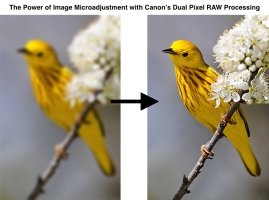
5D Mark IV: Dual Pixel Raw allows focus in post. Wow!

TommyLee said:
sorry if I am not 'up to speed' on this spec for 5d4..
but if it is dual pixel bassed and handled in dpp file processing of RAW...

would the 1dx2 ALSO be capable of doing this once the NEW dpp is out?

(maybe an enablement is required on 1dx2.... in a firmware update... that could not be enabled at release because the 5d4 was not out yet)

am I missing something ...besides a few teeth on my gears...ha

////
everyone here seems up on this.. so clue me in ..
if I get the 1dx2... I likely can dothat dual pixel time travel and focus - tune the shot...

I am leaning BACK to 1dx2 because of some nice features that wont be on 5d4
and I have a 5d3 so I am close to modern there

I am not in NEED of 30 versus 20 megapixels..
$2500 saved smaller footprint

and not in NEEd OF 14/16 FPS...
LOVE spot meter-focus, better shutter speed in aperture, Manual exp comp, ..on and on

BOTH ARE NICE...but not ...defining


thanks for the help..
groggy...woke early... please forgive ...silly questions if that is what this is..

I dont mind canon rummaging thru my wallet ....
I enjoy the experience...the toys

tom
For this to work on other dual pixel cameras, as a minimum, firmware upgrade would be needed. There is talk of new firmware upgrade for 7D2, so maybe this focus adjustment could be in the upgrade?
 
Upvote 0
mycanonphotos said:
So..What specifically will it do for us?..Allow us to choose between two different points of focus or a range of focus...? or other?

The consensus at the sane end of speculation seems to be that it will enable you to provide additional sharpening sharpening within the acceptable depth of field without needing to go into oversharpening territory. The original focus plane will be the same but you can correct something from 'acceptably sharp' to 'Jeez, that's good'.
The idea of totally refocusing the image s you can with Lytro is a pipedream.
 
Upvote 0
Mikehit said:
mycanonphotos said:
So..What specifically will it do for us?..Allow us to choose between two different points of focus or a range of focus...? or other?

The consensus at the sane end of speculation seems to be that it will enable you to provide additional sharpening sharpening within the acceptable depth of field without needing to go into oversharpening territory. The original focus plane will be the same but you can correct something from 'acceptably sharp' to 'Jeez, that's good'.
The idea of totally refocusing the image s you can with Lytro is a pipedream.

+1

Far too many people are getting carried away with misconceptions of what dual pixel raw means. The are two pixels behind each microlens. Lytro used 10 pixels below each microlens to gain much greater data about where the light came from, and much greater adjustments in post. Refocusing with dual pixel raw will not be possible, other than a very minor amount of horizontal alignment. Any vertical focus issues will be impossible to adjust, therefore the chances of Canon allowing for any adjustment of phase is pretty much zero.

However, with depth information, it will be known what is in focus and what is out of focus, so intelligently applying noise reduction to out of focus areas and sharpening to the in focus areas can improve the perceived qualities of the image. Additionally, with foreground objects, selectively switching off (or even reducing) one of the two phases will allow for a small amount of 'looking around' an object should it be framed badly in the first place.
 
Upvote 0
rs said:
Mikehit said:
mycanonphotos said:
So..What specifically will it do for us?..Allow us to choose between two different points of focus or a range of focus...? or other?

The consensus at the sane end of speculation seems to be that it will enable you to provide additional sharpening sharpening within the acceptable depth of field without needing to go into oversharpening territory. The original focus plane will be the same but you can correct something from 'acceptably sharp' to 'Jeez, that's good'.
The idea of totally refocusing the image s you can with Lytro is a pipedream.

+1

Far too many people are getting carried away with misconceptions of what dual pixel raw means. The are two pixels behind each microlens. Lytro used 10 pixels below each microlens to gain much greater data about where the light came from, and much greater adjustments in post. Refocusing with dual pixel raw will not be possible, other than a very minor amount of horizontal alignment. Any vertical focus issues will be impossible to adjust, therefore the chances of Canon allowing for any adjustment of phase is pretty much zero.

However, with depth information, it will be known what is in focus and what is out of focus, so intelligently applying noise reduction to out of focus areas and sharpening to the in focus areas can improve the perceived qualities of the image. Additionally, with foreground objects, selectively switching off (or even reducing) one of the two phases will allow for a small amount of 'looking around' an object should it be framed badly in the first place.


Carried away is what it appears Canon may want in this case..How many end users will actually comprehend its true day to day use. It may look good on paper as a bullet point but is it really beneficial..?
 
Upvote 0
mycanonphotos said:
It may look good on paper as a bullet point but is it really beneficial..?

This is where I think many misunderstand Canon's approach. Canon talks to many professionals about what would make their life easier and these are people who do not follow fads for the latest technology. They are people who need to see a clear cost-benefit to what they are paying for and their priorities are often not what the man in the street would like to see in their bright shiny new toy.
If the move from 12fps to 14fps (1Dx to 1Dx2) or from 7fps to 10fps (7D to 7D2) is seen as a worthwhile improvement in getting the money shot, then I see this feature in the same vein. A nice option to have and the times you need it you will be saying 'Thank God!'.

For action photographers that may well be a more worthwhile improvement than improving DR by half a stop. And, dare I say it, in marketing terms it could be a fantastic way of catching everyone else off guard, moving the line in the sand in a completely different direction in the same way introducing video to the 5D2 did.
 
Upvote 0
rs said:
Refocusing with dual pixel raw will not be possible, other than a very minor amount of horizontal alignment. Any vertical focus issues will be impossible to adjust

While I agree that it's likely a pipe dream, what do you mean by the above? I understand horizontal and vertical lines (or diagonal) as they pertain to focusing, but once an image has been focused and recorded, what does in plane directionality have to do with anything?

Thanks!
 
Upvote 0
Mancubus said:
I say this, because focusing is the ONLY factor that is beyond our total control when taking a photo (using viewfinder). Exposure, ISO, aperture, shutter speed, composition...all these factors can be controlled and a good photographer will know how to do it.

Weeelll.... Not quite. We bump into limitations in all these things sometimes. A photographer is not a god - it is not always possible (or even desirable) to control the light.
 
Upvote 0
3kramd5 said:
rs said:
Refocusing with dual pixel raw will not be possible, other than a very minor amount of horizontal alignment. Any vertical focus issues will be impossible to adjust

While I agree that it's likely a pipe dream, what do you mean by the above? I understand horizontal and vertical lines (or diagonal) as they pertain to focusing, but once an image has been focused and recorded, what does in plane directionality have to do with anything?

Thanks!

A conventional sensor has a single pixel behind each microlens. The idea is that any light which hits the microlens will be captured by the sensor, regardless of the direction.

With a dual pixel sensor, there are two rectangular shaped pixels behind each microlens - one receives the left phase, the other the right phase. Combined, they see the both phases as one, which is the same as a normal sensor. However, use just one and you see half the focused image. Its purely a left/right split. There is no option to split up/down with the way the sensor is built.

Should Canon have put 4 pixels behind each microlens - top left, top right, bottom left, bottom right - there would then be options to align phase both left/right and up/down. Even better, scatter a larger number of pixels behind each microlens such as Lytro have, and then more granular options become available. At this point, the original concept of on sensor phase detect becomes very distant.

However, unlike Lytro, the 5D4 isn't an experimental toy - it will follow in its predecessors footsteps as being a rock solid reliable tool for working professionals. Dual Pixel sensors are tried and tested to deliver the goods - the 1D X II is proof of this. DPRAW simply allows post processing to leverage some of the previously untapped information captured by these sensors.
 
Upvote 0
3kramd5 said:
rs said:
Refocusing with dual pixel raw will not be possible, other than a very minor amount of horizontal alignment. Any vertical focus issues will be impossible to adjust

While I agree that it's likely a pipe dream, what do you mean by the above? I understand horizontal and vertical lines (or diagonal) as they pertain to focusing, but once an image has been focused and recorded, what does in plane directionality have to do with anything?

Thanks!
Out of focus means that the light from one point, coming through the four quadrants of the lens, does not meet in one pixel again. The light coming through the left half is shifted to pixels on the right, the light coming through the right half is shifted to the left, top->down and bottom->up. Even if you can correct the left-right shift with the information of the dual pixel raw to reduce the blur, you will still have the blur/shift in top-bottom direction uncorrected (or the other way round, depending on the orientation of the pixel halves).
And even this limited correction will not be very good, because with only two partial pixels you can not treat light from the very border of the lens (large shift) different to light coming from near the center (only small shift). So the borders will still be undercorrected and the center parts will be overcorrected.
 
Upvote 0
midluk said:
Out of focus means that the light from one point, coming through the four quadrants of the lens, does not meet in one pixel again. The light coming through the left half is shifted to pixels on the right, the light coming through the right half is shifted to the left, top->down and bottom->up. Even if you can correct the left-right shift with the information of the dual pixel raw to reduce the blur, you will still have the blur/shift in top-bottom direction uncorrected (or the other way round, depending on the orientation of the pixel halves).
And even this limited correction will not be very good, because with only two partial pixels you can not treat light from the very border of the lens (large shift) different to light coming from near the center (only small shift). So the borders will still be undercorrected and the center parts will be overcorrected.

Surely the point of post processing is that the software will be programed for that and take selected information to account for it.
 
Upvote 0
Mikehit said:
midluk said:
Out of focus means that the light from one point, coming through the four quadrants of the lens, does not meet in one pixel again. The light coming through the left half is shifted to pixels on the right, the light coming through the right half is shifted to the left, top->down and bottom->up. Even if you can correct the left-right shift with the information of the dual pixel raw to reduce the blur, you will still have the blur/shift in top-bottom direction uncorrected (or the other way round, depending on the orientation of the pixel halves).
And even this limited correction will not be very good, because with only two partial pixels you can not treat light from the very border of the lens (large shift) different to light coming from near the center (only small shift). So the borders will still be undercorrected and the center parts will be overcorrected.

Surely the point of post processing is that the software will be programed for that and take selected information to account for it.

Pretty tricky if the data isn't captured in the first place
 
Upvote 0
scyrene said:
Mancubus said:
I say this, because focusing is the ONLY factor that is beyond our total control when taking a photo (using viewfinder). Exposure, ISO, aperture, shutter speed, composition...all these factors can be controlled and a good photographer will know how to do it.

Weeelll.... Not quite. We bump into limitations in all these things sometimes. A photographer is not a god - it is not always possible (or even desirable) to control the light.

What I mean is: the other factors are within your control. If the light is coming from one direction, it's up to you how to make the best of it for your shot. In most cases you can move/rotate the source or the subject around in order to get what you want.

With focusing, there is always an error possibility (less with more expensive gear), and there's currently no guarantee that your shot will be in perfect focus unless you are on a tripod manual focusing with the live view.

The AF misses (and misses a lot!) in every DSLR body. It also makes your photo unrecoverable in post processing. You can change exposure, reduce noise, sharpen, crop, remove unwanted distractions....but you can not save that slightly out of focus photo, there is no tool that will move the (mis)focus from the ear to the eye.
 
Upvote 0
YuengLinger said:
Dual pixel, with its incorporation of hadron tendrils, will without a doubt lead to commercial transporter beam technology. In fact, according to my friends in Switzerland and Japan, Canon already has a working prototype, successfully beaming sushi from Tokyo to Geneva, and perfectly functioning cuckoo clocks in the other direction.

finally someone who both knows their science and has insider connections as well
 
Upvote 0
Mikehit said:
midluk said:
Out of focus means that the light from one point, coming through the four quadrants of the lens, does not meet in one pixel again. The light coming through the left half is shifted to pixels on the right, the light coming through the right half is shifted to the left, top->down and bottom->up. Even if you can correct the left-right shift with the information of the dual pixel raw to reduce the blur, you will still have the blur/shift in top-bottom direction uncorrected (or the other way round, depending on the orientation of the pixel halves).
And even this limited correction will not be very good, because with only two partial pixels you can not treat light from the very border of the lens (large shift) different to light coming from near the center (only small shift). So the borders will still be undercorrected and the center parts will be overcorrected.

Surely the point of post processing is that the software will be programed for that and take selected information to account for it.

So, you're anticipating the triumph of firmware over physics? Tell ya what, you let us know when that happens, mmmmmkay? ;)
 
Upvote 0