Bingo! New Canon 5Ds has 50.6 MP new rumored specs

PureClassA said:
canonic said:
PureClassA said:
Regarding the updated specs this morning:

Looks like Sync Speed tops out at 1/200 of a second. UGH. For a studio camera I was hoping for at least 250. Crap, my 6D does 180. Wonder what kept them from having a higher sync speed on here. Thoughts anyone?

There is no upgrade here. Same as the older 5D-s.

I get that part, I'm just wondering why. I would think on a S = Studio camera, they would try and step up the sync speed or what the technological limitation is. the 1dx does 250 I believe, granted a better shutter...

I think there are only marketing limitations ...
 
Upvote 0
canonic said:
Lee Jay said:
clicstudio said:
Can someone please explain the advantage of no low pass filter? Thanks!

Gives you more false detail, jaggies, moire, and color artifacts, but makes people feel good who can't tell the difference between false detail and actual detail.

And probable more expensiv as the 5D with low pass filter :)
Lee Jay, i admite "false details", relating to no low pass filter, is new for me. Can you explain?

Let's say you have 6 fence pickets in the distance. Let's say they're far enough away and close enough together that you don't have enough pixels to resolve them. With an AA filter, you'll just get a mostly smooth area. Without, you might get 4 fence pickets. 4, not 6. None of them are real, they're aliasing artifacts.
 
Upvote 0
Lee Jay said:
canonic said:
Lee Jay said:
clicstudio said:
Can someone please explain the advantage of no low pass filter? Thanks!

Gives you more false detail, jaggies, moire, and color artifacts, but makes people feel good who can't tell the difference between false detail and actual detail.

And probable more expensiv as the 5D with low pass filter :)
Lee Jay, i admite "false details", relating to no low pass filter, is new for me. Can you explain?

Let's say you have 6 fence pickets in the distance. Let's say they're far enough away and close enough together that you don't have enough pixels to resolve them. With an AA filter, you'll just get a mostly smooth area. Without, you might get 4 fence pickets. 4, not 6. None of them are real, they're aliasing artifacts.

At the risk of seeming very dim on a popular thread...

Is true that all the AA filter is doing is smoothing things out a bit?

On that basis, if someone goes with no AA filter, and gets moire/etc., they can just smooth it out in PP?
 
Upvote 0
mark99 said:
No A Canon user for 25+ Years, just a very Pizzed off one that this company will not listen to its customers.
I have stuck with them against all my senses, but the choice is no longer an option, I have yo either move to working equipment or retire for press work.
Canon are unable to make what nikon can offer and have been unable to do so for a number of years.
Shooting static well lit objects is easy on any camera, but once the light goes and they start moving you have to accept the Nikon users are going to spank your gear and spank it hard.
My rant is I can no longer wait for them to get their bloody act together and the Rumours of yet even more spreading out of working features over other models has angered me no end.

This time Next Month after at least 25+ years, I will be switching, I held on, foolishly hoping and hoping they would get the act together then out comes the 1dx which to be honest is not even as good as the mkiv on working ISO j-peg output.
To hear they are getting sony technology but are going to drip feed and divide it slowly is the last straw.
If that Makes me a Nikon forum troll, so be it.

Yours one fed up Canon waiting tog.
This is a new one for me. Current Canon gear holds an advantage over current Nikon gear in low light situations - Canon sensors have better DR at high ISO, and less noise. This is before we include the f1.2 lenses in the current range.

The main complaints people have about Canon vs Nikon in the current range is resolution and low ISO performance - and it looks like this particular camera is aimed at addressing those issues.

If all you want is better high ISO performance than Nikon, look no further than the current full frame Canon bodies.
 
Upvote 0
Let's say you have 6 fence pickets in the distance. Let's say they're far enough away and close enough together that you don't have enough pixels to resolve them. With an AA filter, you'll just get a mostly smooth area. Without, you might get 4 fence pickets. 4, not 6. None of them are real, they're aliasing artifacts.

I understand till "None of them are real, they're aliasing artifacts."Why, are they not real? And, are 4 not better as 6? Maybe, do you have a link about this? I think examples (fotos) will help me better in this regard.
 
Upvote 0
AdjustedInCamera said:
At the risk of seeming very dim on a popular thread...

Is true that all the AA filter is doing is smoothing things out a bit?

On that basis, if someone goes with no AA filter, and gets moire/etc., they can just smooth it out in PP?

The AA filter is a blur filter, and yes it smooths things out. This cannot be done in post processing. The AA filter does it to the incoming light before sampling. Once the signal has been digitally sampled, the damage is done. You can use a few tricks to try and hide it, but the original signal cannot be recovered, even theoretically.

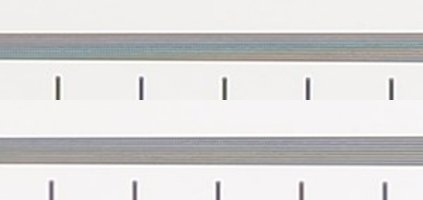
Here's a comparison of the D800e (no AA filter) to the D800. Note the vertical lines and blue/magenta colored streaks in the D800e image (top). Neither one exists. The D800 in the bottom has them too but to a much smaller degree (it has an effective, but imperfect AA filter). This a completely black and white area with nothing but horizontal lines.
 

Attachments

  • D800e versus D800.jpg
    D800e versus D800.jpg
    55 KB · Views: 229
Upvote 0
AdjustedInCamera said:
Lee Jay said:
canonic said:
Lee Jay said:
clicstudio said:
Can someone please explain the advantage of no low pass filter? Thanks!

Gives you more false detail, jaggies, moire, and color artifacts, but makes people feel good who can't tell the difference between false detail and actual detail.

And probable more expensiv as the 5D with low pass filter :)
Lee Jay, i admite "false details", relating to no low pass filter, is new for me. Can you explain?

Let's say you have 6 fence pickets in the distance. Let's say they're far enough away and close enough together that you don't have enough pixels to resolve them. With an AA filter, you'll just get a mostly smooth area. Without, you might get 4 fence pickets. 4, not 6. None of them are real, they're aliasing artifacts.

At the risk of seeming very dim on a popular thread...

Is true that all the AA filter is doing is smoothing things out a bit?

On that basis, if someone goes with no AA filter, and gets moire/etc., they can just smooth it out in PP?
No. The moire is baked into the image, and no amount of softening or downsampling can entirely remove it. Here's an example of what you'd be left with (although its not a fence):

shirt_video.jpg
 
Upvote 0
canonic said:
Let's say you have 6 fence pickets in the distance. Let's say they're far enough away and close enough together that you don't have enough pixels to resolve them. With an AA filter, you'll just get a mostly smooth area. Without, you might get 4 fence pickets. 4, not 6. None of them are real, they're aliasing artifacts.

I understand till "None of them are real, they're aliasing artifacts."Why, are they not real? And, are 4 not better as 6? Maybe, do you have a link about this? I think examples (fotos) will help me better in this regard.

I suggest you read these:

http://en.wikipedia.org/wiki/Aliasing
http://en.wikipedia.org/wiki/Kell_factor

And watch this carefully, in full-screen, starting about 2:20 in. Make sure you look at the area to the right as well.

http://vimeo.com/54863241
 
Upvote 0
I have read some of the messages...

The two Canon 5d's are Studio Cameras. The 50mp Sensor is Produced by Sony! Now we all know Canon loves to way over price their cameras, that Cinema Camera comes to mind on that point...I am guessing $3,500 to almost to $5,000.
 
Upvote 0
Lee Jay said:
AdjustedInCamera said:
At the risk of seeming very dim on a popular thread...

Is true that all the AA filter is doing is smoothing things out a bit?

On that basis, if someone goes with no AA filter, and gets moire/etc., they can just smooth it out in PP?

The AA filter is a blur filter, and yes it smooths things out. This cannot be done in post processing. The AA filter does it to the incoming light before sampling. Once the signal has been digitally sampled, the damage is done. You can use a few tricks to try and hide it, but the original signal cannot be recovered, even theoretically.

Here's a comparison of the D800e (no AA filter) to the D800. Note the vertical lines and blue/magenta colored streaks in the D800e image (top). Neither one exists. The D800 in the bottom has them too but to a much smaller degree (it has an effective, but imperfect AA filter). This a completely black and white area with nothing but horizontal lines.

This is a good example. I see D800E has a little more contrast detail (see vertical lines - the real ones), but has more aritifact in form of moire. Thanks.
 
Upvote 0
dilbert said:
AdjustedInCamera said:
...
At the risk of seeming very dim on a popular thread...

Is true that all the AA filter is doing is smoothing things out a bit?

It also causes light to be lost. The AA filter is a grid on top of the sensor but the grid spacing is different to that of the sensor's. Light that hits the grid material is lost.

That's not true.

https://nikoneurope-en.custhelp.com/app/answers/detail/a_id/56368

"The OLPF generally consists of two layers of birefringent plates and one wavelength plate. Light is split while being transmitted through the birefringent plates onto the image sensor as shown below.In addition, IR coating, AR coating, and IR absorption glass are also used for better colour reproduction characteristics."

Same information here: http://www.optics-online.com/doc/files/Optical%20Low%20Pass%20Filters%20Theory%20and%20Practice.pdf

"OLPFs are made of several layers of birefringent optical crystals cemented together. The number of layers and thickness of each layer is defined by the pixel spacing of the sensor and the application. It follows that each OLPF design must be tuned to a particular sensor and application.

For color imaging, an IR cut-off function is often integrated into OLPF as well. A reflective IR cut-off coating can be applied to an external surface or an absorptive IR cutoff filter layer can be added to the quartz layers."
 
Upvote 0
The same exact discussion all over again, as a 3 y ago with d800 vs d800e.
But keep in mind after all Nikon get rid from D800 and left one body only - D810 with no AA.

So I wouldn't surprise if in a next upgrade 5dS mk II there will no be a two different models , will be one super high mega pixel body with no AA filter.

And BTW Canon do realize that those bodies are not the best video, that's why they keeping 5d mk IV line with lower mp count.
Hopefully 5DsR will be at least with 7d mk II AF system.
www.IsaacImage.com
 
Upvote 0
mskrystalmeth said:
I have read some of the messages...

The two Canon 5d's are Studio Cameras. The 50mp Sensor is Produced by Sony! Now we all know Canon loves to way over price their cameras, that Cinema Camera comes to mind on that point...I am guessing $3,500 to almost to $5,000.

There is no confirmation the sensor is produced by Sony. Not saying it isn't. But there is no confirmation it is. In fact, Canon Watch had a subsequent CW3 (CR 1-2 equivalent) that it is NOT Sony, but Canon. And No Canon doesn't over price their cameras. Everyone thought the 7D2 was going to be $2500+ while kept saying no way, it'll be under $2000 just like the older model. Wham. Same thing with the 100-400 Mk2. Everyone thinking $3000+. I said $2000-$2500. Wham. As you can see I'm planning on going 3 for 3 ;-) The new Studio Rigs will be between $3500-$4000 (maaaaaybe $4200 high side but I'm not feeling' it. They are there to compete with a D810. The 5D4 will Also be the same price as it will have 4k included where these Studio models will not. The Prognosticator hath spoken! ;D
 
Upvote 0
mskrystalmeth said:
I have read some of the messages...

The two Canon 5d's are Studio Cameras. The 50mp Sensor is Produced by Sony! Now we all know Canon loves to way over price their cameras, that Cinema Camera comes to mind on that point...I am guessing $3,500 to almost to $5,000.
How's your 3D printer doing?
 
Upvote 0
PureClassA said:
mskrystalmeth said:
I have read some of the messages...

The two Canon 5d's are Studio Cameras. The 50mp Sensor is Produced by Sony! Now we all know Canon loves to way over price their cameras, that Cinema Camera comes to mind on that point...I am guessing $3,500 to almost to $5,000.

There is no confirmation the sensor is produced by Sony. Not saying it isn't. But there is no confirmation it is. In fact, Canon Watch had a subsequent CW3 (CR 1-2 equivalent) that it is NOT Sony, but Canon. And No Canon doesn't over price their cameras. Everyone thought the 7D2 was going to be $2500+ while kept saying no way, it'll be under $2000 just like the older model. Wham. Same thing with the 100-400 Mk2. Everyone thinking $3000+. I said $2000-$2500. Wham. As you can see I'm planning on going 3 for 3 ;-) The new Studio Rigs will be between $3500-$4000 (maaaaaybe $4200 high side but I'm not feeling' it. They are there to compete with a D810. The 5D4 will Also be the same price as it will have 4k included where these Studio models will not. The Prognosticator hath spoken! ;D

+1 if you are right...

I heared that Canon was indeed thinking of using an non-Canon sensor on one of the tryout-models oft the 7DII, but decided not to do this. I read somewhere in the past, that there was an 24MP sensor in the wild with great specifications (better DR, better ISO,...). The poster wrote, Canon was happy with this sensor, but they were in fear that an marvellous 7DII will "crop" al lot 5D... buyers.
 
Upvote 0
Lee Jay said:
canonic said:
Let's say you have 6 fence pickets in the distance. Let's say they're far enough away and close enough together that you don't have enough pixels to resolve them. With an AA filter, you'll just get a mostly smooth area. Without, you might get 4 fence pickets. 4, not 6. None of them are real, they're aliasing artifacts.

I understand till "None of them are real, they're aliasing artifacts."Why, are they not real? And, are 4 not better as 6? Maybe, do you have a link about this? I think examples (fotos) will help me better in this regard.


I suggest you read these:

http://en.wikipedia.org/wiki/Aliasing
http://en.wikipedia.org/wiki/Kell_factor

And watch this carefully, in full-screen, starting about 2:20 in. Make sure you look at the area to the right as well.

http://vimeo.com/54863241

Great video. Thanks for sharing. I don't know much about the Panys except the GH4, but I don't know whether ANY of them have or have not the low pass filter. What was I looking at? I have to assume based on the strength of that moire that they have no AA?
 
Upvote 0
PureClassA said:
Lee Jay said:
canonic said:
Let's say you have 6 fence pickets in the distance. Let's say they're far enough away and close enough together that you don't have enough pixels to resolve them. With an AA filter, you'll just get a mostly smooth area. Without, you might get 4 fence pickets. 4, not 6. None of them are real, they're aliasing artifacts.

I understand till "None of them are real, they're aliasing artifacts."Why, are they not real? And, are 4 not better as 6? Maybe, do you have a link about this? I think examples (fotos) will help me better in this regard.


I suggest you read these:

http://en.wikipedia.org/wiki/Aliasing
http://en.wikipedia.org/wiki/Kell_factor

And watch this carefully, in full-screen, starting about 2:20 in. Make sure you look at the area to the right as well.

http://vimeo.com/54863241

Great video. Thanks for sharing. I don't know much about the Panys except the GH4, but I don't know whether ANY of them have or have not the low pass filter. What was I looking at? I have to assume based on the strength of that moire that they have no AA?

This is an example of aliasing, not an example of a lack of an AA filter. Because this is a video output at a far lower resolution than the sensor's resolution, the aliasing is caused by other effects besides the lack of an AA filter. However, the effect is the same just easier to visualize.
 
Upvote 0
LetTheRightLensIn said:
Kairumorman said:
traveller said:
Looks like the rumours of a Sony-Canon 50MP sensor are true, even SAR states that one of his 'trusted sources' confirms this and SAR is a bit of a mouthpiece for Sony's marketing department to build hype.

If true then it looks like the Japanese camera manufacturers are in deep retreat in the face of falling DSLR sales. It looks like the Canon don't want to invest in a new fab line at this time, so they're outsourcing to Sony, at least for production. They are both scared -sales are falling and everything they try seems to fail to change this...

both the first global shutter rumor (i gave me the name KAI) and then the sony canon partnership was send in by me. :)

both websites where happy to report this pure fantasy..

i still roll on the floor laughing....

Wow, you're pretty cool!

Or just a tool.
 
Upvote 0