neuroanatomist said:
dilbert said:
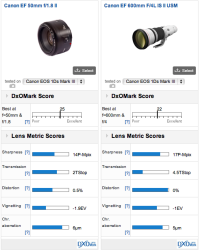
DxO measures the ability of a lens to deliver a quality image. To whit, the 50/1.8 can deliver a higher quality image for than the 600/4.0. Both lenses can be good lenses and deliver exceptional IQ but it is perfectly ok for one lens (even a cheaper lens) to be better than the other for a given purpose.
Just because something is cheap doesn't mean it is bad or low quality, similarly, just because something is expensive doesn't make it high quality.
If you believe that represents a general measure of image quality, you probably think a lens is a camera. Oh wait, you actually
do think that...
I should point that I'm not bashing DxOMark - I find their measurements very useful (notwithstanding the few occasions where they've clearly gotten a bad copy of a lens and pretended that didn't happen).
Specifically, in the case of the 50/1.8 vs. 600/4 II comparison, if you actually look at the optical measurements, the 600/4 II is sharper, has less distortion, less vignetting, and less CA. The only metric on which the 50/1.8 outscores the 600/4 II is on transmission, and the way DxOMark weights the scores, that means the 50/1.8 gets a better overall score (and while their measurements are useful, their overall scores
are totally useless, IMO).
People who just look at the top line number and make assumptions about what that means, with no attempt to understand the rationale behind that number, are unfortunately easily deceived (and maybe that's intentional on DxO's part?).
To say that the higher score of the 50/1.8 means it delivers 'better image quality' is ludicrous. The 50/1.8's higher score simply means it lets in more light...which is pretty obvious from the specified max aperture of the lens.