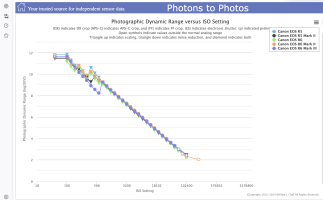
Canon R6 Mark III Dynamic Range Officially Measured

Richard CR

Canon Rumors Premium
Dec 27, 2017
2,316
3,607
17,629
Canada
www.canonnews.com
PhotonsToPhotos is back, and this time, they have finished up their analysis of the Canon EOS R6 Mark III sensor, so we have some actual numbers to quantify here with the sensor and how it measures up against the earlier versions of the Canon EOS R6 lineup and its competition. If we compare all the […]

See full article...
 
  • Like
Reactions: 2 users
Thanks for sharing.
...
When you take all of that and realize that Canon is still competitive, you have to tip your hat to Canon's sensor researchers and engineers who make the most out of what they have been given to work with.

With all that, Sony has dropped the gauntlet and delivered exceptional dynamic range performance, and I'm certain that Canon will up its game even further. Competition spurs further innovation, and we all benefit from that.
Thanks, Richard, for sharing and the interpretation.
So we see that in base/low ISO the BSI sensors are noticeably better, while above that zigzag at about ISO800 everybody looks quite the same, with the A7 V slightly leading.
As I mostly shoot my wildlife at ISO 1600 and above, the R6m3 could be a useful tool instead of my R6m2, delivering same DR at higher MP count and faster readout.
Right now, I see no need to move ;)
 
Last edited:
  • Like
Reactions: 2 users
Upvote 0
PhotonsToPhotos is back, and this time, they have finished up their analysis of the Canon EOS R6 Mark III sensor, so we have some actual numbers to quantify here with the sensor and how it measures up against the earlier versions of the Canon EOS R6 lineup and its competition. If we compare all the […]

See full article...
You do give the caveat that the measurements are affected by the conditions, including temperature. Bear in mind that the measurements are made by new purchasers who send them in and we don’t know whether they are done in an unheated outhouse in the arctic winter or in an Australian summer. I also hate seeing numbers without error bars or the means and standard errors from repeat runs. The low iso results are those that are most affected by environmental conditions as the high iso are dependent basically on photon flux.
 
  • Like
Reactions: 1 users
Upvote 0
You do give the caveat that the measurements are affected by the conditions, including temperature. Bear in mind that the measurements are made by new purchasers who send them in and we don’t know whether they are done in an unheated outhouse in the arctic winter or in an Australian summer. I also hate seeing numbers without error bars or the means and standard errors from repeat runs. The low iso results are those that are most affected by environmental conditions as the high iso are dependent basically on photon flux.

absolutely 100%

how long the camera was turned on for, how many shots were taken before the test shots, ambient temperture, and even slight changes in sensor and camera performance. Also I didn't really allude to it, but I would imagine that canon sensors having to process twice the amount of photodiodes, probably have a disadvantage in terms of needing to run warmer.

Considering Canon pulls this all off with front side illumination, I think is pretty good - now the question is, why and when are they going to move to BSI? they obviously have it. "in theory".
 
Last edited:
  • Like
Reactions: 3 users
Upvote 0
Ugh, over the next year we gonna hear nothing else from the Sony fanboys but "Well my Sony has 1 stop more DynAmIc RaNgE. Canon lags 20 years behind."

We're back to 2018 again. If only Canon would use the dual data they already get with the dual pixel sensor. Cause each pixel captures a slightly different exposure. And there's software that can read both exposures and calculate a picture with higher dynamic range. Why this is not done in-camera is a mystery to me.
 
  • Like
Reactions: 1 user
Upvote 0
Thanks for sharing.

Thanks, Richard, for sharing and the interpretation.
So we see that in base/low ISO the BSI sensors are noticeably better, while above that zigzag at about ISO800 everybody looks quite the same, with the A7 V slightly leading.
As I mostly shoot my wildlife at ISO 1600 and above, the R6m3 could be a useful tool instead of my R6m2, delivering same DR at higher MP count and faster readout.
Right now, I see no need to move ;)

On the other hand, high ISO of the R6 III got worse than the R6II and now is much closer to the original R5 than R6 II or R6 OG according to the noise chart of photons-to-photos. Its up to you to decide whether worse low light capabilities of the R6 III can effect your work or not. Seemingly, increasing the MP count from 24 to 32 MP has some price.
 
  • Like
Reactions: 1 users
Upvote 0
On the other hand, high ISO of the R6 III got worse than the R6II and now is much closer to the original R5 than R6 II or R6 OG according to the noise chart of photons-to-photos. ...
Hi Adam!
Thanks for pointing that out. Could be an issue to me.
Here's the chart for others to find:

@Richard CR:
Maybe this should be included in the article.

Edit:
For noise charts, photonstophotos explicitly states under the plot "These raw values are not appropriate for comparing camera models because they are not adjusted for gain or area."
 
Last edited:
  • Like
Reactions: 1 users
Upvote 0
Hi Adam!
Thanks for pointing that out. Could be an issue to me. Could be an issue.
Here's the chart for others to find:

@Richard CR:
Maybe this should be included in the article.
They all have the same DR above iso 800, which is the important consideration. For noise charts, photonstophotos explicitly states under the plot "These raw values are not appropriate for comparing camera models because they are not adjusted for gain or area." So, ignore them!

Screenshot 2025-12-14 at 13.07.49.png
 
  • Like
Reactions: 6 users
Upvote 0
They all have the same DR above iso 800, which is the important consideration. For noise charts, photonstophotos explicitly states under the plot "These raw values are not appropriate for comparing camera models because they are not adjusted for gain or area." So, ignore them!
Thanks for clearing that up. So is there any way to compare those cameras at high iso? Certainly dynamic range is just a piece of the puzzle when it comes to low light capabilities.
 
Upvote 0
Holding steady with an increase in pixel density is good. And the improvement with the E-shutter is always welcome.

What I'd hope to see is an increase in DR overall, but what I'd like to see is probably not possible. There is only so much light energy in a given amount of pixel space.

It looks like a good improvement in usability. I hope they can do similar with a potential R7 replacement in the future.
 
Upvote 0
Considering Canon pulls this all off with front side illumination, I think is pretty good - now the question is, why and when are they going to move to BSI? they obviously have it. "in theory".
How much difference do you realistically expect with BSI in a full frame sensor? My understanding is that the benefits of BSI are inversely related to pixel size, they are very significant for smartphone sensors with pixel sizes well under 2 µm, but there's much less (or even non meaningful) benefit with larger pixels. BSI was initially developed to enable higher pixel densities for small sensors. The observation that you can achieve similar DR with FSI and BSI full frame sensors is consistent with there being minimal benefit at these large pixel sizes. I've also read that BSI sensors are more expensive to produce, and if that's true it begs the question why use them (other than marketing, which is certainly a valid reason).
 
  • Like
Reactions: 5 users
Upvote 0
For noise charts, photonstophotos explicitly states under the plot "These raw values are not appropriate for comparing camera models because they are not adjusted for gain or area." So, ignore them!
Thanks, @AlanF, for putting that straight. I missed that in the quick comparison.
So it seems that I will have to check the R6m3 IQ and s/n behavior directly hands on.
 
  • Like
Reactions: 1 user
Upvote 0
What I don't fully understand from the article: even if the dynamic range with electronic shutter is the same between the Canon and Sony, isn't there still a benefit to the 14bit files which he Sony delivers? Like in color for example.

The article seems to dismiss this advantage as irrelevant given the DR findings discussed.
 
Upvote 0
Aren't we getting to the point where the dynamic range of both is so good that it doesn't make any practical difference?
I think we're pretty much there at low ISO. At high ISO, we aren't but that may take a leap in technology to really improve, beyond a very small amount. Going on the Photons-to-Photos page and selecting cameras from a few different brands, they are mostly the same at high ISO settings, though Sony seems to have a little 1/3 of a stop special sauce at very high ISO, in some of their bodies. But those numbers re not native ISO according to the chart, so it's hard to say. Could be some noise (and detail) reduction chicanery going on. I'm not very familiar with the Sony bodies so I don't know.
 
Upvote 0
How much difference do you realistically expect with BSI in a full frame sensor? My understanding is that the benefits of BSI are inversely related to pixel size, they are very significant for smartphone sensors with pixel sizes well under 2 µm, but there's much less (or even non meaningful) benefit with larger pixels. BSI was initially developed to enable higher pixel densities for small sensors. The observation that you can achieve similar DR with FSI and BSI full frame sensors is consistent with there being minimal benefit at these large pixel sizes. I've also read that BSI sensors are more expensive to produce, and if that's true it begs the question why use them (other than marketing, which is certainly a valid reason).
I suspect that you are right. If my understanding is correct, DGO needs a fast sensor to simultaneously read out the values with low and high amplification for high dynamic range, i.e. a (partially) stacked sensor for a photo camera. Just BSI is not “enough” to get a higher dynamic range.

See: https://www.dpreview.com/news/57886...cmos-sensors-boost-dynamic-range-breakthrough
 
Last edited:
  • Like
Reactions: 1 user
Upvote 0
I suspect that you are right. If my understanding is correct, DGO needs a fast sensor to simultaneously read out the values with low and high amplification for high dynamic range, i.e. a (partially) stacked sensor for a photo camera. Just BSI is not “enough” to get a higher dynamic range.

See: https://www.dpreview.com/news/57886...cmos-sensors-boost-dynamic-range-breakthrough
I don't think that the sensor is small for that. The sony uses DGO only for mechanical shutter where there's more time to read it out twice. They don't use it in ES.
 
Upvote 0
PhotonsToPhotos is back, and this time, they have finished up their analysis of the Canon EOS R6 Mark III sensor, so we have some actual numbers to quantify here with the sensor and how it measures up against the earlier versions of the Canon EOS R6 lineup and its competition. If we compare all the […]

See full article...
I think you can read the sensor as many times as you want and then you reset it (with the reset transistor) before the next exposure. Am I wrong?
 
Upvote 0