It's not relevant whether or not people are looking to them, and this is not a red herring. Their scores are consistently presented by them and others as IQ scores, yet their methodology is obviously flawed if they can give a consumer APS-C sensor a higher IQ score than a MFDB. This obvious error is usually ignored by "fans" of high scoring cameras.
It is a red herring, because it is not a "flaw" in methodology, it is a limitation in using a single score to describe "overall" performance.
It does not follow at all that the measurements are in any way incorrect.
As a line of argument, it is, in essence, an
ad-hominem -- an attempt to troll the data for "incorrect" results, and attack the source, instead of addressing the real issue (which is that Canon's sensors don't perform well). Besides being a morally reprihensible approach, it is a logical fallacy. It suffers from all the dangers inherent in data mining (that if you look for a given result over a large amount of data, you can usually find it, especially if you don't have a very good understanding of what you are looking at).
When a "fan" wishes to compare, say, Canon and Nikon, then all of a sudden the score is a score of overall IQ that we all must concede.
No, the score represents some subjective weighting of different measurements. "Overall" image quality is also a subjective notion (what does "overall" mean ?)
The measurements however are cold hard factual data. And in the case of Canon vs Nikon, they show that Canon struggles with shadow noise at low ISO. If you often use the camera at ISO 800 or more, this may not matter a whole lot, but if you shoot at ISO100 all the time, it might. The results put forth by way of DxOs measurements (again specifically shadow noise) have been validated by other users/commentators, so no amount of carrying on about medium format and other red herrings will make this go away.
dtaylor said:
You cannot gain dynamic range by down sampling because you throw away detail with noise. If you think you can, your definition of DR is flawed.
Sure you can. Dynamic range is the space between saturation point and a reference SNR. If your reference SNR is 0db (SNR=1), then quantization will bite you. But if you use a different floor, it won't. In practice, SNR=1 isn't where
usable dynamic range starts, so you do gain by going from "14" to "14.4". Of course there is a trade between "detail" (spatial resolution) for noise reduction -- that's why they normalize to the same resolution, it's also why it doesn't make sense to compare a high resolution to low resolution camera without doing that. BTW, some of these medium format (e.g. 80mpx ) backs you are fond of would not look nearly as good if you insisted on using a per-pixel metric to measure their performance.
Also, see my other point -- if you compare two cameras one at 21mpx and one at 36mpx, you could normalize to 21mpx instead of 36mpx. The choice of "target resolution" does not matter, the important point is that everything is normalized to the same resolution.
You keep saying that these are "about the same", and I keep calling you on it. They are not "about the same".
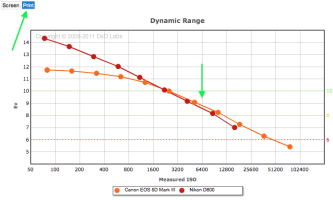
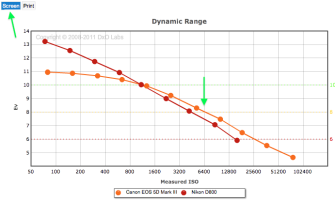
They show a 0.7 stop difference when it's roughly 2 stops.
However you slice and dice it, if you look at the two graphs, it's not "about the same". It's 0.7 stops on the Y axis at base ISO, or about 2 stops on the x axis (meaning that I can crank ISO up two stops on the 7D and get the same DR). That's a very substantial technological bump.
I did, and my question stands -- I saw information on what he has done as a photographer. Again, as a benchmarker, engineer, etc, what are they ?