A few thoughts:
A distance scale is not sexy, but it helps define the 'nice' level of quality/features you are getting, like a car with anti-lock brakes in the year 2000. It isn't going to make the sale, but it underscores that you aren't getting a bargain basement product. It's also somewhat useful for guess / chimp / adjust MF work when the AF has no chance to operate (really dark rooms).
A 58mm filter ring seems unlikely. Though the 24/28/35 IS refresh lenses maintained the older lenses' max aperture, two of the three lenses saw a jump in filter diameter (presumably to get more glass to chase a sharper image?). Heck the 35mm f/2 IS USM jumped in filter diameter by a good 15mm!
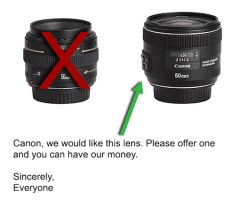
As I've said on a host of other threads, if the 50mm f/nooneknows IS USM turns out to be f/2, I'd buy it -- it would be nice and small. But I don't know how you have a budget / mid-level / L-series value proposition where the mid-level is slower than the budget 50mm f/1.8 STM -- so as much as I'd buy it, I think there's zero chance Canon would ever offer it.
I've just never liked external focusing (though I'll be the first to call this a pretty petty set of reasons):
The externally focusing lenses I've used have historically been cheap and slow focusing. All the internally focusing lenses I've used have been fast and well built.
The externally telescoping barrel is a natural path of ingress for dust, moisture, dirt, etc.
Ext. focusing lenses mean you need to tighten down filters on the sliding/telescoping internal barrel. I strongly prefer to crank on filter rings that are decoupled from sensitive optical tasks (which internal focusing lets you do), but someone could talk me down on that I'm missing something.
This is really niche, but ext. focusing messes with bokeh shape templates you drape over the front of the lens barrel. (It's an amateur's pursuit, I must admit, but a fast 50mm is a great lens to do that on.)
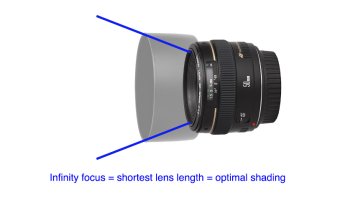
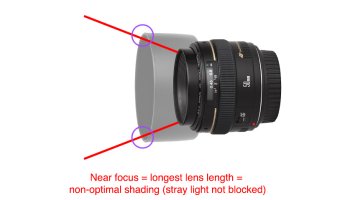
Also, weird question since I brought up external focusing: because the front element is moving in and out to focus, wouldn't that mean that somewhere in the focus range, your shading is less than ideal?
In an internally focusing lens, the front element and hood mount would not move with respect to each other, so this wouldn't happen and you'd get ideal shading.... right? (Please straighten me out if I've missed something.)
- A