Sporgon said:
Surely that picture has been filled, either by flash or some reflector ?
I don't see how it can be an example of DR
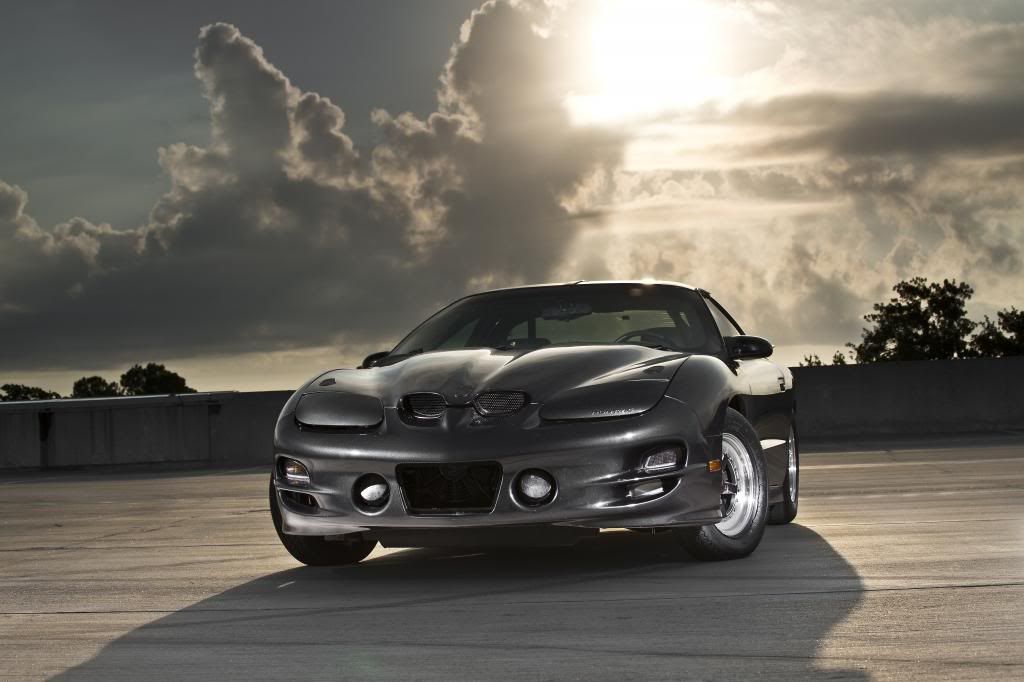
I wouldn't call it an example of DR. It's an example of how, with the right tools, you can still pull off an insanely contrasty shot with just 12 stops of DR. I don't find it limiting at all. I understand landscape shooters don't have the same luxuries, so the landscape folks can just disregard my commentary as irrelevant

BTW, I love your architectural shots!
Anyhow, it's been interesting reading some of the commentary regarding the image I posted, speculation regarding which techniques were used, and suggestions on what techniques should have been used. The real story is that the image is a bit deceiving in that the car is parked on top of a five-story tall parking structure/car park. In other words, the car is 50 feet off the ground, which makes the sun appear much lower in the sky than it really is, which is another way of saying it was a $hit ton of ambient light when the shot was taken.
How bright? I used a 5-stop ND grad filter to darken the sky. There's also a circular polarizer on the lens eating up another 1 stop of light. The ambient light is underexposed an additional two stops for several reasons. First off, when balancing ambient light with flash with cars, it never quite looks right with a neutral exposure. I find that I have to underexpose the ambient by at least 1 stop to achieve a pleasing balance of ambient light vs. flash output. Secondly, I reduced the ambient by 1 stop further to create a more moody, high-contrast feel and to gain additional detail in the clouds. In total, the foreground is underexposed by two stops, which is very noticeable on the door and quarter-panel of the car, where there was no fill flash present. The same goes for the concrete, which as we all know is actually white, not gray.
In total, between the ND grad filters, polarizer, and the intentionally dark exposure, the sky has been darkened a total of 8 stops. Experimenting with darker exposures netted a big loss in could detail with minimal gain in detail around the sun. It's one bright mofo
The car itself is a very dark metallic gray that looks black. With black cars, you would not believe how much power it takes to defeat the ambient light of the sun during the middle of the day using monolights. They're like blackholes. Obviously, underexposing the ambient by 2 stops only compounds matters, as does shooting at f/8 to achieve the desired level of sharpness from my 70-300L. With two White Lightning 2400 monolights, which are actually 1000ws, I still had to crank up the ISO to 400 to achieve the desired flash output. The big lights also spill onto the foreground, so I took a few exposures with the lights turned off, and layered one of them into the shadow area.
I'm sure that in the next 1-2 generation of DLSR bodies, we'll have sensors that can pull out five-stops worth of shadow detail. However, I firmly maintain that in a shot like this, the final image that results from using that approach won't look nearly as good. IMHO, in this particular shot there's a big difference in quality between pulling up the shadows vs. adding fill light and highlights with some monolights. If you pulled the shadows, the light on hood, bumper, and wheels would be way too flat and lack any semblance of definition. A more contrasty light source like a monolight fixes this problem. Likewise, the metal flakes embedded into modern metallic automotive paint must be side-lit or back-lit, otherwise they will not reflect any light and therefore the paint color will look dull, muted, and subdued.
I will always welcome more DR, but even when the day comes when it's possible to lift the shadows by 5 stops, I will still take the same approach to shots like this and bust out the monolights. If I have to choose between good light and lifting shadows, I'll go with good light every single time.
On a side note, as anyone that lives in a tropical climate will attest, the clouds can roll in and out very quickly. When the clouds quickly rolled in and provided the opportunity to take this shot, I had to scramble to switch lenses, rig up the ND grads, re-position the monolights, and balance out the ambient exposure and flash output. In that sense, I suppose it would have been nice if my camera had so much DR that I didn't need to waste time attaching the ND grads. Nevertheless, I was able to fire off a few frames before the clouds disappeared as quickly as they appeared.
I'll take all the DR I can get, but in the meantime I'll manage to get by with 12 stops that I've got



 Which, actually, doubles as a pretty decent, fast, apochromatic refracting telescope in a pinch, as well!
  This is far from the greatest photo of Orion Nebula, due to lack of a GEM that can track, but it demonstrates well enough how good the 600/4 can be for astrophotography: