
Some times I just wonder is it possible that Canon are heading the same was a Kodak, on top and in control but only to fall by the wayside because of the lack of new ideas, I remember all that Kodak achieved and took a wrong turn, Canon seems to be following same path as of late with no interesting new ideas, even the Firmware upgrades are in most cases with just obvious error removals that should not have been their in the first instance, when will the oily spatters be eliminated from our top of the Canon range DSLR etc.
You are using an out of date browser. It may not display this or other websites correctly.
You should upgrade or use an alternative browser.
You should upgrade or use an alternative browser.
ARE Canon heading down the same track as Kodak
- Thread starter lb
- Start date

Humans are heading down the same track as Kodak, so, in a sense, yes.
Otherwise, I agree with Orangutan. And I think the OP has posted here the same stuff under various names. Just a suspicion, though. Otoh, maybe there are more folks who enjoy spending their time posting nonsense in an apparent effort to a) antagonize for the fun of it, and/or b) make a few pennies a post on a troll farm. (Sorry, I'm letting current events confuse me.)
Otherwise, I agree with Orangutan. And I think the OP has posted here the same stuff under various names. Just a suspicion, though. Otoh, maybe there are more folks who enjoy spending their time posting nonsense in an apparent effort to a) antagonize for the fun of it, and/or b) make a few pennies a post on a troll farm. (Sorry, I'm letting current events confuse me.)
Upvote
0
If Canon were really hurting, they would cram more stuff into their DSLRs like Nikon did to avoid bankruptcy with the D850... it was their 'this had better be good or we go bankrupt' camera. Even though Canon make their own sensors, if push comes to shove, they can also get someone else to manufacture them, just like Nikon did.
So far, all I see is Canon doing quite well.... so much so that they comfortably gimp and cripple many features on various products to protect other more expensive products.... and these cameras still sell well because they get the most important things right.
I feel that many people are not frustrated by the fact that Canon gimps certain products to protect others... they understand this is good business practice. The frustrating thing is just how much gimping is taking place, and a feeling that this has gone several steps too far. That the final product has been uncontrollably hit with the nerf bat with nobody saying 'stop, that's enough!... it's worse than the 5 year old camera it is replacing!'
So far, all I see is Canon doing quite well.... so much so that they comfortably gimp and cripple many features on various products to protect other more expensive products.... and these cameras still sell well because they get the most important things right.
I feel that many people are not frustrated by the fact that Canon gimps certain products to protect others... they understand this is good business practice. The frustrating thing is just how much gimping is taking place, and a feeling that this has gone several steps too far. That the final product has been uncontrollably hit with the nerf bat with nobody saying 'stop, that's enough!... it's worse than the 5 year old camera it is replacing!'
Upvote
0
unfocused
Photos/Photo Book Reviews: www.thecuriouseye.com
YuengLinger said:...folks who enjoy spending their time posting nonsense in an apparent effort to a) antagonize for the fun of it...
"a" is the correct answer.
And, by the way, this one isn't particularly good at it. He/she is just copying and pasting inane comments that have been floated and proven wrong hundreds of times before.
Upvote
0

lb said:Some times I just wonder is it possible that Canon are heading the same was a Kodak, on top and in control but only to fall by the wayside because of the lack of new ideas, I remember all that Kodak achieved and took a wrong turn, Canon seems to be following same path as of late with no interesting new ideas, even the Firmware upgrades are in most cases with just obvious error removals that should not have been their in the first instance, when will the oily spatters be eliminated from our top of the Canon range DSLR etc.
Sometimes I think Nikon shooters come through here just to project. To quote David Allen Coe, "Well I was drunk, the day my maw got out of prison. And I went to pick her up in the rain. But before I could get to the station in my pickup truck, she got runned over by a damned ol' train!"
Attachments


Upvote
0
YuengLinger said:Humans are heading down the same track as Kodak, so, in a sense, yes.
Pfft. You must have missed the future-documentary episode of Babylon 5, "The Deconstruction of Falling Stars"

Upvote
0
Every time I read about someone saying that Canon's "apparent lack of progress" is going to be detrimental to them, I can only think about how people are going to perceive the industry we live in today after another 20 years have gone by.
Is everything we have today going to be totally irrelevant in the coming years? Or have we very nearly maximized the potential of the best photographic technologies that will ever exist?
Modern refrigerators work well enough, but they're no better than a fridge from 30 years ago (and often worse). There is a peak in the potential design of any given technology, and it's not unimaginable to think that we aren't very far from hitting that point in camera sensors (as long as all the crazy patents we keep hearing about keep being just crazy patents).
If Canon is looking at the long term potential of the industry and saying "we have three major sensor design improvements left to implement before there is nothing more that can be done", the wise business decision is to stretch those out as long as possible.
The A7RIII may very well be the best camera that Sony will ever produce, and if it is that means everyone who buys one is getting their money's worth, but it also means as soon as everyone who wants a high tech mirrorless body has the A7RIII, Sony will have completely saturated their market potential.
Is everything we have today going to be totally irrelevant in the coming years? Or have we very nearly maximized the potential of the best photographic technologies that will ever exist?
Modern refrigerators work well enough, but they're no better than a fridge from 30 years ago (and often worse). There is a peak in the potential design of any given technology, and it's not unimaginable to think that we aren't very far from hitting that point in camera sensors (as long as all the crazy patents we keep hearing about keep being just crazy patents).
If Canon is looking at the long term potential of the industry and saying "we have three major sensor design improvements left to implement before there is nothing more that can be done", the wise business decision is to stretch those out as long as possible.
The A7RIII may very well be the best camera that Sony will ever produce, and if it is that means everyone who buys one is getting their money's worth, but it also means as soon as everyone who wants a high tech mirrorless body has the A7RIII, Sony will have completely saturated their market potential.
Upvote
0
lb said:Some times I just wonder is it possible that Canon are heading the same was a Kodak, on top and in control but only to fall by the wayside because of the lack of new ideas, I remember all that Kodak achieved and took a wrong turn, Canon seems to be following same path as of late with no interesting new ideas, even the Firmware upgrades are in most cases with just obvious error removals that should not have been their in the first instance, when will the oily spatters be eliminated from our top of the Canon range DSLR etc.
Well, first of all you don't know anything about Kodak, apparently, as they were the leading seller of digital cameras in the US as late as 2005. They also made the first DSLRs for Canon. What Kodak did was make film (a market that almost totally disappeared), photo paper for virtually all the film photo processing (a market that almost totally disappeared) and disposable film cameras (a market that almost totally disappeared).
So what market is going to almost disappear that will send Canon down the same path? Digital cameras?
Upvote
0

9VIII said:Modern refrigerators work well enough, but they're no better than a fridge from 30 years ago (and often worse).
"The average refrigerator manufactured in 1981 consumed 1,278 kilowatt hours (kWh) of energy per year and those manufactured in 2013 consumed only 444 kWh of energy per year..."
http://www.aei.org/publication/home-appliances-good-old-days-now-theyre-cheaper-better-energy-efficient-ever/
http://aceee.org/blog/2014/09/how-your-refrigerator-has-kept-its-co
Upvote
0

dak723 said:Well, first of all you don't know anything about Kodak, apparently, as they were the leading seller of digital cameras in the US as late as 2005. They also made the first DSLRs for Canon. What Kodak did was make film (a market that almost totally disappeared), photo paper for virtually all the film photo processing (a market that almost totally disappeared) and disposable film cameras (a market that almost totally disappeared).
So what market is going to almost disappear that will send Canon down the same path? Digital cameras?
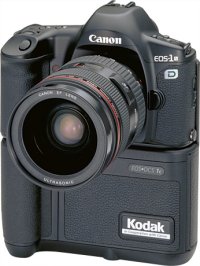
Kodak made DSLR's for Canon? Which ones? They did sell sensors to almost everyone. I owned a Kodak DSLR, but they only made the digital back, not the camera.
Here is a photo of mine, it doesn't really look like a Canon, but they later made one model compatible with canon lenses.

Upvote
0
AlanF said:9VIII said:Modern refrigerators work well enough, but they're no better than a fridge from 30 years ago (and often worse).
"The average refrigerator manufactured in 1981 consumed 1,278 kilowatt hours (kWh) of energy per year and those manufactured in 2013 consumed only 444 kWh of energy per year..."
http://www.aei.org/publication/home-appliances-good-old-days-now-theyre-cheaper-better-energy-efficient-ever/
http://aceee.org/blog/2014/09/how-your-refrigerator-has-kept-its-co
Maybe laundry machines would have been a better example.
Either way my point stands, if we see significant changes in technology everything on market now will be obsolete, or Canon will eventually catch up with the best existing tech.
Upvote
0

We have heard this several hundred times. And let me help you: there has been several posts comparing Canon with Kodak, RIM and Nokia and all have tried to sell the canon is doomed idea. You are assuming Canon has the "lack of new ideas" but there is no fresh and new idea in your question either.lb said:Some times I just wonder is it possible that Canon are heading the same was a Kodak, on top and in control but only to fall by the wayside because of the lack of new ideas, I remember all that Kodak achieved and took a wrong turn, Canon seems to be following same path as of late with no interesting new ideas, even the Firmware upgrades are in most cases with just obvious error removals that should not have been their in the first instance, when will the oily spatters be eliminated from our top of the Canon range DSLR etc.
Upvote
0
Actually, Canon was early to turn out serious DSLR's, they managed the change of paradigm quite well. Right now, they are diversifying into medical imaging, surveillance imaging, and are actively looking for additional business in the imaging area where there are big bucks.
I believe that Canon sees the shrinking photography market as a real threat, and is moving to make sure that in the event conventional cameras go away that the company will be in good shape.
Of the 4,080 billion Yen income, only 1133 came from imaging systems in 2017 (Preliminary) thats about 28 percent.
Canon is making lots of money, and most of it does not come from cameras and lenses.
I believe that Canon sees the shrinking photography market as a real threat, and is moving to make sure that in the event conventional cameras go away that the company will be in good shape.
Of the 4,080 billion Yen income, only 1133 came from imaging systems in 2017 (Preliminary) thats about 28 percent.
Canon is making lots of money, and most of it does not come from cameras and lenses.
Upvote
0
Both Nikon and Canon initially depended on Kodak for early generation digital cameras. Kodak was just so focused on a business model that relied on consumables (film, paper, chemicals) that they just couldn't bring themselves to fully embrace the digital transition. It basically cost them the company.
The transition from dSLR to ML isn't the same fundamental change in business model, it is simply replacing one component part for a different part. Not nearly as dramatic a shift as what Kodak faced.
I agree Canon is more likely looking for other business opportunities to offset the future lack of growth they anticipate in cameras in general. There are only so many big whites the market can absorb given they seem to have a good 10-15 year life expectancy. Not a lot of replacement opportunity. Bodies are approaching a similar plateau as technology evolution slows.
The transition from dSLR to ML isn't the same fundamental change in business model, it is simply replacing one component part for a different part. Not nearly as dramatic a shift as what Kodak faced.
I agree Canon is more likely looking for other business opportunities to offset the future lack of growth they anticipate in cameras in general. There are only so many big whites the market can absorb given they seem to have a good 10-15 year life expectancy. Not a lot of replacement opportunity. Bodies are approaching a similar plateau as technology evolution slows.
Attachments
Upvote
0
unfocused
Photos/Photo Book Reviews: www.thecuriouseye.com
Several years ago, Canon Price Watch compared the return on Canon "L" lenses to the stock market. At the time, the lenses were a better investment.
Thinking about Kodak's new cryptocurrency, maybe instead of "Canon heading down the same track as Kodak" could it be "Kodak heading down the same track as Canon."
Thinking about Kodak's new cryptocurrency, maybe instead of "Canon heading down the same track as Kodak" could it be "Kodak heading down the same track as Canon."
Upvote
0

Mt Spokane Photography said:Kodak made DSLR's for Canon? Which ones? They did sell sensors to almost everyone. I owned a Kodak DSLR, but they only made the digital back, not the camera.
From Wikipedia:
...Kodak's subsequent models integrated the digital module with the camera body more thoroughly, and included LCD preview screens and removable batteries. The DCS 500 series of 1998 was also based on the Canon EOS-1N, and comprised the 2-megapixel DCS 520 and the 6-megapixel DCS 560, which initially had a suggested retail price of $28,500.[7] These models were also sold by Canon, as the Canon D2000 and D6000 respectively, and were the first digital SLRs sold under the Canon name.
Obviously, this was before DSLRs had a price that made them available for the average consumer. But Kodak continued to make DSLRs:
Kodak concluded the initial DCS range with the DCS 700 series, which comprised the 2-megapixel DCS 720x, the 6-megapixel DCS 760, and the 6-megapixel DCS 760m, which had a monochrome sensor. By the time of launch, Kodak faced competition from the popular Nikon D1 and Nikon D1x,[8] which were physically smaller and cheaper. The DCS 760's initial list price was $8,000.
Kodak final generation of DCS cameras was launched with the Kodak DCS Pro 14n, a 14-megapixel full-frame digital SLR, in 2002, and continued with the upgraded DCS PRO SLR/n in 2004. These two cameras were based on a Nikon F80 body, and were considerably more compact than previous Kodaks.
At this point, of course, Nikon and Canon got into the game and Kodak could no longer compete - because they didn't make lenses. Why buy a Kodak and then get Nikon lenses when you can just get a Nikon with lens? People often ask, why doesn't anyone make an EF mount camera to use Canon lenses? I think history shows us that making cameras but not lenses doesn't work. Lenses without cameras...that works, witness Tamron and Sigma. Kodak continued to make Non-DSLR compact digital cameras and led the market until at least 2005 in the US. But once all the camera companies got into the digital game, there was nothing that Kodak had that made them stand out among all the competition.
Again, it is easy to dump on Kodak and say they just didn't adapt to the transition from film to digital, but they made most of the initial cameras and a lot of the sensors, too. But it was not nearly enough to offset the almost complete loss of film and related products because there was no digital substitute for them.
Upvote
0

9VIII said:Modern refrigerators work well enough, but they're no better than a fridge from 30 years ago (and often worse).
When my grandparents passed away, one of their daughters took the refrigerator. At this point there was a short discussion of how old it is. They got it close to another memorable event, so the answer was the refrigerator was close to 50 years old. It was in perfect working order, and never had to be fixed.
No wonder manufacturers are implementing planned obsolescence.
Upvote
0
Similar threads


- Replies
- 102
- Views
- 51K
- Replies
- 323
- Views
- 92K
- Replies
- 101
- Views
- 56K