Canon Asking Select Professionals What They Want in a Mirrorless Camera

Ditboy said:
Canon is so far behind at this point they should just keep making DSLR's and focus on quality lenses. If you want mirrorless buy a Sony and use Canon glass. Or if you don't care about FF go with Fuji. I've used Canon for the duration of my 40 years in journalism. Went through the the change from FD to EOS and took a beating. I had 18 lenses and six camera bodies. I have 4 M5s in addition to a couple DSLR I can use when shooting sports. I use the M5 75% of the time. But basically the 22 EF-M is the only modern Canon lens I use. I have several of the other EF-m lenses, but I use Rokinons, and Canon FD lenses most of the time because I need something faster than f6.3.

I was going to switch to Sony, but I already have a slurpee cup.
 
Upvote 0
ken said:
I don't get the desire for a non-EF mount from so many people. If it has a short flange on the body, you'll just have a flange on EVERY lens (eating up valuable bag space), or the equivalent in an adapter (which makes the mount less stable).

Are the people asking for short flange not aware of the physics? Or... are they wanting the ability to use non-Canon glass? Or something I haven't thought of?

They think that few millimeters of difference is going to add cubic feet of space to their bags. Silly people.
 
Upvote 0
Adelino said:
highdesertmesa said:
ahsanford said:
highdesertmesa said:
snoke said:
Why GFX50? Cant understand it. Color? Noise? Controls?
Because the price point of the rumored rangefinder (and less expensive) version of the GFX 50S body may begin to encroach on the 5DsR (and future 5Ds Mk II) price point. Also once the 100S version is released in 2019, the 50S price will drop substantially. And the GF lenses are not any more expensive than Canon's best L lenses, yet they can resolve up to 100 MP.

I went on a mini rant about medium format's appeal to FF users recently: post 1 / post 2

In my mind, it's a very hard sell to FF users. Many more takeaways than advantages, and the hotness the bigger sensor brings isn't that much hotter than what FF can deliver today.

I'm not saying that there is not benefit to MF -- leaf shutters and bigger sensors are not bad things at all. But I feel one is walking away from so much more than they are walking towards in a FF --> MF conversation.

But a total agreement / +1 on the 100 MP arriving to change things there. That's a clear selling point that FF will not have for some time.

- A

I own the GFX and 5DsR, and I can tell you the difference in the files is substantial and well worth the price difference (I got the GFX body for just over $5K). The only thing I use the 5DsR for any more is longer telephoto shots, but that will change somewhat when the GF 250 plus 1.4x comes out this year. I'll still keep the 5DsR and 100-400 II with 1.4x III for the occasional 500mm+ shot.

Beautiful photos. Santa Fe?

Thank you. They were taken in Placitas, NM – about 10 miles north of ABQ and 40 miles south of Santa Fe on I-25.
 
Upvote 0
highdesertmesa said:
Adelino said:
highdesertmesa said:
ahsanford said:
highdesertmesa said:
snoke said:
Why GFX50? Cant understand it. Color? Noise? Controls?
Because the price point of the rumored rangefinder (and less expensive) version of the GFX 50S body may begin to encroach on the 5DsR (and future 5Ds Mk II) price point. Also once the 100S version is released in 2019, the 50S price will drop substantially. And the GF lenses are not any more expensive than Canon's best L lenses, yet they can resolve up to 100 MP.

I went on a mini rant about medium format's appeal to FF users recently: post 1 / post 2

In my mind, it's a very hard sell to FF users. Many more takeaways than advantages, and the hotness the bigger sensor brings isn't that much hotter than what FF can deliver today.

I'm not saying that there is not benefit to MF -- leaf shutters and bigger sensors are not bad things at all. But I feel one is walking away from so much more than they are walking towards in a FF --> MF conversation.

But a total agreement / +1 on the 100 MP arriving to change things there. That's a clear selling point that FF will not have for some time.

- A

I own the GFX and 5DsR, and I can tell you the difference in the files is substantial and well worth the price difference (I got the GFX body for just over $5K). The only thing I use the 5DsR for any more is longer telephoto shots, but that will change somewhat when the GF 250 plus 1.4x comes out this year. I'll still keep the 5DsR and 100-400 II with 1.4x III for the occasional 500mm+ shot.

Beautiful photos. Santa Fe?

Thank you. They were taken in Placitas, NM – about 10 miles north of ABQ and 40 miles south of Santa Fe on I-25.

Interestingly derivative of Adams' 'Moonrise over Hernandez', but he controlled the exposure of the moon 'better'. I read an interesting article about how he set up for the shot in such a rush he didn't have an exposure meter, but he knew the moon followed the 'Moony/Loony/Luna f11 Rule' so he exposed for that placing it in a high Zone and then lifted the rest of the detail from the shadows via film development and printing mastery.
 
Upvote 0
ahsanford said:
Don Haines said:
The Sony system is a "medium size" solution. It is a very good compromise between small size and quality/ergonomics... Canon already has a successful "small" system (M series) and the lenses for a "large" system (EF mount). It makes much more sense for them to come out with a "large" mirrorless body and to offer the public both a large and high quality/ergonomic system and a small system, than it does to invent a whole new medium sized system that leaves thier current high end users dngling....

Don, I think you're conflating FF and crop with these small/medium/larges above. Crop and FF are apples and oranges to me even if a crop body can use FF glass.

Consider that the A7 is smaller than any FF DSLR Canon has ever made. You say it's a medium, but for FF, I see the A7 and even the thicker A9, A7R3 designs as "Small" for that sensor size and the glass you'll put on it. You can't really make that setup much smaller without turning it into a fancy RX1R point and shoot.

- A
I probably didn’t explain myself too well......

What I was getting at, was that if you wanted small, and all the compromises that goes with it, then you end up with an M series camera, but if you want top quality/ergonomics, to tap into those 140 million lenses out there, and damn the weight, then you put an EF Mount and a Ff sensor together.
 
Upvote 0
Don Haines said:
sigh.......

Perhaps Canon has figured it out already.....

If you want small size in a mirrorless camera, you want short flange sizes and above all else, TINY LENSES! This means a decided lack of F1.4 primes.... and by using a crop sensor, you can keep those F5.6 lenses small. Such a camera will still take great quality pictures..... and so came the "M" series.

If you are after the ultimate in quality from your mirrorless camera, then you want FF and you are going to want big fast lenses. You will avoid short flange distances because of the chromatic aberration problems of bending the light too sharply to fit that short flange. These are the people who are going to want lots of controls and shoulder displays on their camera, so you end up with a body the size of a 5D series camera to fit it in. Any camera designed to meet such criteria will not be tiny like a Sony.

Everything comes at a price. You can not have best quality with great ergonomics, and small size in the same package. They are mutually exclusive.

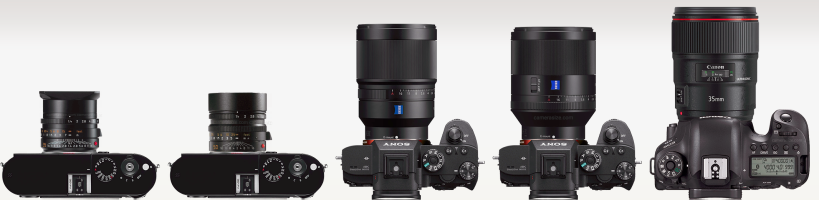
You can have compact f/1.4 primes on a small mirrorless FF sensor camera. Leica M + 35/1.4 or 50/1.4 is small in comparison to A7rIII with similar lenses. 6DmkII + 35/1.4LmkII added to comparison for those not familiar with the size.
 

Attachments

  • f1.4.png
    f1.4.png
    610.7 KB · Views: 109
Upvote 0
hne said:
You can have compact f/1.4 primes on a small mirrorless FF sensor camera. Leica M + 35/1.4 or 50/1.4 is small in comparison to A7rIII with similar lenses. 6DmkII + 35/1.4LmkII added to comparison for those not familiar with the size.

...and don't forget small + fast SLR lenses like the EF 50 f/1.4 USM. Double gauss 50s can be super tiny for their max aperture.

I've always wondered how Leica got such fast lenses so small, and someone please explain if they know. Wild guess: they just use ancient / simple / tiny lens designs and spend a mint on component tolerancing to get the most out of them. Is that how they do it, or are they just really well built old designs that aren't that sharp and have all sorts of older lens optical problems like our 50 f/1.4?

- A
 
Upvote 0
Don Haines said:
ahsanford said:
Don Haines said:
The Sony system is a "medium size" solution. It is a very good compromise between small size and quality/ergonomics... Canon already has a successful "small" system (M series) and the lenses for a "large" system (EF mount). It makes much more sense for them to come out with a "large" mirrorless body and to offer the public both a large and high quality/ergonomic system and a small system, than it does to invent a whole new medium sized system that leaves thier current high end users dngling....

Don, I think you're conflating FF and crop with these small/medium/larges above. Crop and FF are apples and oranges to me even if a crop body can use FF glass.

Consider that the A7 is smaller than any FF DSLR Canon has ever made. You say it's a medium, but for FF, I see the A7 and even the thicker A9, A7R3 designs as "Small" for that sensor size and the glass you'll put on it. You can't really make that setup much smaller without turning it into a fancy RX1R point and shoot.

- A
I probably didn’t explain myself too well......

What I was getting at, was that if you wanted small, and all the compromises that goes with it, then you end up with an M series camera, but if you want top quality/ergonomics, to tap into those 140 million lenses out there, and damn the weight, then you put an EF Mount and a Ff sensor together.

totally agree - it's the ergonomics that dictate the size.

canon could slap a full frame sensor into an SL2 sized mirrorless and call it a day. it'd be as small as a A7 series camera and still use the EF mount.

however it would also have SL2 ergonomics and not 5D Mark IV ergonomics.

you want 5D Mark IV ergonomics, it's going to be nearly the same size (but weigh less) than a 5D Mark IV does now currently.

EF mount or no EF mount, for 5D Mark IV ergonomics the body is going to be similar.
 
Upvote 0
ahsanford said:
hne said:
You can have compact f/1.4 primes on a small mirrorless FF sensor camera. Leica M + 35/1.4 or 50/1.4 is small in comparison to A7rIII with similar lenses. 6DmkII + 35/1.4LmkII added to comparison for those not familiar with the size.

...and don't forget small + fast SLR lenses like the EF 50 f/1.4 USM. Double gauss 50s can be super tiny for their max aperture.

I've always wondered how Leica got such fast lenses so small, and someone please explain if they know. Wild guess: they just use ancient / simple / tiny lens designs and spend a mint on component tolerancing to get the most out of them. Is that how they do it, or are they just really well built old designs that aren't that sharp and have all sorts of older lens optical problems like our 50 f/1.4?

- A

Seems like they're small and sharp:
https://www.lensrentals.com/blog/2014/06/comparing-rangefinder-and-slr-50mm-lenses-version-0-7/
 
Upvote 0
hne said:
Seems like they're small and sharp:
https://www.lensrentals.com/blog/2014/06/comparing-rangefinder-and-slr-50mm-lenses-version-0-7/

Yep, so what's the magic in those designs? Are they just throwing money at airtight tolerances or are these possibly lenses that are only concerned about sharpness? Are those lenses plagued with aberrations, focus shift, distortion, etc?

...or are we sheep for believing that great fast FF lenses must be big? Are big pickle jar modern retrofocus lenses simply a means to deliver the same sharpness a Summilux can without costing $4-5k?

In these discussions, the cruel master -- Physics -- usually eats his supper. Someone please clarify the optical black magic at play here.

- A
 
Upvote 0
privatebydesign said:
highdesertmesa said:
Adelino said:
highdesertmesa said:
ahsanford said:
highdesertmesa said:
snoke said:
Why GFX50? Cant understand it. Color? Noise? Controls?
Because the price point of the rumored rangefinder (and less expensive) version of the GFX 50S body may begin to encroach on the 5DsR (and future 5Ds Mk II) price point. Also once the 100S version is released in 2019, the 50S price will drop substantially. And the GF lenses are not any more expensive than Canon's best L lenses, yet they can resolve up to 100 MP.

I went on a mini rant about medium format's appeal to FF users recently: post 1 / post 2

In my mind, it's a very hard sell to FF users. Many more takeaways than advantages, and the hotness the bigger sensor brings isn't that much hotter than what FF can deliver today.

I'm not saying that there is not benefit to MF -- leaf shutters and bigger sensors are not bad things at all. But I feel one is walking away from so much more than they are walking towards in a FF --> MF conversation.

But a total agreement / +1 on the 100 MP arriving to change things there. That's a clear selling point that FF will not have for some time.

- A

I own the GFX and 5DsR, and I can tell you the difference in the files is substantial and well worth the price difference (I got the GFX body for just over $5K). The only thing I use the 5DsR for any more is longer telephoto shots, but that will change somewhat when the GF 250 plus 1.4x comes out this year. I'll still keep the 5DsR and 100-400 II with 1.4x III for the occasional 500mm+ shot.

Beautiful photos. Santa Fe?

Thank you. They were taken in Placitas, NM – about 10 miles north of ABQ and 40 miles south of Santa Fe on I-25.

Interestingly derivative of Adams' 'Moonrise over Hernandez', but he controlled the exposure of the moon 'better'. I read an interesting article about how he set up for the shot in such a rush he didn't have an exposure meter, but he knew the moon followed the 'Moony/Loony/Luna f11 Rule' so he exposed for that placing it in a high Zone and then lifted the rest of the detail from the shadows via film development and printing mastery.

Yes, and evidently he knew it wasn't exposed exactly right and had to adjust the negative developing, too. A master all around.
 
Upvote 0
ahsanford said:
hne said:
Seems like they're small and sharp:
https://www.lensrentals.com/blog/2014/06/comparing-rangefinder-and-slr-50mm-lenses-version-0-7/

Yep, so what's the magic in those designs? Are they just throwing money at airtight tolerances or are these possibly lenses that are only concerned about sharpness? Are those lenses plagued with aberrations, focus shift, distortion, etc?

...or are we sheep for believing that great fast FF lenses must be big? Are big pickle jar modern retrofocus lenses simply a means to deliver the same sharpness a Summilux can without costing $4-5k?

In these discussions, the cruel master -- Physics -- usually eats his supper. Someone please clarify the optical black magic at play here.

- A
There is no optical back magic here. Leica M mount has a flange distance of 27.8 mm, Canon EF mount has a flange distance of 44mm. That make it much easier to design a small lenses that have focal length 50mm or less for Leica. On top of that Leica lenses are all manual, no auto focus, no electronically controlled iris. That also make the lenses smaller. You are right about Leica put a lot of effort( read it as expense) to make the lens being excellent. The old optical formula are so good that my 50 years old leica lenses can still complete with the modern lenses, except modern Leica lenses
 
Upvote 0
My wishlist would be:
- new mount, but full compatibility with EF mount (probably with an included adapter or ‘dual mount’) with no compromises in performance.
- the above would allow Canon and it’s users to hit the ground running with a great, full system of lenses, but allow the development of:
- a range of slightly more compact, but significantly lighter, lenses. BUT, these must still be fast aperture, top quality, pro lenses with fast silent AF and weather sealing. Leica and Fujifilm do it, so can Canon. Consider f/1.8 lenses instead of f/1.4 if it makes a big difference to size/weight (e.g., Sony/Zeiss FE 55 f/1.8, or Zeiss Batis, etc.)
- body doesn’t have to be much smaller, but should be a few hundred grams lighter than 5Dmkiv. E.g., a little larger/better ergonomically than A7riii but as light.
- IBIS
- not too much resolution, around 30mp but with great clean files and optimised for both stills and video
- body and lenses as well sealed as 5Dmkiv
- 4K with at least 10-bit 4:2:2 internal and choice of FF or APS-C crop. C-log, very well controlled moiré, aliasing, rolling shutter, etc.
- Focus peaking and zebras for video. Scopes would be nice. LUT preview.
- stills and video AF should be on sensor Phase Detect AF/and next generation Dual Pixel AF. Both should have at least Sony A7riii eye tracking AF (this in video would be a first and a game changer)
- Same level of ergonomic control/responsiveness as 5Dmkiv
- Same level of flash functionality as 5Dmkiv
- Canon traditional colour science, and maybe some nice dedicated film emulations à la Fuji
 
Upvote 0
"Canon Asking Select Professionals What They Want in a Mirrorless Camera".

For me - a large 3 cell battery (LP-E4N or similar), full compatibility (without compromise) on EF lenses and a Mirror! If it hasn't got an optical viewfinder and TTL viewing then it is of no use to me.
 
Upvote 0
johnf3f said:
"Canon Asking Select Professionals What They Want in a Mirrorless Camera".

For me - a large 3 cell battery (LP-E4N or similar), full compatibility (without compromise) on EF lenses and a Mirror! If it hasn't got an optical viewfinder and TTL viewing then it is of no use to me.

I do not think that question means what you think it means...
 
Upvote 0
brad-man said:
johnf3f said:
"Canon Asking Select Professionals What They Want in a Mirrorless Camera".

For me - a large 3 cell battery (LP-E4N or similar), full compatibility (without compromise) on EF lenses and a Mirror! If it hasn't got an optical viewfinder and TTL viewing then it is of no use to me.

I do not think that question means what you think it means...

I think it means what pro's want out of a Mirrorless camera. I am not a "Pro" but I do use equivalent gear and shoot alongside a few, so just my thoughts. I (and they) do not lug around heavy pro cameras for their looks, we do it because of the large batteries, solid build and excellent AF - which is of limited use with an EVF.

Certainly, for other users, this may be the way to go - but for me and all bar one of the "Pro" photographers that I know it is not.

Not having a dig just trying to put things in perspective. Many are tempted by mirrorless cameras, as am I, but having tried a few the viewfinders/AF and lenses severely limit them for many uses - or virtually all uses in my personal case.

For the landscape (and similar) shooters they look very tempting - especially the newer Sony models. However they are far from all round cameras, yet. If they suit your needs then GREAT! They just cannot work for me or most of the photographers that I know and shoot with.
 
Upvote 0
johnf3f said:
brad-man said:
johnf3f said:
"Canon Asking Select Professionals What They Want in a Mirrorless Camera".

For me - a large 3 cell battery (LP-E4N or similar), full compatibility (without compromise) on EF lenses and a Mirror! If it hasn't got an optical viewfinder and TTL viewing then it is of no use to me.

I do not think that question means what you think it means...

I think it means what pro's want out of a Mirrorless camera. I am not a "Pro" but I do use equivalent gear and shoot alongside a few, so just my thoughts. I (and they) do not lug around heavy pro cameras for their looks, we do it because of the large batteries, solid build and excellent AF - which is of limited use with an EVF.

Certainly, for other users, this may be the way to go - but for me and all bar one of the "Pro" photographers that I know it is not.

Not having a dig just trying to put things in perspective. Many are tempted by mirrorless cameras, as am I, but having tried a few the viewfinders/AF and lenses severely limit them for many uses - or virtually all uses in my personal case.

For the landscape (and similar) shooters they look very tempting - especially the newer Sony models. However they are far from all round cameras, yet. If they suit your needs then GREAT! They just cannot work for me or most of the photographers that I know and shoot with.

John, I wasn't questioning your rationale behind desiring features currently found only in DSLRs. I recently bought a 5DIV (which I love) and have no interest in a FF mirrorless camera either. I simply found it amusing that one of your requirements for a mirrorless camera was that it have a mirror.
 
Upvote 0
For Professional Journalists, It is about the investment in lenses, but also about size and the ability to hold and operate a camera securely with one hand. The ability to change memory cards in sub zero conditions while wearing gloves. Journalists have some pretty different expectations for a camera.

Then, there are Professional Wedding and Event photographers who have a totally different list of items, the 5 Series was aimed at them, and they are a very large and important group of pros.

Enthusiast photographers seem to run a wide gamut, but they are important because they buy so many cameras and lenses. A camera for them is hard to pin down, some want small, some want big.

I'd like to see better functionality in existing cameras, better exposure algorithms, if Lightroom can do it, so can Cannon. the latest Lightroom takes a poorly exposed image from my camera and does a excellent but not perfect job. Exposures linked to the AF spot in all cameras would be helpful. Right now, I can do that in live view with the touch screen, and its a big improvement for getting the main subject properly exposed.
 
Upvote 0