(I've cut a bit of the nested quotes for ease of reading, don't think it changes what I'm about to say in any way)
The main problem with DxO PMPix is just that - it has no definition. It is an undefined quantity of measurement, where we only know the rudimentary basics of the general procedure, and almost nothing about the weighing factors. It's - in a sort of ways - closely related to the older commonly used SQF metric, but with changes to both cutoff in spatial frequencies and way to arrive at the final metric score.
I know some of the guys working at DxO, and even they tend to be VERY tight lipped about that specific metric, even though they're very open about the rest of their testing procedures. We can replicate almost everything EXCEPT the PMPix metric in our own labs. To surprising precisions.
IMO that means that even they themselves are uncertain about the validity of the metric, and what it implies. As one example, you can look at the extreme difference between the PMPix result between known cameras using the same sensor but different AA filters - like the D800-D800E, the Pentax K5-K5iis, or the D7100-D5200.
But -oops...! They've removed all the results again for the D800E and the K5iis... One minute they were there, now they aren't. Wonder why...? Was it because they gave 20-25% higher PMPix results even though the visual difference between the cameras are close to zero?
So, lets look at the D7100-D5200, the only remaining "known" same sensor base difference (none of the Pana sensors or the Sony sensors used in µFT are "known" identical structures.) Both the D7100 and the 5200 have identical Toshiba 5105 bases.
Lens ; D7100 result ; D5200 result
35/1.8 ; 12MP ; 10MP
50/1.8 ; 14MP ; 11MP
85/1.8 ; 15MP ; 12MP
70-200 ; 15MP ; 12MP
And since there's one lens comparable for the D800-D800E case, the Tamron 70-200:
D800:15MP ; D800E:21MP (!!!???!!!)
I've done enough studio work with both the E and the non-E version to know that there's nowhere near that difference in "resolution" between them. There IS a slight difference, but the main part of it goes lost in digital artifacts even when you use Capture One for raw conversions, and I just can't stand that POS software for larger workflows.
Trying to extrapolate that difference into better lenses on the D800E from the D800 results, you get some 25-30PMPix for most of the superteles, and a only a few PMPix less the better short primes and top zooms.
And since I have real MTF data for some of those lenses, done in a Zeiss K-8 MTF bench, I can say that there's no real difference at all between the "best of the best" lenses on the better modern cameras. Very slight differences in AA filter strengths make several times stronger impacts on the PMPix result than what a few percent of real optical performance MTF does.
Doing a very rough estimate of the weighing factors, and ASSUMING that DxO kept reasonably close to the SQF spatial frequencies arrived at by the I3A CPIQ standards group, the PMPix is corresponding to maximum detail contrast attainable in a roughly 8MP presentation scale. Scaled to mathematical perfection, which of course is never the case in a real scenario. So it doesn't really matter how good the real resolution gets at 20-30-40MP - ONLY the detail contrast around the 8MP resolution mark counts towards the PMPix metric - which of course works well for smartphone camera modules and compact cameras - but not really for APS,FF or even larger formats. The extrapolation uncertainty grows exposnentially the further out from the original measurement point you go.
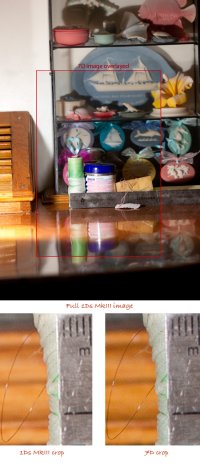
According to PMPix/SQF metric, the image half on the left below has more resolution that the one on the right. Hm.

Since we know neither the spatial frequency range or the weighing factor, the metric is about as useless as knowing how many megafnurps a glortymeter can hold before exploding. Since you don't know what a fnurp is (nor a "glorty" for that matter...) - what use does the number have?
jrista said:outputBlur = sqrt(lensBlur^2 + sensorBlur^2)
outputBlur^2 = lensBlur^2 + sensorBlur^2
outputBlur^2 - sensorBlur^2 = lensBlur^2
lensBlur = sqrt(outputBlur^2 - sensorBlur^2)
Now I don't know of any way to convert DXO's P-mpix measure into simple lp/mm or blur circle size, as they take into account a number of perceptual factors like acutance, and use the lens' best performing aperture. Regardless, P-mpix is taking into account the convolution of the final image. You will never see any lens produce as many P-mpix as the sensors the lens was tested with...the P-mix value will always be lower, because you can never achieve the maximum potential of either lens or sensor.
The main problem with DxO PMPix is just that - it has no definition. It is an undefined quantity of measurement, where we only know the rudimentary basics of the general procedure, and almost nothing about the weighing factors. It's - in a sort of ways - closely related to the older commonly used SQF metric, but with changes to both cutoff in spatial frequencies and way to arrive at the final metric score.
I know some of the guys working at DxO, and even they tend to be VERY tight lipped about that specific metric, even though they're very open about the rest of their testing procedures. We can replicate almost everything EXCEPT the PMPix metric in our own labs. To surprising precisions.
IMO that means that even they themselves are uncertain about the validity of the metric, and what it implies. As one example, you can look at the extreme difference between the PMPix result between known cameras using the same sensor but different AA filters - like the D800-D800E, the Pentax K5-K5iis, or the D7100-D5200.
But -oops...!
They've removed all the results again for the D800E and the K5iis... One minute they were there, now they aren't. Wonder why...? Was it because they gave 20-25% higher PMPix results even though the visual difference between the cameras are close to zero?So, lets look at the D7100-D5200, the only remaining "known" same sensor base difference (none of the Pana sensors or the Sony sensors used in µFT are "known" identical structures.) Both the D7100 and the 5200 have identical Toshiba 5105 bases.
Lens ; D7100 result ; D5200 result
35/1.8 ; 12MP ; 10MP
50/1.8 ; 14MP ; 11MP
85/1.8 ; 15MP ; 12MP
70-200 ; 15MP ; 12MP
And since there's one lens comparable for the D800-D800E case, the Tamron 70-200:
D800:15MP ; D800E:21MP (!!!???!!!)
I've done enough studio work with both the E and the non-E version to know that there's nowhere near that difference in "resolution" between them. There IS a slight difference, but the main part of it goes lost in digital artifacts even when you use Capture One for raw conversions, and I just can't stand that POS software for larger workflows.
Trying to extrapolate that difference into better lenses on the D800E from the D800 results, you get some 25-30PMPix for most of the superteles, and a only a few PMPix less the better short primes and top zooms.
And since I have real MTF data for some of those lenses, done in a Zeiss K-8 MTF bench, I can say that there's no real difference at all between the "best of the best" lenses on the better modern cameras. Very slight differences in AA filter strengths make several times stronger impacts on the PMPix result than what a few percent of real optical performance MTF does.
Doing a very rough estimate of the weighing factors, and ASSUMING that DxO kept reasonably close to the SQF spatial frequencies arrived at by the I3A CPIQ standards group, the PMPix is corresponding to maximum detail contrast attainable in a roughly 8MP presentation scale. Scaled to mathematical perfection, which of course is never the case in a real scenario. So it doesn't really matter how good the real resolution gets at 20-30-40MP - ONLY the detail contrast around the 8MP resolution mark counts towards the PMPix metric - which of course works well for smartphone camera modules and compact cameras - but not really for APS,FF or even larger formats. The extrapolation uncertainty grows exposnentially the further out from the original measurement point you go.
According to PMPix/SQF metric, the image half on the left below has more resolution that the one on the right. Hm.
Since we know neither the spatial frequency range or the weighing factor, the metric is about as useless as knowing how many megafnurps a glortymeter can hold before exploding. Since you don't know what a fnurp is (nor a "glorty" for that matter...) - what use does the number have?
Upvote
0