New high resolution camera

(I've cut a bit of the nested quotes for ease of reading, don't think it changes what I'm about to say in any way)
jrista said:
outputBlur = sqrt(lensBlur^2 + sensorBlur^2)
outputBlur^2 = lensBlur^2 + sensorBlur^2
outputBlur^2 - sensorBlur^2 = lensBlur^2
lensBlur = sqrt(outputBlur^2 - sensorBlur^2)

Now I don't know of any way to convert DXO's P-mpix measure into simple lp/mm or blur circle size, as they take into account a number of perceptual factors like acutance, and use the lens' best performing aperture. Regardless, P-mpix is taking into account the convolution of the final image. You will never see any lens produce as many P-mpix as the sensors the lens was tested with...the P-mix value will always be lower, because you can never achieve the maximum potential of either lens or sensor.

The main problem with DxO PMPix is just that - it has no definition. It is an undefined quantity of measurement, where we only know the rudimentary basics of the general procedure, and almost nothing about the weighing factors. It's - in a sort of ways - closely related to the older commonly used SQF metric, but with changes to both cutoff in spatial frequencies and way to arrive at the final metric score.

I know some of the guys working at DxO, and even they tend to be VERY tight lipped about that specific metric, even though they're very open about the rest of their testing procedures. We can replicate almost everything EXCEPT the PMPix metric in our own labs. To surprising precisions.

IMO that means that even they themselves are uncertain about the validity of the metric, and what it implies. As one example, you can look at the extreme difference between the PMPix result between known cameras using the same sensor but different AA filters - like the D800-D800E, the Pentax K5-K5iis, or the D7100-D5200.

But -oops...! :) They've removed all the results again for the D800E and the K5iis... One minute they were there, now they aren't. Wonder why...? Was it because they gave 20-25% higher PMPix results even though the visual difference between the cameras are close to zero?

So, lets look at the D7100-D5200, the only remaining "known" same sensor base difference (none of the Pana sensors or the Sony sensors used in µFT are "known" identical structures.) Both the D7100 and the 5200 have identical Toshiba 5105 bases.

Lens ; D7100 result ; D5200 result
35/1.8 ; 12MP ; 10MP
50/1.8 ; 14MP ; 11MP
85/1.8 ; 15MP ; 12MP
70-200 ; 15MP ; 12MP

And since there's one lens comparable for the D800-D800E case, the Tamron 70-200:
D800:15MP ; D800E:21MP (!!!???!!!)

I've done enough studio work with both the E and the non-E version to know that there's nowhere near that difference in "resolution" between them. There IS a slight difference, but the main part of it goes lost in digital artifacts even when you use Capture One for raw conversions, and I just can't stand that POS software for larger workflows.

Trying to extrapolate that difference into better lenses on the D800E from the D800 results, you get some 25-30PMPix for most of the superteles, and a only a few PMPix less the better short primes and top zooms.

And since I have real MTF data for some of those lenses, done in a Zeiss K-8 MTF bench, I can say that there's no real difference at all between the "best of the best" lenses on the better modern cameras. Very slight differences in AA filter strengths make several times stronger impacts on the PMPix result than what a few percent of real optical performance MTF does.

Doing a very rough estimate of the weighing factors, and ASSUMING that DxO kept reasonably close to the SQF spatial frequencies arrived at by the I3A CPIQ standards group, the PMPix is corresponding to maximum detail contrast attainable in a roughly 8MP presentation scale. Scaled to mathematical perfection, which of course is never the case in a real scenario. So it doesn't really matter how good the real resolution gets at 20-30-40MP - ONLY the detail contrast around the 8MP resolution mark counts towards the PMPix metric - which of course works well for smartphone camera modules and compact cameras - but not really for APS,FF or even larger formats. The extrapolation uncertainty grows exposnentially the further out from the original measurement point you go.

According to PMPix/SQF metric, the image half on the left below has more resolution that the one on the right. Hm.
PMPix_scale.jpg


Since we know neither the spatial frequency range or the weighing factor, the metric is about as useless as knowing how many megafnurps a glortymeter can hold before exploding. Since you don't know what a fnurp is (nor a "glorty" for that matter...) - what use does the number have?
 
Upvote 0
TheSuede said:
(I've cut a bit of the nested quotes for ease of reading, don't think it changes what I'm about to say in any way)
jrista said:
outputBlur = sqrt(lensBlur^2 + sensorBlur^2)
outputBlur^2 = lensBlur^2 + sensorBlur^2
outputBlur^2 - sensorBlur^2 = lensBlur^2
lensBlur = sqrt(outputBlur^2 - sensorBlur^2)

Now I don't know of any way to convert DXO's P-mpix measure into simple lp/mm or blur circle size, as they take into account a number of perceptual factors like acutance, and use the lens' best performing aperture. Regardless, P-mpix is taking into account the convolution of the final image. You will never see any lens produce as many P-mpix as the sensors the lens was tested with...the P-mix value will always be lower, because you can never achieve the maximum potential of either lens or sensor.

The main problem with DxO PMPix is just that - it has no definition. It is an undefined quantity of measurement, where we only know the rudimentary basics of the general procedure, and almost nothing about the weighing factors. It's - in a sort of ways - closely related to the older commonly used SQF metric, but with changes to both cutoff in spatial frequencies and way to arrive at the final metric score.

Well, I was going to respond with a link to a page that described (at least largely, although it didn't specify the exact math) how P-mpix worked...however the page appears to have disappeared from the entirety of the net. (Which, ironically, speaks entirely to your point...that DXO is keeping it too secretive.) As such, I completely agree. P-mpix is a useless factor, telling you jibber jabber about thingamamonkey...which really isn't surprising, given that the lens scores and camera scores from DXO are also useless factors.

I don't really give DXO the time of day anymore. There are far more useful benchmarks for camera equipment out there that provide more useful insight. DPR, PhotoZone, TDP, etc. are vastly superior resources.
 
Upvote 0
jrista said:
I don't really give DXO the time of day anymore. There are far more useful benchmarks for camera equipment out there that provide more useful insight. DPR, PhotoZone, TDP, etc. are vastly superior resources.

About all I find useful of their lens tests is simply comparing the results of lenses tested on the same body, using the field measurement results so you can see the relative contrast plotted as varying colors. In this way you can get a feel of how a given lens they tested MIGHT perform, relative to itself or sometimes others, at different apertures and-or focal lengths.
 
Upvote 0
privatebydesign said:
StudentOfLight said:
What I think will happen in 2014...

Q1: Pre-release 7D-II bodies in action at Winter Olympics in Russia
Q2: 7D-II official launch (coincides with FIFA world cup in Brazil)
Q3/4: High megapixel, 1-series body officially announced.
(launch only Q2/Q3-2015)

These are just my speculations. I do not have any inside info or contacts.

People that earn their livings and gamble their reputations and careers shooting the Olympics and World Cup won't be shooting with a 7D Mk anything. The 1DX and D4 rule and will until a 1DX MkII and D5 come out, I wouldn't be surprised if there are a few pre production versions of them there though.

Companies use marketing to support and promote product launches and existing products. (I assume you are familiar with CPN Masterclass, Explorer of Light....) Established professionals have been used in the past to demonstrate the value and capability of new equipment and equipment which is not necessarily top of the line.

Have you shot with a 7D-II? How do you know it is not suitable for professional sports photography? You are probably on the same position as me in only having rumors to go on.

Rumored specs indicate it will have 60% longer reach than 1DX and 30% more resolution but with 18-30% less max fps. With a good good buffer size, an experienced sports photographer can definitely make it work.
 
Upvote 0
StudentOfLight said:
Have you shot with a 7D-II?

There's no need whatsoever to actually shoot with a 7D Mark II to realize that if such a camera is released it will be using a crop sensor. This alone cements a striking image quality difference, which is exactly what will keep professional shooters from using it when it counts most. Privatebydesign phrased this quite nicely.

Forget assumptions that with diminished sensor size you can easily outdo a larger sensor. Higher MP density doesn't bring about better image quality, if the sensor is much smaller such as with the difference between 7D and 1D-X. Both have 18 MPs, but there are striking differences in the per-pixel image quality. Once you need to crop an image, you are much better off with a full-frame sensor.

In addition I don't remember sports to be held exclusively at bright sunlight. With not-so-well-lit environments and a need to keep shutter speeds fast, how can you expect to get good results with a crop sensor? Given the small pixel size it will suffer in low light.
 
Upvote 0
Hello. I will need to read the submissions a few times and have a few reference sites open at the same time to cross reference bits! I can handle the maths, just the concepts may take time...but am enjoying this! thank you all for the contributions!

My question though is related to some of the items mentioned. So here goes - if in theory a 800mp sensor was made, would it then be possible to remove the AA filter? I recall reading something along these lines in DPReview some years ago. All things being equal, on a very high Mp sensor, would removing the AA filter benefit image quality?
 
Upvote 0
jrista said:
privatebydesign said:
jrista said:
I don't agree with this.

I know you don't, and you argue my examples when I show them, that is fine, you make your cjhoices for yourself and I'll make mine for me.

But I never questioned system resolution as a concept, I know full well the interplay of the elements within that system. We just come to different conclusions when looking at the images they produce, I don't care a fig for technical theories, just understanding why I see what I see.

Well, the example I've usually seen from you is the 7D vs. the 1D III, and I think your argument usually boils down to the fact that the AA filter on the 7D is fairly strong, thus diminishing the value of the 7D. I won't deny that a strong AA filter throws another factor into the mix, and it is a factor to take into account when actually measuring different devices. Even so, the use, or not, of an AA filter isn't a reason to stop pushing megapixel count/spatial resolution. My theory always assumes "all else being equal"...in which case the AA filter would be tuned to provide similar results around nyquist for any given sensor resolution.

I don't deny that it is important to use empirical data as well, however empirical data can and is often interpreted differently. It's a subjective measure, and how the data is interpreted, according to what criteria, and by whom, are all important factors in normalizing empirical results. Personally, I see a meaningful, if not "ideal", improvement in resolution with the 7D over the 1D III in your past visual examples, you do not... That is an important discrepancy, and just because the data is yours does not inherently invalidate the observations of others. I have very good 20/10 vision with my corrective lenses, and perhaps that plays a role. If the 7D had a weaker AA filter, the difference would likely be even more pronounced. One could also perform a test with the AA filter removed from both cameras (thus eliminating the additional factor), and I think the difference in spatial resolution would be quite clear in that case.

Your argument is usually perceptual (subjective), where as I try to make mine objective. Perceptual/subjective arguments, while not invalid, are hard to use as a viable basis for comparison because of the very fact that they can be interpreted differently in the absence of normalization. You see the 7D as having no visual benefit over the 1D III...I see the 7D as indeed having a visible benefit over the 1D III, if not quite as much as theory would have predicted...all using the exact same source images that you yourself produce. That is a war neither of us will win, and one which doesn't help anyone else understand the fundamental value of having a higher resolution sensor.

A 24mp APS-C sensor would arguably demonstrate an even greater lead over the 1D III...I'd be very curious to see you perform a visual comparison of say a D7100 vs. the 1D III, or even the 5D III that was identical to your test of the 7D and 1D III. I'd wager the D7100 clearly outperforms either Canon camera in the realm of final resolving power (spatial resolution).

I'm sorry if my replies frustrate you, but you often seem to be making the (subjectively based) argument that there is no value whatsoever to increasing megapixel count beyond the point where Canon currently is (~20mp APS-C, ~24mp FF). From an objective standpoint, there most definitely is, and I think it is important that people understand that. All else being equal, you don't lose anything by moving to a higher resolution sensor, and in fact you almost always gain something.

Subjectively, images from the D800 (at least at lower ISO/in good light) are superior, often vastly superior, to anything that you can get out of any Canon camera on the market right now. As a Canon fan, I don't really like to give a bone to the competition, but in this case, both subjectively and objectively, a higher resolution sensor most definitely has something to offer...and in a clearly visible, empirical way.

No as always you completely misrepresent me, invent what you think my assertions are, even though I never actually mention them (AA filters would be a fine example) and you, yet again, refuse to even recognise the cameras I used to make my tests, there is quite a difference between a 1D MkIII and a 1Ds MkIII. But you, with your 7D and 20:30 sight have drawn your own conclusions, and bearing in mind the amount of difference between what I write and you either misrepresent, or make up, it is clear what they are.

I am a photographer, that is nothing special though other than the fact that I leave and breath by images (which have never been world beaters), I don't care for theory other than an interesting diversion when I am at the computer, in my world empirical rules, I don't care for yours and AlanF's theories on why my 300 f2.8 should give me 40% more reach on a 7D as opposed to a 1Ds MkIII, I just know it doesn't, because I actually did it. And that seems to be where we differ.

AlanF used to make this wonderful theoretical argument about how the 7D vastly outperforms the FF cameras for reach, a direct test of pixel density, until he got a 5D MKIII, guess what he shoots his focal length limited birds with now?

P.S. I have never said nobody would ever benefit from a high mp camera, but the number of people who are committed to Live View manual focus, tripods, and top quality lenses are few and far between, play that off against the number of times they will reproduce that image where the extra resolution would make a difference and you start to understand why the downside of high mp cameras becomes obvious, faster processors and programs and storage are not as cheap as is often put forward.

The question becomes how many is enough? For some whatever the number becomes it will never be enough, for many people crop cameras and current mp are more than capable, for most FF is overkill, truthfully overkill, I believe the ever steepening slope of diminishing returns begins in the mid 20 for ff sensors; for AF users, for hand held users, or iso's over a few hundred, for people without the very best glass even now it is moot, they are already far below their cameras potential.
 
Upvote 0
AmbientLight said:
StudentOfLight said:
Have you shot with a 7D-II?
In addition I don't remember sports to be held exclusively at bright sunlight. With not-so-well-lit environments and a need to keep shutter speeds fast, how can you expect to get good results with a crop sensor? Given the small pixel size it will suffer in low light.

A fair point, 1DX will undoubtedly have better low light capability.

I'd be interested in seeing a comparison between 1DX+200-400mm(1.4x on) and a 7D-II+200-400mm(1.4x off)...
 
Upvote 0
I can see Canon launching a 5D 4a with 24MP and a 5D 4b with 36MP. On the other hand the improvements in mirrorless technology could make Canon's current lineup redundant. We might just get a pair of FF mirrorless cameras with a new number and a mirrorless to EF adaptor.
I'd be happier with a Canon body + Canon adaptor + Canon lens than a Sony body + Metabones adaptor + Canon lens.
I'd be even happier if Canon bought out a FF mirrorless camera with an EF mount and used the extra body space to double the battery capacity and include WiFi and GPS.
 
Upvote 0
StudentOfLight said:
AmbientLight said:
StudentOfLight said:
Have you shot with a 7D-II?
In addition I don't remember sports to be held exclusively at bright sunlight. With not-so-well-lit environments and a need to keep shutter speeds fast, how can you expect to get good results with a crop sensor? Given the small pixel size it will suffer in low light.

A fair point, 1DX will undoubtedly have better low light capability.

I'd be interested in seeing a comparison between 1DX+200-400mm(1.4x on) and a 7D-II+200-400mm(1.4x off)...

very good point...
 
Upvote 0
I think a high MP DSLR canon camera with phase detection would be well received and popular.

There are a lot of photographers like myself using medium format less and less in commercial shoots due to the changing nature of advertising, editorial and commercial shoots. Budget and format requirements. Although most of it ends up on the internet, clients still want to be able to crop into an image and get as much out of the 'hero' frames as possible for print. Shoot horizontal and clients want to still pull verticals for print. For my money the 5D3 is really just not good enough resolution wise to be the one and only camera which I want it to be. It's close, but just lacks fine detail. If you've shot anything medium format from from the last 5 years I think you'd agree it's leaps and bounds ahead of DSLR quality wise at low ISO's. The amount of glass in MF lenses have a fair bit to do with it of course.
Anyway - not all of us are sports photographers Canon. There is a large gap in the market for professional shooters wanting a high spec DSLR. The fact the 5D3 is years old and still the highest MP Canon is a worry... not so patiently waiting.... waiting.... waiting....
 
Upvote 0
StudentOfLight said:
AmbientLight said:
StudentOfLight said:
Have you shot with a 7D-II?
In addition I don't remember sports to be held exclusively at bright sunlight. With not-so-well-lit environments and a need to keep shutter speeds fast, how can you expect to get good results with a crop sensor? Given the small pixel size it will suffer in low light.

A fair point, 1DX will undoubtedly have better low light capability.

I'd be interested in seeing a comparison between 1DX+200-400mm(1.4x on) and a 7D-II+200-400mm(1.4x off)...

A more useful comparison would be a 7D II (which of course doesn't exist yet) and a 200-400mm with the 1.4x on and a 1DX also with a 200-400 mm 1.4x on, but the 1DX cropped to the same field of view as the 7D.

I don't know anyone who argues that a APS-C sensor can outperform a full frame sensor when both cameras are using identical effective focal lengths (that is, no cropping on either camera). I would certainly expect that my 5DIII with a 400mm lens on it should outperform my 7D with a 250mm lens on it. But, that's not what people do in the real world.

What people do debate though, is whether an APS-C sensor uncropped can provide better image quality than a full frame sensor cropped to the same field of view.

Many 5DIII and 1DX owners say they can crop their images to the same field of view as an APS-C sensor and have a better or equal image quality. That's probably true at higher ISOs, not so sure it would be the case at ISO 400 and below.

Or more significantly, which will perform better if you need to crop the image in both APS-C and full frame. For example, if you shoot a bird in flight that fills 1/4 of the frame using a 7D, then take the same shot from the same location with a full frame body and crop so that the final image is the same size as the cropped APS-C image, which image will have less noise and more detail?

Partisans on both sides will argue their case. I really don't care. I think there is room for both and it depends more on the photographer, on his or her particular needs, on his or her post-processing skills and on the ultimate use of the photograph.
 
Upvote 0
privatebydesign said:
jrista said:
privatebydesign said:
jrista said:
I don't agree with this.

I know you don't, and you argue my examples when I show them, that is fine, you make your cjhoices for yourself and I'll make mine for me.

But I never questioned system resolution as a concept, I know full well the interplay of the elements within that system. We just come to different conclusions when looking at the images they produce, I don't care a fig for technical theories, just understanding why I see what I see.

Well, the example I've usually seen from you is the 7D vs. the 1D III, and I think your argument usually boils down to the fact that the AA filter on the 7D is fairly strong, thus diminishing the value of the 7D. I won't deny that a strong AA filter throws another factor into the mix, and it is a factor to take into account when actually measuring different devices. Even so, the use, or not, of an AA filter isn't a reason to stop pushing megapixel count/spatial resolution. My theory always assumes "all else being equal"...in which case the AA filter would be tuned to provide similar results around nyquist for any given sensor resolution.

I don't deny that it is important to use empirical data as well, however empirical data can and is often interpreted differently. It's a subjective measure, and how the data is interpreted, according to what criteria, and by whom, are all important factors in normalizing empirical results. Personally, I see a meaningful, if not "ideal", improvement in resolution with the 7D over the 1D III in your past visual examples, you do not... That is an important discrepancy, and just because the data is yours does not inherently invalidate the observations of others. I have very good 20/10 vision with my corrective lenses, and perhaps that plays a role. If the 7D had a weaker AA filter, the difference would likely be even more pronounced. One could also perform a test with the AA filter removed from both cameras (thus eliminating the additional factor), and I think the difference in spatial resolution would be quite clear in that case.

Your argument is usually perceptual (subjective), where as I try to make mine objective. Perceptual/subjective arguments, while not invalid, are hard to use as a viable basis for comparison because of the very fact that they can be interpreted differently in the absence of normalization. You see the 7D as having no visual benefit over the 1D III...I see the 7D as indeed having a visible benefit over the 1D III, if not quite as much as theory would have predicted...all using the exact same source images that you yourself produce. That is a war neither of us will win, and one which doesn't help anyone else understand the fundamental value of having a higher resolution sensor.

A 24mp APS-C sensor would arguably demonstrate an even greater lead over the 1D III...I'd be very curious to see you perform a visual comparison of say a D7100 vs. the 1D III, or even the 5D III that was identical to your test of the 7D and 1D III. I'd wager the D7100 clearly outperforms either Canon camera in the realm of final resolving power (spatial resolution).

I'm sorry if my replies frustrate you, but you often seem to be making the (subjectively based) argument that there is no value whatsoever to increasing megapixel count beyond the point where Canon currently is (~20mp APS-C, ~24mp FF). From an objective standpoint, there most definitely is, and I think it is important that people understand that. All else being equal, you don't lose anything by moving to a higher resolution sensor, and in fact you almost always gain something.

Subjectively, images from the D800 (at least at lower ISO/in good light) are superior, often vastly superior, to anything that you can get out of any Canon camera on the market right now. As a Canon fan, I don't really like to give a bone to the competition, but in this case, both subjectively and objectively, a higher resolution sensor most definitely has something to offer...and in a clearly visible, empirical way.

No as always you completely misrepresent me, invent what you think my assertions are, even though I never actually mention them (AA filters would be a fine example) and you, yet again, refuse to even recognise the cameras I used to make my tests, there is quite a difference between a 1D MkIII and a 1Ds MkIII. But you, with your 7D and 20:30 sight have drawn your own conclusions, and bearing in mind the amount of difference between what I write and you either misrepresent, or make up, it is clear what they are.

Sorry, I know it is the 21.1mp FF 1DsIII you used...I just miss typing the s for some reason. I never intend to misrepresent the cameras you have used.

privatebydesign said:
I am a photographer, that is nothing special though other than the fact that I leave and breath by images (which have never been world beaters), I don't care for theory other than an interesting diversion when I am at the computer, in my world empirical rules, I don't care for yours and AlanF's theories on why my 300 f2.8 should give me 40% more reach on a 7D as opposed to a 1Ds MkIII, I just know it doesn't, because I actually did it. And that seems to be where we differ.

AlanF used to make this wonderful theoretical argument about how the 7D vastly outperforms the FF cameras for reach, a direct test of pixel density, until he got a 5D MKIII, guess what he shoots his focal length limited birds with now?

I would use the 5D III for birds as well, but not because of pixel pitch. I'd use it because of its AF system, which is without issue vastly superior to the 7D AF system. I don't argue these points because I am a die-hard 7D fan. I'm the first to admit the 7D definitely has it's flaws, and one of the biggest is the AF system. It's better than Canon's 9-pt systems, but it has plenty of issues of it's own that reduce the keeper rate. It is easy to argue the AA filter is too strong as well, and that is often a matter of opinion...really depends on how often you shoot subjects that might produce aliasing. If I had the money to buy a 5D III right now, and use it for my bird photography I would. It's a better camera overall.

That said, I wouldn't have any illusions that, assuming I could shoot the same bird with the same lens on both the 5D III and 7D, assuming both locked focus ideally, that the 7D would resolve more detail from the same distance. That isn't too much of a problem with the 5D III, though...I can always close the gap by throwing a 2x TC on my lens and using f/8 AF, and any edge the 7D may have had disappears at that point. But that isn't the point I usually debate. I am not sure about AlanF's arguments that the 7D "vastly" outperforms the 1Ds III/5D II. I would agree that, with it's archaic AF system, the 5D II was at a pretty healthy disadvantage to the 7D. The 1Ds III? Not so much. I DO indeed believe that in your prior visual comparisons of the 1Ds III vs. 7D resolving power, the 7D detail, while not "vastly" superior (and probably not 40% superior) was better by enough of a margin to clearly see it. Maybe 25%-30% better...but as far as technology goes, a 25% improvement anywhere is usually a damn good one.

(To contrast, performance improvements in successive generations of CPUs are often only in the 10-15% range, if that. Extensive overclocking of a CPU might buy you an additional 20%, and if you are really freaking good, use expensive liquid cooling technology, etc. you might be able to extract 40% in a good overclock. If your a total wackjob with tons of disposable income, you might use liquid nitrogen and an elaborate cooling setup to double your CPU performance.)

Now, we regularly butt heads on the 1Ds III vs. 7D thing. Let's assume the 7D had pixels twice as small (i.e. you could fit 4 7Dx pixels into one 7D pixel.) Do you believe the resolution advantage of the 7Dx would be moot in comparison to the 1Ds III? The margine isn't massive between the 1Ds III and 7D. But it would be quite considerable between the 1Ds III and our hypothetical 7Dx. I may simply be misunderstanding you, but by your arguments, it always sounds to me like your trying to make the point that a camera like our hypothetical 7Dx is unnecessary, and therefor should never be made in the first place. If I'm wrong about that, please let me know. As far as I am concerned, which cameras are actually compared don't really matter...1Ds III vs. 7D, 1D X vs. 7D II, 5D III vs. 1D X...the actual cameras and their sensor's don't really matter to me. My point is that there is value to increasing sensor spatial resolution, and there will continue to be value for quite some time.

privatebydesign said:
P.S. I have never said nobody would ever benefit from a high mp camera, but the number of people who are committed to Live View manual focus, tripods, and top quality lenses are few and far between, play that off against the number of times they will reproduce that image where the extra resolution would make a difference and you start to understand why the downside of high mp cameras becomes obvious, faster processors and programs and storage are not as cheap as is often put forward.

The question becomes how many is enough? For some whatever the number becomes it will never be enough, for many people crop cameras and current mp are more than capable, for most FF is overkill, truthfully overkill, I believe the ever steepening slope of diminishing returns begins in the mid 20 for ff sensors; for AF users, for hand held users, or iso's over a few hundred, for people without the very best glass even now it is moot, they are already far below their cameras potential.

Comparing photos from the D800 with photos from the 5D III, while the 5D III still tends to lock focus faster and better, when both focus properly, the D800 still has more detail. A lot more detail. So...is 23mp really enough? Is 36mp really enough? I've seen photos from some smaller form factor mirrorless and compact cameras that have even smaller pixels, and the detail levels, assuming a roughly equivalent focal length, are even higher. With some of the latest models of these cameras, which use very advanced sensor fabrication technology, not only are the detail levels high, but noise levels are still acceptable.

Assuming we don't simply divide pixels size, and also assume that pixel quality increases at a similar rate...then I think enough is a long ways away. I think we can push the envelope 3x, maybe 4x farther than were Canon is now (i.e. approaching 100mp FF), before we actually reach a point where we truly have more than enough. Why? Because then we have sufficient raw pixel information to support full 2x2 pixel downsampling to 25mp, which would greatly reduce noise, improve dynamic range, and still support printing at very large sizes. Or, it would allow cropping the middle 25% of the frame, and still having quality similar to the current 5D III. Whichever you do most often, more pixels would never be a bad thing, and quite probably a good thing, even a better thing.

Is such a capability overkill? Well, depends on who your referring to. For most entry-level DSLR users, certainly. For a range of professional, or avid enthusiast/hobbyist photographers, probably not. There is never anything wrong with better quality. Getting better quality is the reason we are all here on CR, bickering about these kinds of things. We all want, hell we all THRIVE, on better quality. If it wasn't for such a strong desire to extract ever more quality from our photos, we wouldn't have any need to upgrade our cameras at all, or spend so many hours of our lives debating the issue in forums like this. It is ok if you are personally happy with 21.1 to 22.3mp, but that does not mean continuing to push the resolution envelope offers no value to everyone else. Just because 50mp or 100mp is overkill for the average casual photographer does not mean it will never have any use or value to someone far more serious about their work. As someone who has a very good optical prescription for my eyes, I can attest to the fact that with 20/10 vision, what I get now from the 7D is not enough. The 5D III, assuming identical framing, is an improvement...but I've also seen better. Therefor, I want better. And even better. As far as I am concerned, keep improving everything, on all fronts, until you reach some unbreakable physical limitation or exponentially accelerating costs that would obliterate any value in the technological gain (and I don't think we are even remotely close to either yet.)

I'd point out that, beyond just the theoretical, I'm not arguing that every random joe with a $500 DSLR or mirrorless needs more megapixels. I'm arguing that more resolution cannot ever be a bad thing, and if it cannot ever be a bad thing, why stop improving it? Even if we don't use every single original pixel in our final output, the more pixels you start with only ever means better results in the end (especially if you downsample the result), assuming you otherwise use the device effectively.
 
Upvote 0
At the very least we should be using sensor resolutions high enough to get rid of the AA filter and still not get moire. The fact that my camera has an element in front of the sensor designed explicitly to reduce detail makes me cringe inside.
 
Upvote 0
9VIII said:
At the very least we should be using sensor resolutions high enough to get rid of the AA filter and still not get moire. The fact that my camera has an element in front of the sensor designed explicitly to reduce detail makes me cringe inside.
What resolution is high enough to avoid moire? It depends on the lens and the shooting conditions. If someone made a 200MP AA free sensor, some lens (current or future) may well be able to induce moire in certain conditions. So do you take it even higher just in case, even though many lenses struggle to resolve a meaningful 20mp of detail in normal use?

For landscape shots with no repeating patterns, AA filters get in the way. But if you're ever shooting subjects which could induce moire, you could end up ruined, unrecoverable shots. Try explaining to the bride and groom that all the shots of the groom have a horrible swirly coloured pattern on his suit, and you want them to reinact the whole day with a different camera...

If you do end up with a camera with such a high resolution that no lens, shooting conditions or subject could ever induce moire, then by it's very definition it means you've got a camera/lens combo that can never produce razor sharp results when viewed at 100%. So why choose to not have an AA filter on that sensor? It won't be any sharper anyway.
 
Upvote 0
I wonder how much of the 'reach' advantage of a crop sensor is psychological. I've filled the frame ero it's better.

For myself the advantage of crop is that it's a cheaper system - to achieve more or less the same result as a larger format.
 
Upvote 0
unfocused said:
Partisans on both sides will argue their case. I really don't care. I think there is room for both and it depends more on the photographer, on his or her particular needs, on his or her post-processing skills and on the ultimate use of the photograph.

I have always maintained exactly the same point of view, there are very good reasons for preferring either system on an individuals basis based on their needs and output criteria. What bugs me, seriously bugs me, is when people who haven't compared images they actually shot themselves make endless theoretical arguments in support of a case that is easily settled by looking at a couple of images. Sure the theory side s a nice distraction, but photography is a visual medium that fully supports an empirical standard.

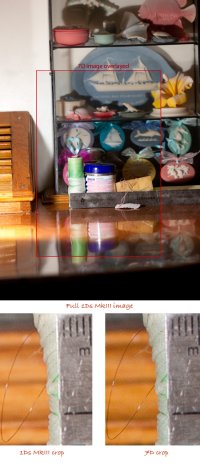
I have posted these images many times before. I post them again because it seems some posters have a genuine interest in the empirical results.

The test; I was interested in a 7D to compliment my 1Ds MkIII for focal length limited situations, internet wisdom was that with my 300 f2.8 I would achieve an effective 40% "reach advantage" using a much higher density crop camera than cropping my lower density ff camera. Both sensors were of a similar generation, actually the 7D (the wildly well received sports and BIF crop camera) is newer so has a slight technological advantage. I made a setup to show the biggest differences you could ever attain, solid tripod with the lens mounted on it, all I dd was swap bodies, Live View manual focus, cable release, remote flash for good contrast, 300 f2.8, optimum aperture, optimum iso (200 which favours the 7D slightly too) etc etc, things I could never use in the circumstances I wanted the 7D for but I wanted to see this 40% more reach.

Image on the left is the ff image, the red rectangle is the full image from the 7D. I then noticed a human hair next to the ruler. The 7D image is reproduced at over 100%, the 1Ds MkIII image was interpolated in PS to give the same pixel numbers as the 7D crop and is well over 200%.


My conclusions have always been that whilst in this perfect situation the 7D does have a slight resolution advantage it is very slight, and, given the extreme conditions I had to go to to see even that small difference I realised the differences in AF, iso, contrast etc would affect real world images to a greater degree than the mythical 40% more reach. I didn't get a 7D because I felt the cropped 1Ds MkIII images were close enough in ideal situations and any differences disappeared in real world shooting situations.


Now I invite you to draw your own conclusions.
 

Attachments

  • 1111.jpg
    1111.jpg
    262.1 KB · Views: 399
Upvote 0