EOS-1D X Mark II Claims of 15 Stops of DR [CR3]

Jack Douglas said:
What really tweaked my understanding was the statement that we're photographing a light source and the lit objects together, so the light levels are many magnitudes apart and DR specs will never resolve the issue.

In many ways that's the crux – when the light source is not in the frame, 11-12 stops of DR are usually more than enough, and when the light source is in the frame, 15-16 stops falls short.
 
Upvote 0
bdunbar79 said:
Sporgon said:
3kramd5 said:
Sporgon said:
What would excite me is a sensor with greater DR at the upper - highlight end. Now that would make a difference, but it will be harder to achieve as you are talking about much much more of a light intensity increase.

Couldn't you do that with larger pixels?

I don't think so because it's a result of light density rather than light volume. If you went with really large pixels the base ISO would end up being higher.

Hmm. Larger pixels are the ONLY way I can think of to do this. How else would you be able to collect more light without blowing highlights? I also don't think it makes sense to say "more DR at the upper end." That is not how DR works.

Larger pixels don't help. Think about putting out a bucket in the rain. Whether it's a huge diameter bucket or a small one, they fill at the same rate.

The way to do this is deeper wells (the analogy being taller buckets). This would result in lower base ISOs. I've heard that ISO 25 base is not out of the range of possibilities for today's technologies.
 
Upvote 0
Lee Jay said:
bdunbar79 said:
Sporgon said:
3kramd5 said:
Sporgon said:
What would excite me is a sensor with greater DR at the upper - highlight end. Now that would make a difference, but it will be harder to achieve as you are talking about much much more of a light intensity increase.

Couldn't you do that with larger pixels?

I don't think so because it's a result of light density rather than light volume. If you went with really large pixels the base ISO would end up being higher.

Hmm. Larger pixels are the ONLY way I can think of to do this. How else would you be able to collect more light without blowing highlights? I also don't think it makes sense to say "more DR at the upper end." That is not how DR works.

Larger pixels don't help. Think about putting out a bucket in the rain. Whether it's a huge diameter bucket or a small one, they fill at the same rate.

The way to do this is deeper wells (the analogy being taller buckets). This would result in lower base ISOs. I've heard that ISO 25 base is not out of the range of possibilities for today's technologies.

Sorry. I didn't mean larger pixels, I really meant a larger FWC.
 
Upvote 0
dilbert said:
When DxO test cameras and say > 14 stops of DR for Nikon, everyone here says "bullsh*t, DxO are stupid/wrong."

When Canon does a press release and says "15 stops of DR", everyone goes "wow, cool."

Back in the threads discussing Nikon/Sony getting more stops of DR than they have bits of image data, I mentioned that they might not have a 1:1 mapping of values - and I got shouted down because of it.

Now people are using the very same argument to say how Canon can do it and everyone is happy about it (except jrista.)

And not only that, people are accepting Canon's "15 stops of DR" statements over testing that actually shows less.

I suspect if Canon said "The Sun will rise in the west tomorrow" lots of people here would go "Cool! Where can I go and see it?"

LOL! A good one, dilbert! :D I'm dying right now.. :D
 
Upvote 0
dilbert said:
I suspect if Canon said "The Sun will rise in the west tomorrow" lots of people here would go "Cool! Where can I go and see it?"
Hasn't it been rising there there the last few days? :o
Oh, wait! I just got back from a nearly month-long Australia trip and still have trouble remembering to drive on the right side of the road.
 
Upvote 0
Jack Douglas said:
scyrene, thanks! Very kind of you to share that. Most of this is probably common sense, but when one is a beginner sometimes common sense is faulty and wrong conclusions are drawn.

What really tweaked my understanding was the statement that we're photographing a light source and the lit objects together, so the light levels are many magnitudes apart and DR specs will never resolve the issue.

Jack

Ah my pleasure. Not common sense so much as a lot of trial and error! It's a great subject, but one of the most frustrating...

And that description is very good, I hadn't thought of it that way. You could experiment by trying to photograph a candle and the room it illuminates without blowing out the flame - similarly tricky!
 
Upvote 0
Rutgerhermelin said:
jrista said:
You can't always expose a scene such that nothing needs to be pushed or pulled. Not when the scene has more dynamic range than the camera. One of the most difficult subjects for me to shoot as a bird photographer are birds with white and black feathers in direct sunlight. Even if I've got the sun behind me, black feathers don't reflect much, and white feathers reflect a ton. The 5D III suffers severely in that case. So did my 7D. I simply don't have enough dynamic range in the camera to get an exposure where I could just leave it be without recovering highlights AND lifting shadows.

There are a lot of birds like this. Loons. A wide range of ducks. Chickadees. Nuthatches. The list goes on and on. Bird photography isn't a situation where you can sit still and bracket. The bird's are there then gone a moment later. You gotta get the shot in a single frame, and to get the best shot, you need to fire off a whole string of single frames to get one with the bird posed right and without any subject blur. The compromise I am forced into these days is to underexpose the dark feathers. I have no other option, because to go the other way would mean permanently clipping the light feathers, and that is completely unrecoverable. Because of the high read noise in Canon cameras, I cannot recover those dark feathers without heavy noise. The 5D III in particular has this very speckled (due to hot pixels from the rather high dark current) and often banded noise as well.

There are many ways to use an increase in dynamic range. I would LOVE to be able to set my exposure 2/3rds to 1 stop underexposed in a well lit exposure, and just leave it there. Bird photography is catching fleeting moments where a bird shows up before it's gone, and short sequences of action. Sometimes the light changes on a dime, and with the limited DR of current Canon cameras, you don't have the option of leaving yourself any headroom to deal with those moments when the sun pops out from behind a passing cloud and the scene brightens by a stop for a couple frames before slipping behind a cloud again. You have to constantly be on the ball, constantly adjusting your exposure for every change in the light. Gets really tedious after a while, and there are always moments when your focused on getting the right moment instead of keeping an eye on the exposure meter...and oops, you just clipped the crap out of those bright white feathers.

Sometime you just can't get that perfectly exposed shot without the need to recover anything, and it's in those moments when having more DR is invaluable.

I have a friend who wrote the same two-years ago and was mocked here at Canon Rumors, nice that some more are open-minded than others regarding DR. tell me why strive Canon now for greater DR if it is completely uninteresting, unnecessary as long Canon doesn't have it ? or is it ?
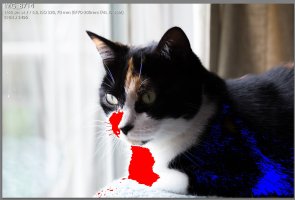
Sometimes all you need is a multi-coloured cat in the sunshine.... some parts overexposed (red), some parts underexposed (blue).... a bit more DR won't solve all problems, but it will certainly help....
 

Attachments

  • clipping.jpg
    clipping.jpg
    215.4 KB · Views: 156
Upvote 0
Lee Jay said:
bdunbar79 said:
Sporgon said:
3kramd5 said:
Sporgon said:
What would excite me is a sensor with greater DR at the upper - highlight end. Now that would make a difference, but it will be harder to achieve as you are talking about much much more of a light intensity increase.

Couldn't you do that with larger pixels?

I don't think so because it's a result of light density rather than light volume. If you went with really large pixels the base ISO would end up being higher.

Hmm. Larger pixels are the ONLY way I can think of to do this. How else would you be able to collect more light without blowing highlights? I also don't think it makes sense to say "more DR at the upper end." That is not how DR works.

Larger pixels don't help. Think about putting out a bucket in the rain. Whether it's a huge diameter bucket or a small one, they fill at the same rate.

The way to do this is deeper wells (the analogy being taller buckets). This would result in lower base ISOs. I've heard that ISO 25 base is not out of the range of possibilities for today's technologies.

Deeper = larger, no? Fair enough, larger in the sensor context generally refers to frontal area. Regardless, I intended to convey pixels with larger capacities. Noise floor is already pretty low relatively speaking. So increase the total amount of light a given pixel can collect, or add buffers to count the number of times each pixel saturates on a given exposure.
 
Upvote 0
heptagon said:
jrista said:
heptagon said:
Jack Douglas said:
I really want better IQ with lower noise in the ISO 2000 to 6400 range.

Not going to happen with current silicon technology using the Bayer pattern because it is physically not possible.

* They have about 50% of quantum efficiency. If that gets increased to a perfect 100% it would be an improvement by 1 step. With silicon this is probably not going to happen.

* Readout noise is not the big problem at high ISO. Little to none to gain here except regarding DR at low ISO.

* What I'm waiting for is stacked photodetectors to replace the Bayer pattern. The green channel would double its pixel count resulting in a 1 step of improvement which could actually be achieved.

* A diversification into more color channels would reduce the noise amplification when decomposing the sensor data into RGB channels. Also it would improve white balance and color rendition.

That's what we can hope for in the next 10, 100, 1000 years: 2 steps and a little something of improvement in high ISO performance.

This is also the reason why Canon greatly improves the digital noise reduction of their JPEG engine. There is much more to gain for people who shoot JPEG.

It's already happened. The A7s did it. The A7s II did it. The D500 did it. Those cameras are already pushing 65% Q.E. Sony's also got sensors on the market (not in DSLRs) that have ove 77% Q.E. The A7s has phenomenal high ISO performance not because it's got higher Q.E. but because it's got bigger pixels...and more importantly, because it switches to a higher gain mode at ISO 2000. In the higher gain mode Sony mapped the input analog signal to the output digital signal differently, which is how they were able to gain back dynamic range at higher ISOs.

We were talking about transfer curves earlier. That is another way that the analog signal could be mapped more effectively into the output bit depth. Instead of using a linear amplifier, a non-linear amplifier (log amplifier or something similar) could be used to amplify darker pixels more and brighter pixels less. Maybe even combine that with something like Sony's high gain mode. That would preserve dynamic range even more, at both low and high ISO. A reversing curve could be stored in the RAW (or simply specified in the specifications for how to decode the given RAW format) allowing the non-linear compression to be reversed by a RAW editor for proper rendering to screen.

There are many ways to improve dynamic range beyond just increasing Q.E. or pixel size. ;)

I interpreted the question not in regards to DR but in regards of SNR instead.

The 18% grey area does not benefit from increased DR.

You won't improve SNR with any technique when it's limited by poisson noise. You need more detected photons and you only get that with more QE, more sensor area, less ISO.

Regarding DR, yes, that is an interesting area to improve upon.

Depends on what ISO we are talking about. :P An 18% gay at ISO 6400 is more like a shadow at ISO 100 than anything. An 18% gray at ISO 6400 is still going to be affected by read noise. Not a lot, but it will still be affected by it.

Increasing Q.E. will help as well, but at the moment the best high ISO performers are already at 60-65% Q.E. There isn't much headroom left, and I don't know of any consumer grade sensors that top 90% Q.E....and what few sensors do cost immense sums of money in most cases. (I don't know of any sensor that has over 100% Q.E....theoretically it's possible, where a single photon strike releases more than one electron...however I don't think that is possible with visible spectrum photons...they just don't have enough energy.) So Q.E. is not where we are going to get the most gains.

We could move to multi-layer photodiodes. That's been patented, a good deal...but there are a lot of inherent problems with it that make the gains too small for the cost, so it hasn't hit the main stream yet. Maybe in the future, assuming the problems can be overcome.

I wouldn't say that LESS ISO is actually really the best option. Higher ISO actually makes far more efficient use of each and every electron in the photodiode, low ISO is actually more wasteful. The reason we have more DR at lower ISO is just because of the linear and limited nature of the output buffers for the amplified signals. If the buffer is limited to the ISO 100 capacity, 65ke-, then every time you increase ISO you lose about half that in terms of pixel capacity. If you amplify the pixel signal by a factor of two, then you could only amplify a 32.5ke- signal before the output buffer saturated. However...what if the output buffer was larger? What if it was 130ke-? What if it was 260ke-? At that point, we could amplify signals at every higher ISO's more (i.e. use higher gain, like the Sony A7s), without clipping the output signal...and gain dynamic range. That wouldn't help much for short exposures, but if you had the option of using longer exposures (that would normally clip at a higher ISO), then you could have more dynamic range at high ISO without needing bigger pixels or higher Q.E.

Anyway...there are a lot of options out there. It's just a matter of figuring out which ones are most viable. There are some amazing patents for amazing sensor technology out there from just the last couple years that have radically increased the sensitivity of sensors in unconventional ways. The thing is, most of them now require fairly advanced fabrication processes, some even require down to 65nm, which is WELL beyond what Canon is capable of (which as far as I know is limited to 180nm at best, and 500nm for most of their DSLR sensors.)
 
Upvote 0
scyrene said:
jrista said:
Canon users are used to having to keep shadows very dark (and personally I would say unnaturally dark in many cases), because to do otherwise means dealing with more noise.

I don't disagree with most of what you say, but this statement strikes me as odd. It's certainly not my experience (and while one person's experience is merely anecdote, it's no worse than 'lots of unspecified people think/do XYZ'. Partly, it comes back to - could you tell, given a series of finished images, what brand of camera was used to create each one? If you're right, it should be obvious. But it's not - I spend a lot of time looking at images made by all manner of equipment, and hardly ever can you tell what was used except in the broadest terms (obviously we'd all welcome equipment that makes things easier - and more DR, lower noise, etc. would mean less intensive processing etc.) But also, technique like ETTR* (which I appreciate is more a Canon thing nowadays) means the shadow worries are just not the case the way you mean - you're pulling the exposure down, so the shadows aren't especially compromised. It's not perfect, but I just don't think Canon shots have 'unnaturally dark' shadows, nor do I approach exposure or editing with trepidation towards darker areas - does anyone else?

*You talk about black and white birds later in the thread. I shoot birds more than any other subject, and certainly black and white ones are a challenge (in direct sunlight). But I don't feel like it's the massive problem you make out - I can only conclude you want images with brighter shadows than I do (a legitimate difference of taste). You can ETTR a fair bit before the highlights are truly blown. Much more and the shadows would look weird imho.

1txtAni.jpg


I guess it is best to demonstrate. This is a shot that I grabbed before noticing that the sun had popped out from behind a cloud. If you've ever photographed buffleheads...when they are bathing or eating, you usually only have a few seconds from the time they bob up to the surface, look around for a second, then dive again. The sun popped out for about 5 seconds, then was behind a cloud again. In that moment, the bird had already popped up and I had pressed the shutter button. Not much I could do. The moment was gone. It was overexposed, not a ton, but enough to clip some of the white highlights. It overexposed because I was already ETTRed to try and get more detail in the darker feathers. Despite that...the shadows still ended up unnaturally dark. What I saw with my own eyes did not look like this...I could still see color in the area back underside of the bird's iridescent feathers on it's head.

To me, the extreme darkness of those shadows (and they run right down to the left edge of the histogram, which represents pure black) is unnatural. I've shared this image on these forums in the past, and the responses I got were along the lines of "Well shadows are supposed to be dark!" Well, sure...but how dark? Black dark? Totally devoid of detail dark? That was a "shadow" in real life...but it wasn't black. I could still see color and detail in that region of the bird. It was a shadow in real life...it just didn't have that much global contrast. I see the shadow as unnatural, other Canon users on these forums in the past did not.

Furthermore, this photo WAS ETTRed, and it was because I had it ETTRed for a slightly lower light level that the highlights clipped in the short moment that the sun came out. It's not just the highlights that were affected, though...all of those beautiful iridescent feathers on the bird's head were brightened and washed out as well. With careful processing a better contrast can be restored, and color saturation can be restored, but it still doesn't look quite as amazing as those feathers do in real life. They look a bit over-processed...slightly unnatural. ETTR is a risky and less than ideal NECESSITY because of the more limited DR in Canon cameras. I'd have much preferred to not ETTR, and maybe even ETTL a bit, so those iridescent feathers drifted back towards the upper midtones, where they would naturally have the greatest color saturation and would preserve their natural contrast without washing out like they did here.

Anyway. I don't see landscapes or astrophotography as the only reason to NEED more dynamic range. I could have totally used a couple extra stops on this image right here with this bird photograph.
 
Upvote 0
jhpeterson said:
dilbert said:
I suspect if Canon said "The Sun will rise in the west tomorrow" lots of people here would go "Cool! Where can I go and see it?"
Hasn't it been rising there there the last few days? :o
Oh, wait! I just got back from a nearly month-long Australia trip and still have trouble remembering to drive on the right side of the road.
Hope you enjoyed your time in straylia
 
Upvote 0
Jon, I think your case is well illustrated here and I agree that the shadows would have contained more color detail, having shot these guys a few times myself.

In these discussions there will always be folk who are not as focused on perfection. As a youth I could never understand how my mother could complement the music emanating from a 3" speaker but that's not unlike looking at a person with many faults and still praising them.

Sometimes we need to mentally fill in the last bit of perfection that was missing in the photo and be satisfied or even thrilled that we are getting such gems. Trouble is you and I somehow caught the perfection bug in our formative years.

Jack
 
Upvote 0
jrista said:
So they ARE using a compression curve to achieve it. Well, that is less than ideal. Sounds much the same as Sony using craw to preserve dynamic range with their lossy raw compression. Bummer. Definitely not good for Astro...we need linear signals. Might be fine for landscapes though.

For for video they often do since it's often cooked files into 8-10bits so there is no other way.
 
Upvote 0
neuroanatomist said:
Lee Jay said:
heptagon said:
An image which is exposed "correctly" such that nothing has to be pushed or pulled does not need high DR. Do you know any display device that can display more than 10 stops of DR?

All of them, including prints.

It's not hard to tone map 25 stops of DR into a 6 stop capable display system. If you go to the Hubble Site, you'll see a lot of that sort of thing going on. Many of those images (but not all) have absolutely huge DR, all mapped into an 8-bit JPEG.

That doesn't answer the question.

I'm not quite sure the spec but I think Dolby Cinema Laser projectors can display at least 14 stops of DR (I see some claims of 21, but that might be the goal for the next version). LG and a few others have just released the first HDR displays. Hard to get exact specs but I think they are maybe 10-14 stop range.

As I've been saying for some time, UHD, ultra wide gamut and HDR displays will soon be sold all over the place and close to standard in another two years.
 
Upvote 0
I share Jon's views. I have the same experience with birds, where the white is blown and black is texture free black, with noise (debated to death in a previous thread). I also share his point about shadow noise. Quite a few posters on CR claim that all this shadow lifting makes images look unnatural and several examples have been posted to prove that point. When you lift it as much as some of these examples show, you have to be blind to disagree. I do not wish to lift shadows nearly that much, but I’d like the shadows to have structure and texture, which requires DR and/or better controlled noise. Because that looks natural. Jon’s example of feathers is a good one. When you look at a black and white bird through your binoculars, you can see that it is dressed in feathers, it is not painted black and white.

I also find noise and DR to be less of a problem with landscapes. Firstly because I have the time to make sure exposure is dead on and secondly, if the contrast is bad enough, I can use HDR. Birds and wildlife in shifting light conditions is a totally different ball game.
 
Upvote 0
LetTheRightLensIn said:
I'm not quite sure the spec but I think Dolby Cinema Laser projectors can display at least 14 stops of DR (I see some claims of 21, but that might be the goal for the next version). LG and a few others have just released the first HDR displays. Hard to get exact specs but I think they are maybe 10-14 stop range.

As I've been saying for some time, UHD, ultra wide gamut and HDR displays will soon be sold all over the place and close to standard in another two years.


Are we talking about a) static or b) dynamic dynamic range?

a) Where each pixel on the same image has the whole dynamic range.

b) Where they dim the light source (or parts of it) to increase the dynamic range between images or between distant parts of the image.


Using OLED or laser displays in a dark room sound promising to me.
 
Upvote 0
For those that show pictures of iridescent black and white subject where the software is showing both highlight and lowlight to be lost; prepare for disappointment in the increased DR. For a given exposure you are getting no more highlight range, so, to preserve the highlight with your new higher DR camera you under expose to hold the highlights. But even with your previous longer exposure you had lost all shadow data, so by under exposing to preserve highlights with a camera that doesn't actually have any more highlight range you use up your extra DR range in the shadows anyway, and you end up trying to lift zero data.

The extra DR does have occasional advantages in a very narrow EV band, but this example isn't one of them.
 
Upvote 0
Sporgon said:
For those that show pictures of iridescent black and white subject where the software is showing both highlight and lowlight to be lost; prepare for disappointment in the increased DR. For a given exposure you are getting no more highlight range, so, to preserve the highlight with your new higher DR camera you under expose to hold the highlights. But even with your previous longer exposure you had lost all shadow data, so by under exposing to preserve highlights with a camera that doesn't actually have any more highlight range you use up your extra DR range in the shadows anyway, and you end up trying to lift zero data.

The extra DR does have occasional advantages in a very narrow EV band, but this example isn't one of them.

There is no such thing as "highlight DR", nor is there "shadow DR"...there is simply DR. You either have more dynamic range or not. Dynamic range is by definition the ratio of the full well capacity to the read noise floor. This is something I hear a lot from Canon users, and it's just a misconception, a misnomer. Dynamic range represents the entire range of tones the camera can discern, without segregation.

In practice, with a camera that has nearly 14 stops of DR, you can indeed back off exposure a bit to preserve highlights, and still have plenty of room left to recover detail out of the shadows, and with significantly less noise than a camera that has 11 or even 12 stops of DR. The shadows won't be totally noise-free, but they don't need to be. They just need to have low enough noise to support an acceptable shadow push to reveal the right amount of detail in them.
 
Upvote 0