EOS-1D X Mark II Claims of 15 Stops of DR [CR3]

Eldar said:
I share Jon's views. I have the same experience with birds, where the white is blown and black is texture free black, with noise (debated to death in a previous thread). I also share his point about shadow noise. Quite a few posters on CR claim that all this shadow lifting makes images look unnatural and several examples have been posted to prove that point. When you lift it as much as some of these examples show, you have to be blind to disagree. I do not wish to lift shadows nearly that much, but I’d like the shadows to have structure and texture, which requires DR and/or better controlled noise. Because that looks natural. Jon’s example of feathers is a good one. When you look at a black and white bird through your binoculars, you can see that it is dressed in feathers, it is not painted black and white.

I also find noise and DR to be less of a problem with landscapes. Firstly because I have the time to make sure exposure is dead on and secondly, if the contrast is bad enough, I can use HDR. Birds and wildlife in shifting light conditions is a totally different ball game.
+1000000000 :)
 
Upvote 0
jrista said:
Sporgon said:
For those that show pictures of iridescent black and white subject where the software is showing both highlight and lowlight to be lost; prepare for disappointment in the increased DR. For a given exposure you are getting no more highlight range, so, to preserve the highlight with your new higher DR camera you under expose to hold the highlights. But even with your previous longer exposure you had lost all shadow data, so by under exposing to preserve highlights with a camera that doesn't actually have any more highlight range you use up your extra DR range in the shadows anyway, and you end up trying to lift zero data.

The extra DR does have occasional advantages in a very narrow EV band, but this example isn't one of them.

There is no such thing as "highlight DR", nor is there "shadow DR"...there is simply DR. You either have more dynamic range or not. Dynamic range is by definition the ratio of the full well capacity to the read noise floor. This is something I hear a lot from Canon users, and it's just a misconception, a misnomer. Dynamic range represents the entire range of tones the camera can discern, without segregation.

In practice, with a camera that has nearly 14 stops of DR, you can indeed back off exposure a bit to preserve highlights, and still have plenty of room left to recover detail out of the shadows, and with significantly less noise than a camera that has 11 or even 12 stops of DR. The shadows won't be totally noise-free, but they don't need to be. They just need to have low enough noise to support an acceptable shadow push to reveal the right amount of detail in them.

Then would the read noise floor, the weaker part of Canon's sensor, govern the shadow lifting ability? Is that where the noise originates in the shadows?
 
Upvote 0
bdunbar79 said:
jrista said:
Sporgon said:
For those that show pictures of iridescent black and white subject where the software is showing both highlight and lowlight to be lost; prepare for disappointment in the increased DR. For a given exposure you are getting no more highlight range, so, to preserve the highlight with your new higher DR camera you under expose to hold the highlights. But even with your previous longer exposure you had lost all shadow data, so by under exposing to preserve highlights with a camera that doesn't actually have any more highlight range you use up your extra DR range in the shadows anyway, and you end up trying to lift zero data.

The extra DR does have occasional advantages in a very narrow EV band, but this example isn't one of them.

There is no such thing as "highlight DR", nor is there "shadow DR"...there is simply DR. You either have more dynamic range or not. Dynamic range is by definition the ratio of the full well capacity to the read noise floor. This is something I hear a lot from Canon users, and it's just a misconception, a misnomer. Dynamic range represents the entire range of tones the camera can discern, without segregation.

In practice, with a camera that has nearly 14 stops of DR, you can indeed back off exposure a bit to preserve highlights, and still have plenty of room left to recover detail out of the shadows, and with significantly less noise than a camera that has 11 or even 12 stops of DR. The shadows won't be totally noise-free, but they don't need to be. They just need to have low enough noise to support an acceptable shadow push to reveal the right amount of detail in them.

Then would the read noise floor, the weaker part of Canon's sensor, govern the shadow lifting ability? Is that where the noise originates in the shadows?

Noise doesn't originate in the shadows, noise is everywhere. Signal, however, is low relative to noise in the shadows.

So yes, the noise level governs how far you can lift the shadows. However, many sensors it seems are nearing diminishing return with respect to read noise.

But imagine if you could keep exposing twice as long without blowing out highlights (assume some magical doubling of full well capacity and no associated increase in the noise floor). You would in turn double the signal in the shadow range.
 
Upvote 0
3kramd5 said:
bdunbar79 said:
jrista said:
Sporgon said:
For those that show pictures of iridescent black and white subject where the software is showing both highlight and lowlight to be lost; prepare for disappointment in the increased DR. For a given exposure you are getting no more highlight range, so, to preserve the highlight with your new higher DR camera you under expose to hold the highlights. But even with your previous longer exposure you had lost all shadow data, so by under exposing to preserve highlights with a camera that doesn't actually have any more highlight range you use up your extra DR range in the shadows anyway, and you end up trying to lift zero data.

The extra DR does have occasional advantages in a very narrow EV band, but this example isn't one of them.

There is no such thing as "highlight DR", nor is there "shadow DR"...there is simply DR. You either have more dynamic range or not. Dynamic range is by definition the ratio of the full well capacity to the read noise floor. This is something I hear a lot from Canon users, and it's just a misconception, a misnomer. Dynamic range represents the entire range of tones the camera can discern, without segregation.

In practice, with a camera that has nearly 14 stops of DR, you can indeed back off exposure a bit to preserve highlights, and still have plenty of room left to recover detail out of the shadows, and with significantly less noise than a camera that has 11 or even 12 stops of DR. The shadows won't be totally noise-free, but they don't need to be. They just need to have low enough noise to support an acceptable shadow push to reveal the right amount of detail in them.

Then would the read noise floor, the weaker part of Canon's sensor, govern the shadow lifting ability? Is that where the noise originates in the shadows?

Noise doesn't originate in the shadows. Rather, signals are low enough in the shadows that noise dominates, thus you can see it.

Right. So, again, does that come from read noise? I'm talking about shadow lifting and apparent noise. Yes I realize that the noise is always present but I'm also keeping in mind that we are viewing photos. If read noise were to improve, would that then translate to more latitude in the shadows? Or not? Because there are some sensors with large pixels that also have lower read noise than Canon sensors, even with large pixels.
 
Upvote 0
bdunbar79 said:
Right. So, again, does that come from read noise? I'm talking about shadow lifting and apparent noise. Yes I realize that the noise is always present but I'm also keeping in mind that we are viewing photos. If read noise were to improve, would that then translate to more latitude in the shadows? Or not? Because there are some sensors with large pixels that also have lower read noise than Canon sensors, even with large pixels.

It comes from total noise, but yes: if you reduce noise, all else being equal, you have a corresponding higher signal to noise ratio, and therefore more latitude in the shadows. My question is: how much room is there to improve in noise (sensors in general, not just Canon's), versus the potentially limitless growth in well capacity?
 
Upvote 0
jrista said:
Sporgon said:
For those that show pictures of iridescent black and white subject where the software is showing both highlight and lowlight to be lost; prepare for disappointment in the increased DR. For a given exposure you are getting no more highlight range, so, to preserve the highlight with your new higher DR camera you under expose to hold the highlights. But even with your previous longer exposure you had lost all shadow data, so by under exposing to preserve highlights with a camera that doesn't actually have any more highlight range you use up your extra DR range in the shadows anyway, and you end up trying to lift zero data.

The extra DR does have occasional advantages in a very narrow EV band, but this example isn't one of them.

There is no such thing as "highlight DR", nor is there "shadow DR"...there is simply DR. You either have more dynamic range or not. Dynamic range is by definition the ratio of the full well capacity to the read noise floor. This is something I hear a lot from Canon users, and it's just a misconception, a misnomer. Dynamic range represents the entire range of tones the camera can discern, without segregation.

In practice, with a camera that has nearly 14 stops of DR, you can indeed back off exposure a bit to preserve highlights, and still have plenty of room left to recover detail out of the shadows, and with significantly less noise than a camera that has 11 or even 12 stops of DR. The shadows won't be totally noise-free, but they don't need to be. They just need to have low enough noise to support an acceptable shadow push to reveal the right amount of detail in them.

You know exactly what I mean: ability to record a greater light density within the overall EV range of the camera.

The current greater DR cameras cannot do this so to preserve highlights you have to use a faster exposure - relatively - and then use the greater shadow recovery. Then what I described above is exactly what happens in this situation. I know. I bought an Exmor censored camera with a purported 14.5 stops of DR at 100 ISO, and in the intense back and white scenario that I describe above it is of little benefit - precisely because it clips the highlights at the same exposure as the older Canon camera.

This is my whole argument with those that hype up the odd stop or two of dynamic range; they speak as if it is able to record a higher light density and it can't.
 
Upvote 0
3kramd5 said:
Noise doesn't originate in the shadows, noise is everywhere. Signal, however, is low relative to noise in the shadows.

So yes, the noise level governs how far you can lift the shadows. However, many sensors it seems are nearing diminishing return with respect to read noise.

But imagine if you could keep exposing twice as long without blowing out highlights (assume some magical doubling of full well capacity and no associated increase in the noise floor). You would in turn double the signal in the shadow range.

Your statement just game me an idea.

Normally you start with an empty bucket (at the photosite) and you fill it with electrons as photons strike the photosite.
Canon has the dual pixel photosite now, so maybe half can operate as normal and the other half could start being full and as photons strike it electrons are removed from the bucket.
Since the noise is the problem when the bucket is mostly empty, this should increase SNR. At the end of the exposure the second backup is inverted and compared to the first bucket. Either the bigger ones wins or maybe both are added together. Or the difference is taken to remove the noise.

Is this even a possibility?
 
Upvote 0
3kramd5 said:
bdunbar79 said:
Right. So, again, does that come from read noise? I'm talking about shadow lifting and apparent noise. Yes I realize that the noise is always present but I'm also keeping in mind that we are viewing photos. If read noise were to improve, would that then translate to more latitude in the shadows? Or not? Because there are some sensors with large pixels that also have lower read noise than Canon sensors, even with large pixels.

It comes from total noise, but yes: if you reduce noise, all else being equal, you have a corresponding higher signal to noise ratio, and therefore more latitude in the shadows. My question is: how much room is there to improve in noise (sensors in general, not just Canon's), versus the potentially limitless growth in well capacity?

Yeah, good point. I don't know. You could increase QE several different ways and USE more of the photons captured. Or, like others said, a completely different non-Bayer design.
 
Upvote 0
3kramd5 said:
bdunbar79 said:
Right. So, again, does that come from read noise? I'm talking about shadow lifting and apparent noise. Yes I realize that the noise is always present but I'm also keeping in mind that we are viewing photos. If read noise were to improve, would that then translate to more latitude in the shadows? Or not? Because there are some sensors with large pixels that also have lower read noise than Canon sensors, even with large pixels.

It comes from total noise, but yes: if you reduce noise, all else being equal, you have a corresponding higher signal to noise ratio, and therefore more latitude in the shadows. My question is: how much room is there to improve in noise (sensors in general, not just Canon's), versus the potentially limitless growth in well capacity?
I think there is still a lot of room to decrease sensor noise based on using smaller manufacturing technologies (currenly 14nm processes are being used for building processors chips), 3d technologies for active elements and sensor layers , copper or better conductors, BSI with cooling layer at circuits layer side etc. So reducing dark currents, having individual ADC per each pixel thus reducing signal path and as result almost eliminating read noise. There are number of things available now for implementation, some of them being used in sCMOS.
This all would result in better DR and less noise in shadows for sitiations with good light.

For low light photography there still will be limiting factor which is shot noise - smaller number of captured photons will results in lower SNR which would be close to SQRT(Number of photons).
The only one way here for improvements is to increase number of captured photons.
Bayer sensor design itself is limiting factor here. It captures only 25% of photons for blue and red channels and 50% for green channel. So Foveon like type sensor is the way to go here (or one with microprizms using Panasonic patent) - both ensure that 100% photons captured for each color channel.
This could give about 2 stops improvdments in light capturing capabilities.
Another way is using true MF sensors - like latest Sony 100mpx one used by Phase One which is already available now but too much expensive so far.
In some time MF will be be the same as FF currently when MF sensor production cost will be much lower.
Than at some time later MF Foveon like type sensor - resulting in 3 stops better low light performance than current FF sensors.
Then using controlled photon multiplication elements/layers in lenses or on sensors which would allow more than 100% QE.
Also using other than silicon materials for semiconductors.
All depends on technologies evolution and ability to implement them at affordable cost using better manufacturing prosesses.

 
Upvote 0
Neutral said:
3kramd5 said:
bdunbar79 said:
Right. So, again, does that come from read noise? I'm talking about shadow lifting and apparent noise. Yes I realize that the noise is always present but I'm also keeping in mind that we are viewing photos. If read noise were to improve, would that then translate to more latitude in the shadows? Or not? Because there are some sensors with large pixels that also have lower read noise than Canon sensors, even with large pixels.

It comes from total noise, but yes: if you reduce noise, all else being equal, you have a corresponding higher signal to noise ratio, and therefore more latitude in the shadows. My question is: how much room is there to improve in noise (sensors in general, not just Canon's), versus the potentially limitless growth in well capacity?
I think there is still a lot of room to decrease sensor noise based on using smaller manufacturing technologies (currenly 14nm processes are being used for building processors chips), 3d technologies for active elements and sensor layers , copper or better conductors, BSI with cooling layer at circuits layer side etc. So reducing dark currents, having individual ADC per each pixel thus reducing signal path and as result almost eliminating read noise. There are number of things available now for implementation, some of them being used in sCMOS.
This all would result in better DR and less noise in shadows for sitiations with good light.

For low light photography there still will be limiting factor which is shot noise - smaller number of captured photons will results in lower SNR which would be close to SQRT(Number of photons).
The only one way here for improvements is to increase number of captured photons.
Bayer sensor design itself is limiting factor here. It captures only 25% of photons for blue and red channels and 50% for green channel. So Foveon like type sensor is the way to go here (or one with microprizms using Panasonic patent) - both ensure that 100% photons captured for each color channel.
This could give about 2 stops improvdments in light capturing capabilities.
Another way is using true MF sensors - like latest Sony 100mpx one used by Phase One which is already available now but too much expensive so far.
In some time MF will be be the same as FF currently when MF sensor production cost will be much lower.
Than at some time later MF Foveon like type sensor - resulting in 3 stops better low light performance than current FF sensors.
Then using controlled photon multiplication elements/layers in lenses or on sensors which would allow more than 100% QE.
Also using other than silicon materials for semiconductors.
All depends on technologies evolution and ability to implement them at affordable cost using better manufacturing prosesses.
Also post prosessing could do a lot.
From my experience I believe that DXO PRIME noise reduction cope very well with shot noise described by Poisson distribution.
 
Upvote 0
Lee Jay said:
fentiger said:
if i want to see detail in the shadows i use a flash gun :-)

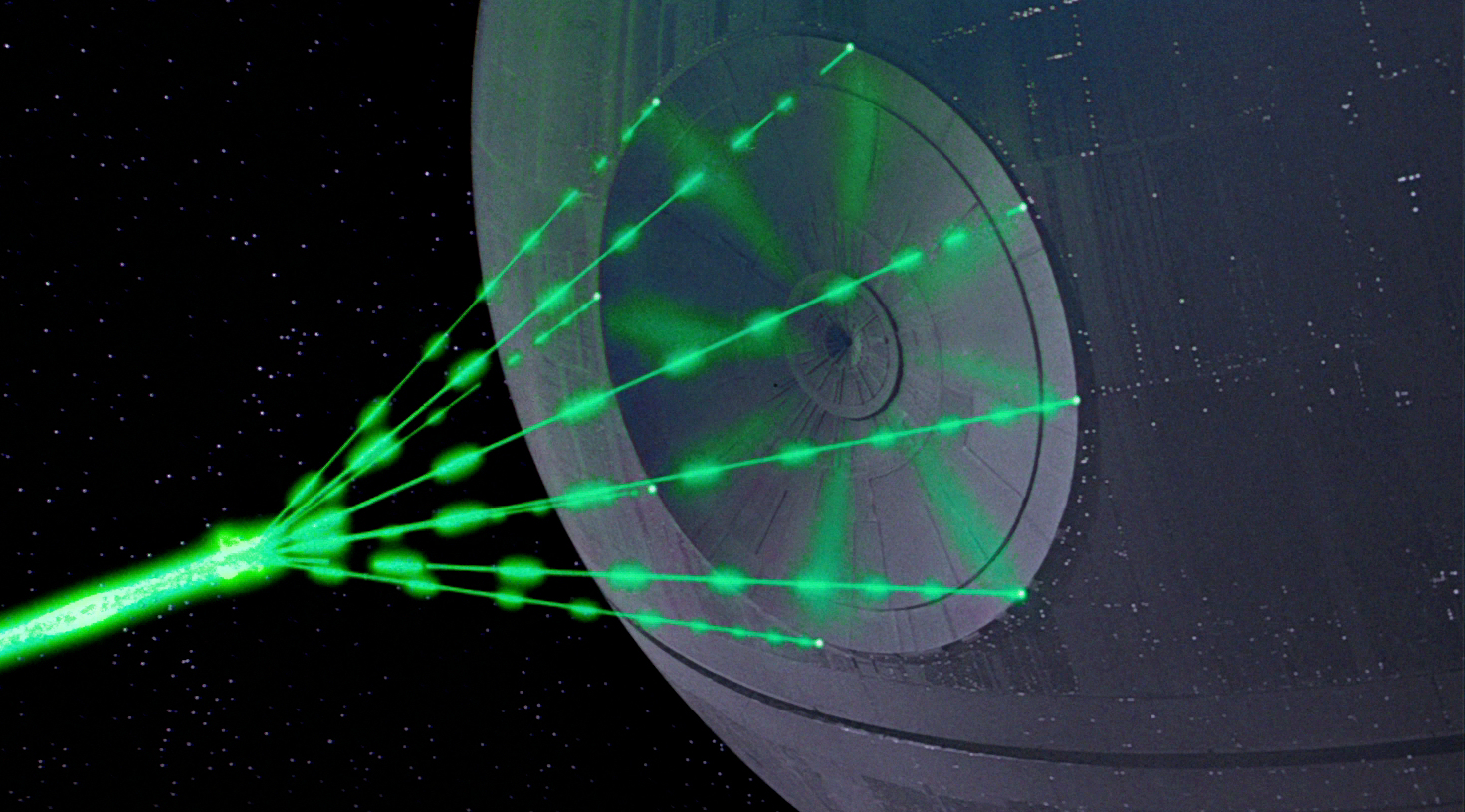
Sound's good. What model do I need to illuminate the dark side of the moon?

Superlaser2.jpg
 
Upvote 0
bdunbar79 said:
jrista said:
Sporgon said:
For those that show pictures of iridescent black and white subject where the software is showing both highlight and lowlight to be lost; prepare for disappointment in the increased DR. For a given exposure you are getting no more highlight range, so, to preserve the highlight with your new higher DR camera you under expose to hold the highlights. But even with your previous longer exposure you had lost all shadow data, so by under exposing to preserve highlights with a camera that doesn't actually have any more highlight range you use up your extra DR range in the shadows anyway, and you end up trying to lift zero data.

The extra DR does have occasional advantages in a very narrow EV band, but this example isn't one of them.

There is no such thing as "highlight DR", nor is there "shadow DR"...there is simply DR. You either have more dynamic range or not. Dynamic range is by definition the ratio of the full well capacity to the read noise floor. This is something I hear a lot from Canon users, and it's just a misconception, a misnomer. Dynamic range represents the entire range of tones the camera can discern, without segregation.

In practice, with a camera that has nearly 14 stops of DR, you can indeed back off exposure a bit to preserve highlights, and still have plenty of room left to recover detail out of the shadows, and with significantly less noise than a camera that has 11 or even 12 stops of DR. The shadows won't be totally noise-free, but they don't need to be. They just need to have low enough noise to support an acceptable shadow push to reveal the right amount of detail in them.

Then would the read noise floor, the weaker part of Canon's sensor, govern the shadow lifting ability? Is that where the noise originates in the shadows?

The way I see it is this. If your working with a scene, or a subject, that has more dynamic range than your camera, then you have options. Risk clipping the highlights with ETTR, to preserve as much as you can in the shadows, or preserve the highlights and lose more detail and color fidelity to shadow noise. The dynamic range is just a range...how you use it is up to you. You can use that range to preserve the highlights or to preserve the shadows. With more limited dynamic range (i.e. 11 stops) you are going to have to make compromises more often, with greater dynamic range (i.e. 13.8 stops or even 15 stops) you are going to have more leeway to move the signal around within the dynamic range, and the ability to preserve more detail...at either or both ends of the tonal range.

This can happen with any camera, because until we get to the point where cameras have like 20 stops of DR, there are always going to be scenes with higher DR. The difference is how much the noise affects your shadows if you end up choosing to preserve the highlights.

The difference with a camera that has 2-3 stops more DR is that when you pull back exposure a bit to preserve the highlights, you have far less noise to eat away at those darker details, making them much more recoverable before the post-push noise levels of the shadows increase to the point where they are unsightly.

I really hope Canon delivers 15 stops of DR. Even if it isn't literal DR a 16-bit RAW, if they find a way to use a non-linear compression curve to preserve more shadow detail in the data that is ultimately stored in a 14-bit RAW, I still think that would be much better than just leaving those extra...what, it would be nearly four stops of DR if we compare to the 5D III's 10.97 stops, buried in the noise. I think that would be a huge step forward, and I'd take it in a heartbeat. ;P I would still prefer true 16-bit RAW with the full precision if it was an option, but I'll take any interim step Canon can give me.
 
Upvote 0
How much of the bit depth is taken up by DR that is measurable but not useful? I really doubt some of the 14 stop sensors that DXO measures really offer that much usable latitude.

Couldn't Canon just clip off the bottom end where most of the noise is stored and create 14 bit files with the effective usefulness of measured 15 stops? The files would measure around 14 stops like other cameras but the usable DR is a stop of two greater?

Sony cameras do not do true 14 bit files, do they? Yet they still kill the Canon cameras at low ISO for exposure latitude.

Just some thoughts from someone who knows far less than everyone else in this thread about sensor tech. :)
 
Upvote 0
jrista said:
bdunbar79 said:
jrista said:
Sporgon said:
For those that show pictures of iridescent black and white subject where the software is showing both highlight and lowlight to be lost; prepare for disappointment in the increased DR. For a given exposure you are getting no more highlight range, so, to preserve the highlight with your new higher DR camera you under expose to hold the highlights. But even with your previous longer exposure you had lost all shadow data, so by under exposing to preserve highlights with a camera that doesn't actually have any more highlight range you use up your extra DR range in the shadows anyway, and you end up trying to lift zero data.

The extra DR does have occasional advantages in a very narrow EV band, but this example isn't one of them.

There is no such thing as "highlight DR", nor is there "shadow DR"...there is simply DR. You either have more dynamic range or not. Dynamic range is by definition the ratio of the full well capacity to the read noise floor. This is something I hear a lot from Canon users, and it's just a misconception, a misnomer. Dynamic range represents the entire range of tones the camera can discern, without segregation.

In practice, with a camera that has nearly 14 stops of DR, you can indeed back off exposure a bit to preserve highlights, and still have plenty of room left to recover detail out of the shadows, and with significantly less noise than a camera that has 11 or even 12 stops of DR. The shadows won't be totally noise-free, but they don't need to be. They just need to have low enough noise to support an acceptable shadow push to reveal the right amount of detail in them.

Then would the read noise floor, the weaker part of Canon's sensor, govern the shadow lifting ability? Is that where the noise originates in the shadows?

The way I see it is this. If your working with a scene, or a subject, that has more dynamic range than your camera, then you have options. Risk clipping the highlights with ETTR, to preserve as much as you can in the shadows, or preserve the highlights and lose more detail and color fidelity to shadow noise. The dynamic range is just a range...how you use it is up to you. You can use that range to preserve the highlights or to preserve the shadows. With more limited dynamic range (i.e. 11 stops) you are going to have to make compromises more often, with greater dynamic range (i.e. 13.8 stops or even 15 stops) you are going to have more leeway to move the signal around within the dynamic range, and the ability to preserve more detail...at either or both ends of the tonal range.

This can happen with any camera, because until we get to the point where cameras have like 20 stops of DR, there are always going to be scenes with higher DR. The difference is how much the noise affects your shadows if you end up choosing to preserve the highlights.

The difference with a camera that has 2-3 stops more DR is that when you pull back exposure a bit to preserve the highlights, you have far less noise to eat away at those darker details, making them much more recoverable before the post-push noise levels of the shadows increase to the point where they are unsightly.

I really hope Canon delivers 15 stops of DR. Even if it isn't literal DR a 16-bit RAW, if they find a way to use a non-linear compression curve to preserve more shadow detail in the data that is ultimately stored in a 14-bit RAW, I still think that would be much better than just leaving those extra...what, it would be nearly four stops of DR if we compare to the 5D III's 10.97 stops, buried in the noise. I think that would be a huge step forward, and I'd take it in a heartbeat. ;P I would still prefer true 16-bit RAW with the full precision if it was an option, but I'll take any interim step Canon can give me.
Speaking from a cinematography point of view where we get 14 stops of DR from the Alexa preserving highlights is far more important because clipped highlights are simply unrecoverable in any shape. Getting noise and even muted color from shadow is not too disimilar to the human eye which sees less than modern CMOS sensors can anyway. Different artificial light sources such as street lighting also change the look of colors dark reds for instance can first appear brown until we adjust to what were looking at.
In Astro photography I can see your desire to preserve both ends of the spectrum but in general photography we also need to preserve a sense of realism and the fact is the human eye can adjust for 20 stops of DR but not see 20 stops of DR at any one time.
14 Stop cameras still need to use filters to balance exposure and so would 15 stop, certainly not to the same level as a 12 stop camera but its not uncommon to be using filters for a three to four stop difference and generally this is to reduce overexposure of highlights.
 
Upvote 0
heptagon said:
LetTheRightLensIn said:
I'm not quite sure the spec but I think Dolby Cinema Laser projectors can display at least 14 stops of DR (I see some claims of 21, but that might be the goal for the next version). LG and a few others have just released the first HDR displays. Hard to get exact specs but I think they are maybe 10-14 stop range.

As I've been saying for some time, UHD, ultra wide gamut and HDR displays will soon be sold all over the place and close to standard in another two years.


Are we talking about a) static or b) dynamic dynamic range?

a) Where each pixel on the same image has the whole dynamic range.

b) Where they dim the light source (or parts of it) to increase the dynamic range between images or between distant parts of the image.


Using OLED or laser displays in a dark room sound promising to me.

static
 
Upvote 0