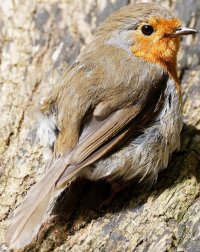
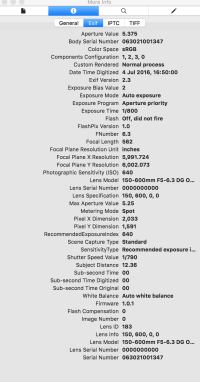
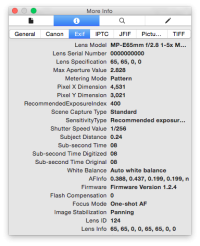
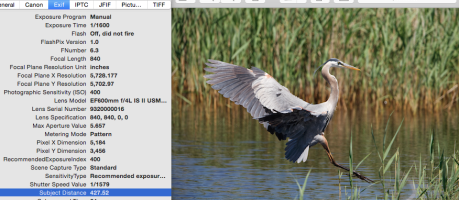
picturefan said:
It seems you don`t like beans - respectively bean-bags. Disagree here, very often a good technique

The problem isn't the bean bag per se – it's the bean bag + 1/20 s exposure + living subject + expectation of a tack sharp shot.
picturefan said:
For me the problem with wildlife shooting and same time the solution is cropping, as animal distance in Europe often is very far. I can imagine that many wildlife/birders are finding themselves in the situation that the object distance is much further than the heron. So on a budget you go for 7DII and high-quality telezoom.
There are three possible solutions:
[list type=decimal]
[*]Move closer
[*]Get a longer lens
[*]Accept that there are shots you simply will not be able to get
[/list]
#1 is mainly about fieldcraft, which can be learned and practiced.
#2 is somewhat about money, unfortunately. In the Canon world, there's a threshold at APS-C + 400mm (or 560mm with the f/8 AF on the 7DII and 80D, but limited to center point selection only). Going longer requires a substantial investment. The Sigma/Tamron 150-600mm zooms are an option, although there's probably little difference between those at the long end and cropping a shot with the Canon 100-400 II, due to the better optical performance of the latter.
#3 is free, at least.
Another consideration is APS-C vs. FF. On a budget, there's generally only one choice. But a FF sensor allows use of a higher ISO, which allows one to shoot in lower light while keeping a fast enough shutter speed. FF sensors also maintain IQ better with more cropping than APS-C (because relative to an equal outout size, the APS-C is already cropped by 1.6x relative to FF). But again, to get good AF along with that FF sensor means higher cost.
Post processing is also very important, using a RAW converter with good NR (I use DxO Optics Pro), and appropriate sharpening for your final output size.
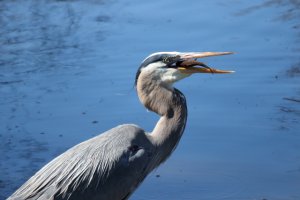
Although I usually use a 1D X and 600/4L IS II for birds, frequently with a 1.4x TC, that's not always the case as you can see below with a shot at 200mm on APS-C. For this shot, I approached the heron very slowly over a period of several minutes until I was close enough to get the shot without too much cropping.. Fast shutter speed, ISO as low as feasible (I prefer not to go much higher than ISO 800 on APS-C).
"Down the Hatch"
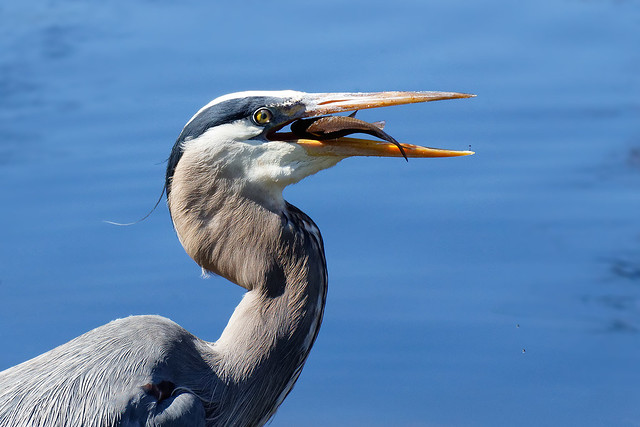
EOS M2, EF-M 55-200mm f/4.5-6.3 IS STM @ 200mm, 1/1600 s, f/6.3, ISO 800
Below is the original version, no edits to the RAW file, just converted with DPP using the Standard picture style and at the same pixel dimensions as the image above (although you can click the pic above for a larger image). Hopefully that illustrates the importance of post-processing.