The List of Gear to be Announced in February, Including More Speedlite Information [CR3]

Re: The List of Gear to be Announced in February

Refurb7 said:
Laser?! Are you sure it's laser? And there's a safety issue? I thought it was just a red beam of near infra-red light. The AF assist light is a huge benefit on flashes. Seems like a real safety issue would come with a big warning, or be banned.
I am not speaking about flashes (or what ever came up later to ridicule me), but specifically about the Yongnuo YN-E3-RT flash trigger unit. I also have not yet seen any laser based AF assist lamp on a flash (although my experience there is limited to Canon brand).

All the LED based AF assist lamps on the Canon flashes produce some broad soft pattern. The red plastic in front of the lamp seems to have multiple angled surfaces to produce the pattern through refraction. The whole system is relatively huge.

The AF assist on the Yongnuo YN-E3-RT produces some very tiny bright dots with the typical laser speckle pattern. I can't imagine to produce this without collimated coherent laser light. And compared to the Canon flashes, the AF assist system on the YN-E3-RT is just one very tiny flat light source (very likely a laser diode with some micro structured filter) with a flat red cover.

Likely the laser power is low enough to not cause eye damage, but I would not want to risk it. To be honest, I wouldn't trust any Chinese manufacturer selling products under its own brand to comply with any regulations.
 
Upvote 0
Re: UPDATED: The List of Gear to be Announced in February, Including More Speedlite Information [CR3

neuroanatomist said:
transpo1 said:
We need a weather resistant EOS-M, even if APS-C.

Well, it's a pretty small camera.

discount_Ziploc_Sandwich_Bags_Smart_Zip_Seal_40_Count_Box_12_pack_25700711391_in_bulk.jpg


:P

While the camera will survive you get a unique "bad weather look" photographing through some not really optically perfect material. And I think these bags do not come in multi coated versions!
 
Upvote 0
Re: UPDATED: The List of Gear to be Announced in February, Including More Speedlite Information [CR3

Talys said:
Possible AI auto-bounce...

Flash has "ceiling mode" -- point the flash at the ceiling, flash automatically determines range to celing, then, assuming it's a white ceiling, combines with angle, rotation, ETTL to calculate required adjusted power level and camera exposure settings.

That's how ETTL works already, it doesn't need a 'ceiling mode' because it measures reflected light from the scene and subject.

You should try ETTL with bounce, it is very cool.
 
Upvote 0
Re: UPDATED: The List of Gear to be Announced in February, Including More Speedlite Information [CR3

privatebydesign said:
Talys said:
Possible AI auto-bounce...

Flash has "ceiling mode" -- point the flash at the ceiling, flash automatically determines range to celing, then, assuming it's a white ceiling, combines with angle, rotation, ETTL to calculate required adjusted power level and camera exposure settings.

That's how ETTL works already, it doesn't need a 'ceiling mode' because it measures reflected light from the scene and subject.

You should try ETTL with bounce, it is very cool.
Afaik ETTL-II in all modern cameras takes into account the focus distance setting of the lens for direct flash and not just uses the measurement of reflected light. But I doubt that any improvement related to that would be called "AI auto-bounce", it would be more likely called ETTL-III.

For me this sounds more like a motorized bounce card.
 
Upvote 0
Re: UPDATED: The List of Gear to be Announced in February, Including More Speedlite Information [CR3

midluk said:
privatebydesign said:
Talys said:
Possible AI auto-bounce...

Flash has "ceiling mode" -- point the flash at the ceiling, flash automatically determines range to celing, then, assuming it's a white ceiling, combines with angle, rotation, ETTL to calculate required adjusted power level and camera exposure settings.

That's how ETTL works already, it doesn't need a 'ceiling mode' because it measures reflected light from the scene and subject.

You should try ETTL with bounce, it is very cool.
Afaik ETTL-II in all modern cameras takes into account the focus distance setting of the lens for direct flash and not just uses the measurement of reflected light. But I doubt that any improvement related to that would be called "AI auto-bounce", it would be more likely called ETTL-III.

For me this sounds more like a motorized bounce card.

The focus distance is another metric the system can use, after testing it seems the most important use for it is when the background is very reflective, this is easily tested by putting the lens in Manual focus. Don't forget it is using the zones to try to establish where the subject is within the frame and ETTL II is designed to prioritize the 'subject' exposure, the ambient exposure is trying to expose the 'background' correctly.
 
Upvote 0
Re: UPDATED: The List of Gear to be Announced in February, Including More Speedlite Information [CR3

My 2ct about AI Auto Bounce:

What about a flash which is able to split the light between direct light and light to bounce? Maybe with a mirror which adjusts the light between two diffusor screens on the flash front and the top of the flash - or alternatively two light sources which can be mixed according to the situation. A reflectance sensor on the top of the flash measures if there is something close and "white" enough to support bouncing. The sensor would cost 5 $/EUR and a movable mirror might cost 10$/EUR for the hardware.

AI is the "decision making mechanism" inside the flash. If there is no chance to bounce the flash is used as a direct flash, if there is enough bouncing area of good quality the flash operates in bounce mode. I see a lot of situations where this might be helpful - not only for parties but also for reportage.
 
Upvote 0
Re: UPDATED: The List of Gear to be Announced in February, Including More Speedlite Information [CR3

transpo1 said:
vangelismm said:
Sharlin said:
T100? How much lower can you go than the 1x00D series? A $200 DSLR? Except for the Wi-Fi most of the tech in the T6/1300D is almost ten years old. I guess the T7 could inherit features from the T5i/T6i generation (omg, 24MPix sensor, all cross-type AF points!) and the T100 might be an even more stripped-down T6 (bye Wi-Fi? What did the RF certification data say again?)

That was the first thing i thought. But does not make sense build the T7 with the same features of Txi and create a new entry level camera.

Maybe an EOS -m with the body of DSLR? No mirror, no EVF, no OVF.

We need a weather resistant EOS-M, even if APS-C.

who's this "we"? I certainly don't need it.
 
Upvote 0
Re: UPDATED: The List of Gear to be Announced in February, Including More Speedlite Information [CR3

mb66energy said:
neuroanatomist said:
transpo1 said:
We need a weather resistant EOS-M, even if APS-C.

Well, it's a pretty small camera.

discount_Ziploc_Sandwich_Bags_Smart_Zip_Seal_40_Count_Box_12_pack_25700711391_in_bulk.jpg


:P

While the camera will survive you get a unique "bad weather look" photographing through some not really optically perfect material. And I think these bags do not come in multi coated versions!

No problem, if you want a multi coated version, just put some more bags on :). Bonus - it will have a higher level of weather resistance.
 
Upvote 0
Re: UPDATED: The List of Gear to be Announced in February, Including More Speedlite Information [CR3

Oh is this going to spiral into one of those 'Put 1D features on an entry level body' thread? Fun!
 
Upvote 0
Re: UPDATED: The List of Gear to be Announced in February, Including More Speedlite Information [CR3

mb66energy said:
My 2ct about AI Auto Bounce:

What about a flash which is able to split the light between direct light and light to bounce? Maybe with a mirror which adjusts the light between two diffusor screens on the flash front and the top of the flash - or alternatively two light sources which can be mixed according to the situation. A reflectance sensor on the top of the flash measures if there is something close and "white" enough to support bouncing. The sensor would cost 5 $/EUR and a movable mirror might cost 10$/EUR for the hardware.

AI is the "decision making mechanism" inside the flash. If there is no chance to bounce the flash is used as a direct flash, if there is enough bouncing area of good quality the flash operates in bounce mode. I see a lot of situations where this might be helpful - not only for parties but also for reportage.

michi said:
magarity said:
"Speedlite 470EX AI Auto Bounce *UPDATE* Judging by the name, this will be a flash with some new technology"

"AI Bounce" is the bizarrely worded error one gets when the 430-iii's little white bounce card isn't pushed in all the way. As for the "Auto" part, maybe, the flash detects nearby white walls and ceilings and a motor whips it into the optimum bounce position. And some people complain about the mirror movement shaking the camera, hah hah!

Or like a dual flash/reflector setup like some Metz flashes have? Wishful thinking, bounce really doesn't imply that. I do love my Metz flash though if I can only take one flash with me.

mb66energy, your thoughts / 2 cents about having 2 light sources (one bounce, one direct) were somewhat answered and discussed earlier in this thread - see the quote I copied from michi. There are some flashes that, as a single unit, can emit light in 2 directions. That is, the flash employs both a 'forward / direct flash' possibility while the main flash is directed up (or at an angle, for 'bounce' flash.

For about a decade, I have owned the Nissin 866mkII Pro flash. This has this possibility (like some Metz flashes can do) of flashing light in 2 directions. While my Nissin currently can only operate both flashes in manual mode, having an advanced algorithm to operate both forward and bounce as E-TTL could be an advantage in certain scenarios (e.g. rapidly changing light / changing conditions). However I prefer manual control for the vast majority of my flash photography.

I own several Canon flashes (including the top of the line model: 600EX-RT and a number of 430EX III-RT (great little flash too!) However there are times that I choose the Nissin 86mmkII for a certain application - because it can submit a forward / direct flash and the bounce flash in one, which can be very handy (e.g. when having limited space / time - such as when travelling - but still allow very creative lighting options).

Looking forward to future advances in the areas of advanced flash photography... by more brands - including OEM such as Canon and 3rd party brand also. Radio Transmission (RT) has certainly become a great feature in recent years.

Regards

Paul
 
Upvote 0
Re: UPDATED: The List of Gear to be Announced in February, Including More Speedlite Information [CR3

rrcphoto said:
transpo1 said:
vangelismm said:
Sharlin said:
T100? How much lower can you go than the 1x00D series? A $200 DSLR? Except for the Wi-Fi most of the tech in the T6/1300D is almost ten years old. I guess the T7 could inherit features from the T5i/T6i generation (omg, 24MPix sensor, all cross-type AF points!) and the T100 might be an even more stripped-down T6 (bye Wi-Fi? What did the RF certification data say again?)

That was the first thing i thought. But does not make sense build the T7 with the same features of Txi and create a new entry level camera.

Maybe an EOS -m with the body of DSLR? No mirror, no EVF, no OVF.

We need a weather resistant EOS-M, even if APS-C.

who's this "we"? I certainly don't need it.

"We" meaning all the smart people who don't want to shoot through a plastic ziplock bag ;)
 
Upvote 0
Re: UPDATED: The List of Gear to be Announced in February, Including More Speedlite Information [CR3

Rampuri said:
mb66energy said:
neuroanatomist said:
transpo1 said:
We need a weather resistant EOS-M, even if APS-C.

Well, it's a pretty small camera.

discount_Ziploc_Sandwich_Bags_Smart_Zip_Seal_40_Count_Box_12_pack_25700711391_in_bulk.jpg


:P

While the camera will survive you get a unique "bad weather look" photographing through some not really optically perfect material. And I think these bags do not come in multi coated versions!

No problem, if you want a multi coated version, just put some more bags on :). Bonus - it will have a higher level of weather resistance.

I do have to admit that the plastic bag method of weather resistance does have some interesting creative possibilities. :)
 
Upvote 0
Re: UPDATED: The List of Gear to be Announced in February, Including More Speedlite Information [CR3

transpo1 said:
"We" meaning all the smart people who don't want to shoot through a plastic ziplock bag ;)

Then "we" will also need a full line of weather-sealed EF-M lenses.

I'll admit to being part of the 'we' here, I was actually tempted by the Nikon 1 AW system, but put off by the small sensor size (particularly for underwater use, where light is at a premium and the bigger the sensor, the better).
 
Upvote 0
Re: UPDATED: The List of Gear to be Announced in February, Including More Speedlite Information [CR3

neuroanatomist said:
transpo1 said:
"We" meaning all the smart people who don't want to shoot through a plastic ziplock bag ;)

Then "we" will also need a full line of weather-sealed EF-M lenses.

I'll admit to being part of the 'we' here, I was actually tempted by the Nikon 1 AW system, but put off by the small sensor size (particularly for underwater use, where light is at a premium and the bigger the sensor, the better).

Rented the AW1 and their sealed 10mm f/2.8 (27mm FF equiv I think) and took it snorkeling in Hawaii a few years back. Not good at all. It felt like halfway from a cell phone to a Rebel, and the snorkeling shots (in some challenging light, of course) were pretty dreadful.

But it was indeed a well sealed camera and the AF was snappy.

- A
 
Upvote 0
Re: UPDATED: The List of Gear to be Announced in February, Including More Speedlite Information [CR3

privatebydesign said:
midluk said:
privatebydesign said:
Talys said:
Possible AI auto-bounce...

Flash has "ceiling mode" -- point the flash at the ceiling, flash automatically determines range to celing, then, assuming it's a white ceiling, combines with angle, rotation, ETTL to calculate required adjusted power level and camera exposure settings.

That's how ETTL works already, it doesn't need a 'ceiling mode' because it measures reflected light from the scene and subject.

You should try ETTL with bounce, it is very cool.
Afaik ETTL-II in all modern cameras takes into account the focus distance setting of the lens for direct flash and not just uses the measurement of reflected light. But I doubt that any improvement related to that would be called "AI auto-bounce", it would be more likely called ETTL-III.

For me this sounds more like a motorized bounce card.

The focus distance is another metric the system can use, after testing it seems the most important use for it is when the background is very reflective, this is easily tested by putting the lens in Manual focus. Don't forget it is using the zones to try to establish where the subject is within the frame and ETTL II is designed to prioritize the 'subject' exposure, the ambient exposure is trying to expose the 'background' correctly.

Wait wait wait.

ETTL II measures reflected flash using data from the image through the lens. As Canon says, it "brought two major changes – the way that EOS cameras meter reflected flash and the method they use to determine the level of the output required."

ETTL II does NOT know whether you have a 9 ft ceiling, 12 ft ceiling, or a 20 ft ceiling, or if you're in a gymnasium.

If you use an 85mm lens in a room to shoot a couple, and your lens doesn't see a ceiling, ETTL II won't know anything about a ceiling 15 ft up, the assistant off the edge holding a 6 ft reflector your bouncing off of, or anything else.

What I'm saying is that the flash head -- the actual unit that you rotate to bounce -- gets a sensor, right on it. The sensor tilts and swivels with the light source. It determines distance to surface you're bouncing off of, rather than the surface the lens sees.

If, at 45 degrees, it senses a ceiling at a total distance of 1.8 meters, and your subject is standing 8 meters away, an auto bounce could then, for instance, triangulate that the lighting would not hit your subject at all, and warn you. If you moved closer to your subject or reduced the angle of the bounce flash, auto bounce could then correctly (sort of?) meter that. But it would be impossible without a sensor pointed in the direction of the illumination beam.

What I was saying earlier was that should this be the case with auto bounce, it would only really work if you floor and ceiling were parallel and the camera was perpendicular to this plane. For example, a sloped white ceiling would be very hard for a flash to evaluate, without an array of sensors, because the flash cannot evaluate whether the ceiling is flat or sloped at 45 degrees. And, the camera can't know if you're standing perpendicular to the subject, or you're angled down or up, unless it has a gyroscope.
 
Upvote 0
Re: UPDATED: The List of Gear to be Announced in February, Including More Speedlite Information [CR3

pj1974 said:
mb66energy said:
My 2ct about AI Auto Bounce:

What about a flash which is able to split the light between direct light and light to bounce? Maybe with a mirror which adjusts the light between two diffusor screens on the flash front and the top of the flash - or alternatively two light sources which can be mixed according to the situation. A reflectance sensor on the top of the flash measures if there is something close and "white" enough to support bouncing. The sensor would cost 5 $/EUR and a movable mirror might cost 10$/EUR for the hardware.

AI is the "decision making mechanism" inside the flash. If there is no chance to bounce the flash is used as a direct flash, if there is enough bouncing area of good quality the flash operates in bounce mode. I see a lot of situations where this might be helpful - not only for parties but also for reportage.

michi said:
magarity said:
"Speedlite 470EX AI Auto Bounce *UPDATE* Judging by the name, this will be a flash with some new technology"

"AI Bounce" is the bizarrely worded error one gets when the 430-iii's little white bounce card isn't pushed in all the way. As for the "Auto" part, maybe, the flash detects nearby white walls and ceilings and a motor whips it into the optimum bounce position. And some people complain about the mirror movement shaking the camera, hah hah!

Or like a dual flash/reflector setup like some Metz flashes have? Wishful thinking, bounce really doesn't imply that. I do love my Metz flash though if I can only take one flash with me.

mb66energy, your thoughts / 2 cents about having 2 light sources (one bounce, one direct) were somewhat answered and discussed earlier in this thread - see the quote I copied from michi. There are some flashes that, as a single unit, can emit light in 2 directions. That is, the flash employs both a 'forward / direct flash' possibility while the main flash is directed up (or at an angle, for 'bounce' flash.

For about a decade, I have owned the Nissin 866mkII Pro flash. This has this possibility (like some Metz flashes can do) of flashing light in 2 directions. While my Nissin currently can only operate both flashes in manual mode, having an advanced algorithm to operate both forward and bounce as E-TTL could be an advantage in certain scenarios (e.g. rapidly changing light / changing conditions). However I prefer manual control for the vast majority of my flash photography.

I own several Canon flashes (including the top of the line model: 600EX-RT and a number of 430EX III-RT (great little flash too!) However there are times that I choose the Nissin 86mmkII for a certain application - because it can submit a forward / direct flash and the bounce flash in one, which can be very handy (e.g. when having limited space / time - such as when travelling - but still allow very creative lighting options).

Looking forward to future advances in the areas of advanced flash photography... by more brands - including OEM such as Canon and 3rd party brand also. Radio Transmission (RT) has certainly become a great feature in recent years.

Regards

Paul

Hi Paul - I remember these flashes which had a movable main flash and a fixed fill in flash with (very) low power. I have forgotten to clarify that I meant two full flashes (or LED flash arrays) which could be mixed without further action of the user. I think this is the AI part in the name of the device.

These older (or still available) flashes were - as far as I know - not able to decide if there was a well suited area for bouncing so it was always some trial and error ... or if you had stable conditions e.g. a white ceiling, a matter of experience to get good (= natural looking) flash photos.
If I were developer for flash units I would add a sensor package which uses a reflectance sensor for possible bouncing surfaces and derive the chance to use bouncing - if not, leave it at direct flash use.

Best - Michael
 
Upvote 0
Re: UPDATED: The List of Gear to be Announced in February, Including More Speedlite Information [CR3

Talys said:
privatebydesign said:
midluk said:
privatebydesign said:
Talys said:
Possible AI auto-bounce...

Flash has "ceiling mode" -- point the flash at the ceiling, flash automatically determines range to celing, then, assuming it's a white ceiling, combines with angle, rotation, ETTL to calculate required adjusted power level and camera exposure settings.

That's how ETTL works already, it doesn't need a 'ceiling mode' because it measures reflected light from the scene and subject.

You should try ETTL with bounce, it is very cool.
Afaik ETTL-II in all modern cameras takes into account the focus distance setting of the lens for direct flash and not just uses the measurement of reflected light. But I doubt that any improvement related to that would be called "AI auto-bounce", it would be more likely called ETTL-III.

For me this sounds more like a motorized bounce card.

The focus distance is another metric the system can use, after testing it seems the most important use for it is when the background is very reflective, this is easily tested by putting the lens in Manual focus. Don't forget it is using the zones to try to establish where the subject is within the frame and ETTL II is designed to prioritize the 'subject' exposure, the ambient exposure is trying to expose the 'background' correctly.

Wait wait wait.

ETTL II measures reflected flash using data from the image through the lens. As Canon says, it "brought two major changes – the way that EOS cameras meter reflected flash and the method they use to determine the level of the output required."

ETTL II does NOT know whether you have a 9 ft ceiling, 12 ft ceiling, or a 20 ft ceiling, or if you're in a gymnasium.

If you use an 85mm lens in a room to shoot a couple, and your lens doesn't see a ceiling, ETTL II won't know anything about a ceiling 15 ft up, the assistant off the edge holding a 6 ft reflector your bouncing off of, or anything else.

What I'm saying is that the flash head -- the actual unit that you rotate to bounce -- gets a sensor, right on it. The sensor tilts and swivels with the light source. It determines distance to surface you're bouncing off of, rather than the surface the lens sees.

If, at 45 degrees, it senses a ceiling at a total distance of 1.8 meters, and your subject is standing 8 meters away, an auto bounce could then, for instance, triangulate that the lighting would not hit your subject at all, and warn you. If you moved closer to your subject or reduced the angle of the bounce flash, auto bounce could then correctly (sort of?) meter that. But it would be impossible without a sensor pointed in the direction of the illumination beam.

What I was saying earlier was that should this be the case with auto bounce, it would only really work if you floor and ceiling were parallel and the camera was perpendicular to this plane. For example, a sloped white ceiling would be very hard for a flash to evaluate, without an array of sensors, because the flash cannot evaluate whether the ceiling is flat or sloped at 45 degrees. And, the camera can't know if you're standing perpendicular to the subject, or you're angled down or up, unless it has a gyroscope.

Yes but my point, and Canon's, is you don't need to measure the distance to the surface or it's angle you are bouncing off, or its reflectivity, because those metrics only add up to how much light reaches the subject, which ETTL already measures.

Think about an incidence meter, it doesn't care how big or close or what angle the light is reaching it, it just measures the power of that light, which is all you need to know to get an accurate exposure. Same with a reflectance meter in camera with the normal reflectance meter/subject reflectivity caveat that kind of reading will always give you, that's why we have FEC and EC. FEC to adjust subject exposure, EC to adjust background exposure all within the same overall exposure.
 
Upvote 0
Re: UPDATED: The List of Gear to be Announced in February, Including More Speedlite Information [CR3

transpo1 said:
rrcphoto said:
transpo1 said:
vangelismm said:
Sharlin said:
T100? How much lower can you go than the 1x00D series? A $200 DSLR? Except for the Wi-Fi most of the tech in the T6/1300D is almost ten years old. I guess the T7 could inherit features from the T5i/T6i generation (omg, 24MPix sensor, all cross-type AF points!) and the T100 might be an even more stripped-down T6 (bye Wi-Fi? What did the RF certification data say again?)

That was the first thing i thought. But does not make sense build the T7 with the same features of Txi and create a new entry level camera.

Maybe an EOS -m with the body of DSLR? No mirror, no EVF, no OVF.

We need a weather resistant EOS-M, even if APS-C.

who's this "we"? I certainly don't need it.

"We" meaning all the smart people who don't want to shoot through a plastic ziplock bag ;)

I'd question the intelligence of these supposed smart people who would want a weathersealed camera with no weathersealed lenses or even a weathersealed EF to EF-M adapter.
 
Upvote 0
Re: UPDATED: The List of Gear to be Announced in February, Including More Speedlite Information [CR3

transpo1 said:
Rampuri said:
mb66energy said:
neuroanatomist said:
transpo1 said:
We need a weather resistant EOS-M, even if APS-C.

Well, it's a pretty small camera.

discount_Ziploc_Sandwich_Bags_Smart_Zip_Seal_40_Count_Box_12_pack_25700711391_in_bulk.jpg


:P

While the camera will survive you get a unique "bad weather look" photographing through some not really optically perfect material. And I think these bags do not come in multi coated versions!

No problem, if you want a multi coated version, just put some more bags on :). Bonus - it will have a higher level of weather resistance.

I do have to admit that the plastic bag method of weather resistance does have some interesting creative possibilities. :)

@Rampori Your understanding of multicoated made me laugh
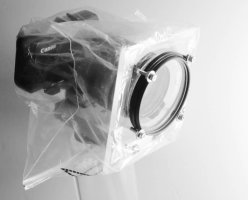
@transpo1 I have been creative with these bags ~ 3 years ago - the product (only rain protection, no deep sea diving) can be seen below: EOS M with adapted EF 2.0 100. The "port" is made of some 82mm UV filter, a sheet of lucite (plexiglas TM or PMMA for chemists) to hold the UV filter, a rubber ring and the plastic bag together. The base is a wooden sheet with different holes for different lenses.
Operating the camera via touch screen is easy through the plastic bag which doesn't irritate the capacitive display - rain would irritate it. but it can easily be removed. With 8 liter bags it would be easy to adapt a 70-200 4.0 IS USM which would be a good idea: IS helps definitely.
I am planning a 3D printed "protecting bag" version but that needs some time in one piece. Not for the printing but for the construction! But it will do only the port because - as written above - modern cameras can be easily used via the touch screen. And I plan to be free to use the 200D too.
 

Attachments

  • eosm_water_shielding_bockhorst_m.jpg
    eosm_water_shielding_bockhorst_m.jpg
    36.8 KB · Views: 112
Upvote 0