jrista said:scyrene said:jrista said:Canon users are used to having to keep shadows very dark (and personally I would say unnaturally dark in many cases), because to do otherwise means dealing with more noise.
I don't disagree with most of what you say, but this statement strikes me as odd. It's certainly not my experience (and while one person's experience is merely anecdote, it's no worse than 'lots of unspecified people think/do XYZ'. Partly, it comes back to - could you tell, given a series of finished images, what brand of camera was used to create each one? If you're right, it should be obvious. But it's not - I spend a lot of time looking at images made by all manner of equipment, and hardly ever can you tell what was used except in the broadest terms (obviously we'd all welcome equipment that makes things easier - and more DR, lower noise, etc. would mean less intensive processing etc.) But also, technique like ETTR* (which I appreciate is more a Canon thing nowadays) means the shadow worries are just not the case the way you mean - you're pulling the exposure down, so the shadows aren't especially compromised. It's not perfect, but I just don't think Canon shots have 'unnaturally dark' shadows, nor do I approach exposure or editing with trepidation towards darker areas - does anyone else?
*You talk about black and white birds later in the thread. I shoot birds more than any other subject, and certainly black and white ones are a challenge (in direct sunlight). But I don't feel like it's the massive problem you make out - I can only conclude you want images with brighter shadows than I do (a legitimate difference of taste). You can ETTR a fair bit before the highlights are truly blown. Much more and the shadows would look weird imho.

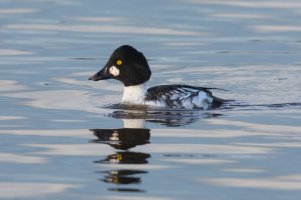
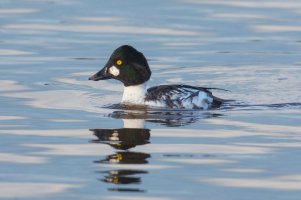
I guess it is best to demonstrate. This is a shot that I grabbed before noticing that the sun had popped out from behind a cloud. If you've ever photographed buffleheads...when they are bathing or eating, you usually only have a few seconds from the time they bob up to the surface, look around for a second, then dive again. The sun popped out for about 5 seconds, then was behind a cloud again. In that moment, the bird had already popped up and I had pressed the shutter button. Not much I could do. The moment was gone. It was overexposed, not a ton, but enough to clip some of the white highlights. It overexposed because I was already ETTRed to try and get more detail in the darker feathers. Despite that...the shadows still ended up unnaturally dark. What I saw with my own eyes did not look like this...I could still see color in the area back underside of the bird's iridescent feathers on it's head.
To me, the extreme darkness of those shadows (and they run right down to the left edge of the histogram, which represents pure black) is unnatural. I've shared this image on these forums in the past, and the responses I got were along the lines of "Well shadows are supposed to be dark!" Well, sure...but how dark? Black dark? Totally devoid of detail dark? That was a "shadow" in real life...but it wasn't black. I could still see color and detail in that region of the bird. It was a shadow in real life...it just didn't have that much global contrast. I see the shadow as unnatural, other Canon users on these forums in the past did not.
Furthermore, this photo WAS ETTRed, and it was because I had it ETTRed for a slightly lower light level that the highlights clipped in the short moment that the sun came out. It's not just the highlights that were affected, though...all of those beautiful iridescent feathers on the bird's head were brightened and washed out as well. With careful processing a better contrast can be restored, and color saturation can be restored, but it still doesn't look quite as amazing as those feathers do in real life. They look a bit over-processed...slightly unnatural. ETTR is a risky and less than ideal NECESSITY because of the more limited DR in Canon cameras. I'd have much preferred to not ETTR, and maybe even ETTL a bit, so those iridescent feathers drifted back towards the upper midtones, where they would naturally have the greatest color saturation and would preserve their natural contrast without washing out like they did here.
Anyway. I don't see landscapes or astrophotography as the only reason to NEED more dynamic range. I could have totally used a couple extra stops on this image right here with this bird photograph.
Black and white birds in direct sun are notoriously tricky to expose properly, and I absolutely agree that more processing latitude would help us with these especially. But it is nonetheless possible to photograph these birds with current Canon sensor technology and get good results.
Actually in this example I'd underexposed a little by accident. But I don't think you could tell in the finished image one way or the other. Perhaps I like the dark parts darker than some others. You can have a little more noise in these dark feathers, I'd say, as can be hard to tell apart noise from feather texture. But again, not having to do anything special to retain highlight and shadow detail would be most welcome. I just don't think it's as nightmarish at present as some might infer from these discussions.
Edit: I've included a second processed version, with brighter shadows for those who prefer them. I don't think the noise is really noticeable, and certainly not objectionable.
Attachments
Upvote
0