EOS-1D X Mark II Claims of 15 Stops of DR [CR3]

jrista said:
scyrene said:
jrista said:
Canon users are used to having to keep shadows very dark (and personally I would say unnaturally dark in many cases), because to do otherwise means dealing with more noise.

I don't disagree with most of what you say, but this statement strikes me as odd. It's certainly not my experience (and while one person's experience is merely anecdote, it's no worse than 'lots of unspecified people think/do XYZ'. Partly, it comes back to - could you tell, given a series of finished images, what brand of camera was used to create each one? If you're right, it should be obvious. But it's not - I spend a lot of time looking at images made by all manner of equipment, and hardly ever can you tell what was used except in the broadest terms (obviously we'd all welcome equipment that makes things easier - and more DR, lower noise, etc. would mean less intensive processing etc.) But also, technique like ETTR* (which I appreciate is more a Canon thing nowadays) means the shadow worries are just not the case the way you mean - you're pulling the exposure down, so the shadows aren't especially compromised. It's not perfect, but I just don't think Canon shots have 'unnaturally dark' shadows, nor do I approach exposure or editing with trepidation towards darker areas - does anyone else?

*You talk about black and white birds later in the thread. I shoot birds more than any other subject, and certainly black and white ones are a challenge (in direct sunlight). But I don't feel like it's the massive problem you make out - I can only conclude you want images with brighter shadows than I do (a legitimate difference of taste). You can ETTR a fair bit before the highlights are truly blown. Much more and the shadows would look weird imho.

1txtAni.jpg


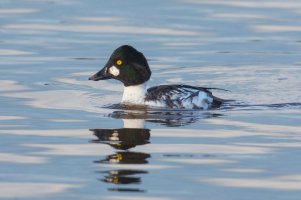
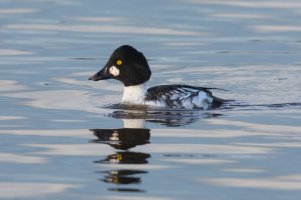
I guess it is best to demonstrate. This is a shot that I grabbed before noticing that the sun had popped out from behind a cloud. If you've ever photographed buffleheads...when they are bathing or eating, you usually only have a few seconds from the time they bob up to the surface, look around for a second, then dive again. The sun popped out for about 5 seconds, then was behind a cloud again. In that moment, the bird had already popped up and I had pressed the shutter button. Not much I could do. The moment was gone. It was overexposed, not a ton, but enough to clip some of the white highlights. It overexposed because I was already ETTRed to try and get more detail in the darker feathers. Despite that...the shadows still ended up unnaturally dark. What I saw with my own eyes did not look like this...I could still see color in the area back underside of the bird's iridescent feathers on it's head.

To me, the extreme darkness of those shadows (and they run right down to the left edge of the histogram, which represents pure black) is unnatural. I've shared this image on these forums in the past, and the responses I got were along the lines of "Well shadows are supposed to be dark!" Well, sure...but how dark? Black dark? Totally devoid of detail dark? That was a "shadow" in real life...but it wasn't black. I could still see color and detail in that region of the bird. It was a shadow in real life...it just didn't have that much global contrast. I see the shadow as unnatural, other Canon users on these forums in the past did not.

Furthermore, this photo WAS ETTRed, and it was because I had it ETTRed for a slightly lower light level that the highlights clipped in the short moment that the sun came out. It's not just the highlights that were affected, though...all of those beautiful iridescent feathers on the bird's head were brightened and washed out as well. With careful processing a better contrast can be restored, and color saturation can be restored, but it still doesn't look quite as amazing as those feathers do in real life. They look a bit over-processed...slightly unnatural. ETTR is a risky and less than ideal NECESSITY because of the more limited DR in Canon cameras. I'd have much preferred to not ETTR, and maybe even ETTL a bit, so those iridescent feathers drifted back towards the upper midtones, where they would naturally have the greatest color saturation and would preserve their natural contrast without washing out like they did here.

Anyway. I don't see landscapes or astrophotography as the only reason to NEED more dynamic range. I could have totally used a couple extra stops on this image right here with this bird photograph.

Black and white birds in direct sun are notoriously tricky to expose properly, and I absolutely agree that more processing latitude would help us with these especially. But it is nonetheless possible to photograph these birds with current Canon sensor technology and get good results.

Actually in this example I'd underexposed a little by accident. But I don't think you could tell in the finished image one way or the other. Perhaps I like the dark parts darker than some others. You can have a little more noise in these dark feathers, I'd say, as can be hard to tell apart noise from feather texture. But again, not having to do anything special to retain highlight and shadow detail would be most welcome. I just don't think it's as nightmarish at present as some might infer from these discussions.

Edit: I've included a second processed version, with brighter shadows for those who prefer them. I don't think the noise is really noticeable, and certainly not objectionable.
 

Attachments
  • HA6A9091-1.jpg
    HA6A9091-1.jpg
    793.7 KB · Views: 166
  • HA6A9091-2.jpg
    HA6A9091-2.jpg
    858.5 KB · Views: 156
Upvote 0
Jack Douglas said:
jrista said:
bdunbar79 said:
jrista said:
Sporgon said:
For those that show pictures of iridescent black and white subject where the software is showing both highlight and lowlight to be lost; prepare for disappointment in the increased DR. For a given exposure you are getting no more highlight range, so, to preserve the highlight with your new higher DR camera you under expose to hold the highlights. But even with your previous longer exposure you had lost all shadow data, so by under exposing to preserve highlights with a camera that doesn't actually have any more highlight range you use up your extra DR range in the shadows anyway, and you end up trying to lift zero data.

The extra DR does have occasional advantages in a very narrow EV band, but this example isn't one of them.

There is no such thing as "highlight DR", nor is there "shadow DR"...there is simply DR. You either have more dynamic range or not. Dynamic range is by definition the ratio of the full well capacity to the read noise floor. This is something I hear a lot from Canon users, and it's just a misconception, a misnomer. Dynamic range represents the entire range of tones the camera can discern, without segregation.

In practice, with a camera that has nearly 14 stops of DR, you can indeed back off exposure a bit to preserve highlights, and still have plenty of room left to recover detail out of the shadows, and with significantly less noise than a camera that has 11 or even 12 stops of DR. The shadows won't be totally noise-free, but they don't need to be. They just need to have low enough noise to support an acceptable shadow push to reveal the right amount of detail in them.

Then would the read noise floor, the weaker part of Canon's sensor, govern the shadow lifting ability? Is that where the noise originates in the shadows?

The way I see it is this. If your working with a scene, or a subject, that has more dynamic range than your camera, then you have options. Risk clipping the highlights with ETTR, to preserve as much as you can in the shadows, or preserve the highlights and lose more detail and color fidelity to shadow noise. The dynamic range is just a range...how you use it is up to you. You can use that range to preserve the highlights or to preserve the shadows. With more limited dynamic range (i.e. 11 stops) you are going to have to make compromises more often, with greater dynamic range (i.e. 13.8 stops or even 15 stops) you are going to have more leeway to move the signal around within the dynamic range, and the ability to preserve more detail...at either or both ends of the tonal range.

This can happen with any camera, because until we get to the point where cameras have like 20 stops of DR, there are always going to be scenes with higher DR. The difference is how much the noise affects your shadows if you end up choosing to preserve the highlights.

The difference with a camera that has 2-3 stops more DR is that when you pull back exposure a bit to preserve the highlights, you have far less noise to eat away at those darker details, making them much more recoverable before the post-push noise levels of the shadows increase to the point where they are unsightly.

I really hope Canon delivers 15 stops of DR. Even if it isn't literal DR a 16-bit RAW, if they find a way to use a non-linear compression curve to preserve more shadow detail in the data that is ultimately stored in a 14-bit RAW, I still think that would be much better than just leaving those extra...what, it would be nearly four stops of DR if we compare to the 5D III's 10.97 stops, buried in the noise. I think that would be a huge step forward, and I'd take it in a heartbeat. ;P I would still prefer true 16-bit RAW with the full precision if it was an option, but I'll take any interim step Canon can give me.

I don't detect anything in this comment that is not on the mark. I guess what it comes down to is how each of us individually relate to the shadows that aren't as defined as some would like.

It reminds me of a friends comment that my "black" bird was overexposed because it showed hints of gray. It was the Pileated woodpecker that I now observe daily often up close and it is grayish (more definition in the black) or it is black in real life depending on the quality of the light.

If I choose to lift the shadows then I have more detail but the bird may not really impress the public, depending on their foreknowledge and personal taste. As said by others I think DR has been presented as critically important when it's just important. I'll gladly take whatever more they can deliver but it's not going to phase me too much.

So what should be done with this sample (excluding cleaning the beak!) - trash it, raise the shadows or??

Jack

That's a nice shot, I don't think it needs much doing (for me, just a little extra contrast/brightening the highlights). It's chiaroscuro, which is all too rare in a lot of current photography, despite often having the most visual impact.
 
Upvote 0
Maiaibing said:
PureClassA said:
Superlaser2.jpg


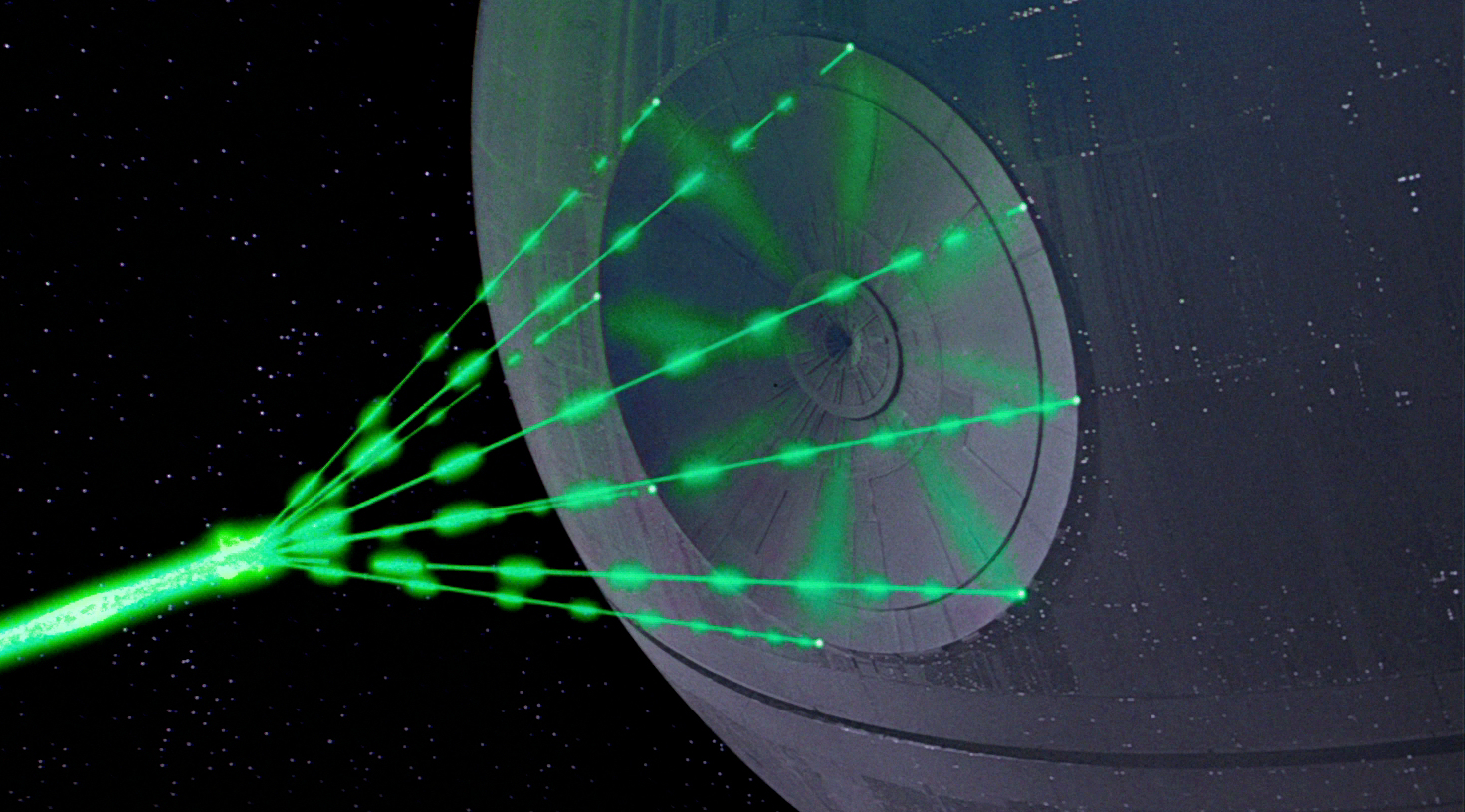
I heard the Empire used Canon FD glass back in the day to focus the Death Star's laser beams...

The Dark Side uses Nikon - Why do you think Nikon is called the "Dark Side" in the first place?!? ;D

Vader's Lightsaber had "VR" on it. Luke's said "IS"
 
Upvote 0
PureClassA said:
Maiaibing said:
PureClassA said:
Superlaser2.jpg


I heard the Empire used Canon FD glass back in the day to focus the Death Star's laser beams...

The Dark Side uses Nikon - Why do you think Nikon is called the "Dark Side" in the first place?!? ;D

Vader's Lightsaber had "VR" on it. Luke's said "IS"
Yeah, but how many people do you see at ComicCon dressed up as Luke Skywalker and how many do you see as Darth Vader?
 
Upvote 0
Lee Jay said:
3kramd5 said:
hubie said:
he sun still wouldn't exceed the sensor's capacity (if 1/8000 is short enough)

It's not.

That depends on sun elevation, atmospheric transparency, and f-stop.

Well sure, obviously if one can continue stopping down past common limits, one could shoot the sun at a full second.

Here are some benign conditions: early morning, sun partially occluded, 1/8000sec exposure time, f/40, ISO 100. The sun is blown out.
 

Attachments

  • Screen Shot 2016-01-16 at 7.34.08 AM.png
    Screen Shot 2016-01-16 at 7.34.08 AM.png
    1.8 MB · Views: 135
Upvote 0
Lee Jay said:
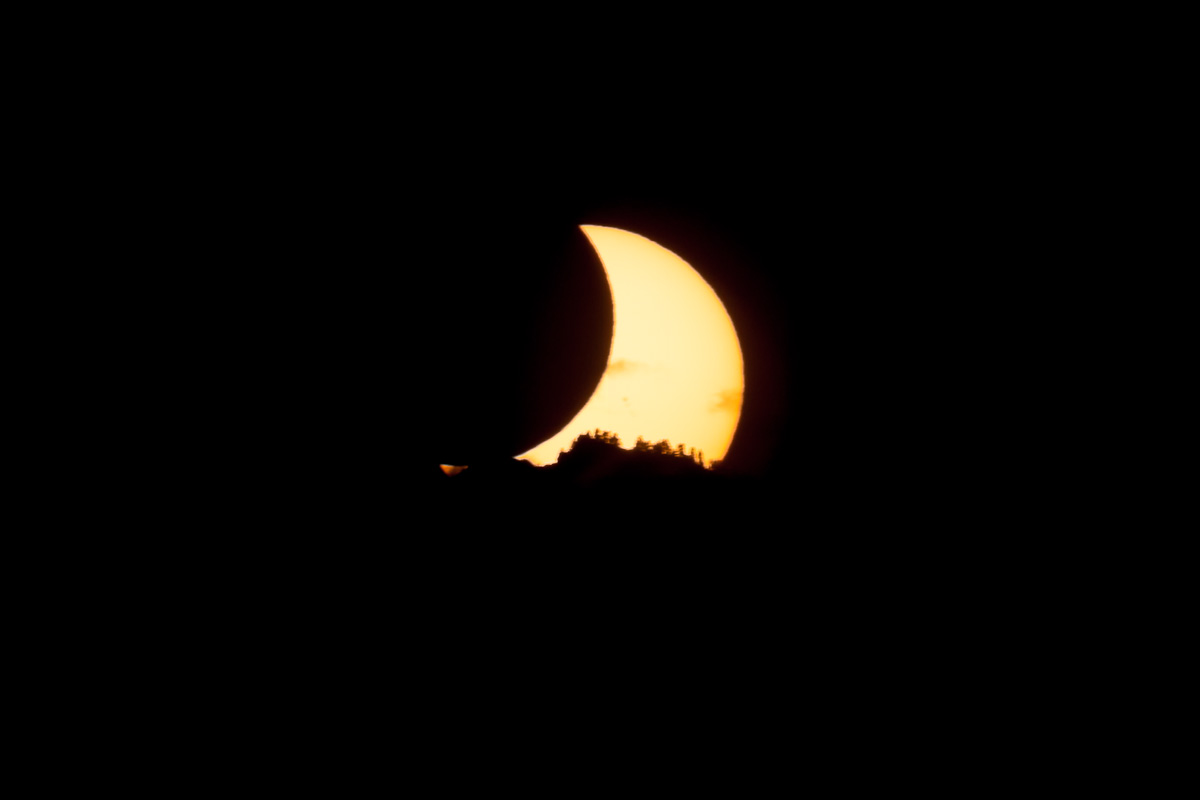
Here's a solar eclipse, 1/4000th, f/16, ISO 100, the sun is not blown out. I could show you images of the sun just coming up over the horizon with much more exposure and a sun that isn't blown out.

20D47378.jpg

No filtering?

Pretty crazy that atmospheric conditions could account for that much disparity (2-1/2 stops or so).
 
Upvote 0
3kramd5 said:
Lee Jay said:
Here's a solar eclipse, 1/4000th, f/16, ISO 100, the sun is not blown out. I could show you images of the sun just coming up over the horizon with much more exposure and a sun that isn't blown out.

20D47378.jpg

No filtering?

Pretty crazy that atmospheric conditions could account for that much disparity (2-1/2 stops or so).
When the sun is low there is a LOT of attenuation through the atmosphere.

At 15 degrees up, the magnitude is -26.28
at 10, it's -26.09
at 8, it's -25.89
at 6, it's -25.63
at 4, it's -25.17
at 3, it's -24.81
at 2, it's -24.25
at 1, it's -23.35

The drop from 15 degrees up to just above the horizon is 3 degrees of magnitude, or a factor of 16, or 4 stops.....
 
Upvote 0
Lee Jay said:
Don Haines said:
tpatana said:
Moon looks underexposured IMHO.
and where is the shadow detail :)

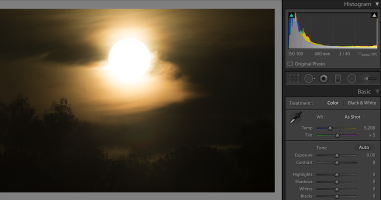
This is the one base-ISO shot I've taken where there isn't enough dynamic range for all subjects. However, if you do the math, you'd need close to 30 stops of DR to get it all so the 1-2 extra you get from a Sony sensor would be utterly useless.
This is just my personal observation, but most of the time 12 stops is fine.....yeah, a couple more stops would be better, and I certainly would not complain if Canon delivered, but I can live with 12. That said, I could live happier with 15 stops......
 
Upvote 0
Don Haines said:
jrista said:
K said:
I can hear it already...Nikon fanboys saying "you have to spend $6,500 to do a 5-stop push"

Unless the 5D IV comes out with similar DR.
Or the EOS-M :)

Not as something that would directly compete with a Nikon D810 though. I'm not terribly impressed nor excited about Canon's mirrorless offerings...they would really have to pack it full of features including a high DR sensor to even twitch the needle as far as I am concerned. Canon is much farther behind on the mirrorless front than they are on the sensor front.

The 5D IV is overdue, and if there is any camera out there people are looking forward to for having a big jump in IQ, especially in comparison to Nikon cameras, it's the 5D IV.
 
Upvote 0