Re: Update to EOS 5DS & 5DS R Coming in 2017? [CR1]
tron said:
I do not care at all for mirrorless. But to tell the truth a global shutter would help in very high resolution. It was mentioned that in that case we need tripods. High speed shooting does not help because above flash sync speed (1/200, 1/250) it is being simulated by the moving blades. With small pixels (or smaller microlenses if you will) movement would show easier even with high speed.
Was it you who claimed, only the other day, that high shutter-speeds "don't help because they are only 'simulated' by the moving blades", and were told that this is rubbish? Someone tried to use this argument here, only a few days ago.
If fast shutter speeds were only "simulated", then how is it that as you make shutter speed faster, keeping everything else the same, the exposure decreases linearly, and the photo gets less exposed?
Ok. You're talking about camera-shake causing pixel-level blurring. YES, it's true that at fast shutter-speeds, one side of the photo is still "taken" say, 1/250s "later" than the other side, so the whole photo "spans" 1/250s, even if you have a faster shutter speed selected.
BUT still, each cluster of neighbouring pixels is still only illuminated - and therefore capable of suffering shake-induced blurring - for the much shorter time of the exposure.
HOWEVER, you are right that an effect could manifest itself at fast shutter-speeds: Imagine you're taking a fast photo of, say, a building with long, straight walls, and the building fills most of the frame. As you're taking the photo, your hands are shaking because:
a) You've got a hangover and you need more booze and you've got the shakes
b) It's cold
c) A bird flies over and poos on your head and you recoil in disgust
d) Someone shoves you
Now the camera moves significantly during the exposure, and IS is absent or cannot compensate.
The photo will show those straight lines of the building as wavy, rather than straight. But those lines, despite being wavy, will not be blurred; they'll still be sharp, because at the pixel level, exposure time was still, say, 1/2000s or whatever.
The effect is more like a kind of still-photo-rolling-shutter.


 Even today nothing prevents them to scale the 80D's 24Mpx 1.6x APS-C to FF so it'll be around 61Mpx.

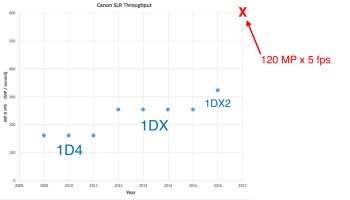
 They feel the same way about giving up any detail at all for fps reasons. If a 100 MP rig @ 1 fps was offered, they'd sell their car to get it on day one.

 )
)