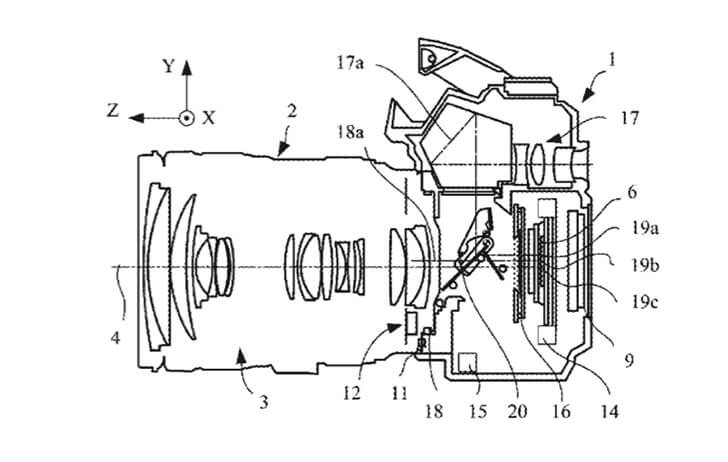
Canon EOS R5 Specifications

Who else had or has plans to buy into the RF body system yet keep their EF glass and potentially not buy RF lenses for quite some time? (or ever...I have 3 expensive hobbies and I can't make the others jealous too often) I really like my collection of Canon lenses and none of the RF's do anything for me focal length wise. This may change ;)
That's the great thing about the R cameras - you could easily keep a full EF lens inventory for a long time and use them perfectly. Unlike the FD to EF debacle. Now just waiting on the proper R body!
 
  • Like
Reactions: 1 users
Upvote 0
With all this talk of new cameras coming it makes me wonder what will happen to the R and Rp.

If there is a replacement for the R then traditionally Canon has ended production of the earlier model. However this trend has for other manufacturers been going out of fashion - and for good reason. Apple for example is, having already sunk the costs of design, certification, manufacturing lines etc, now keen to keep producing older models to sell at a lower price.

Sony has really taken this model on board for their cameras and it has proved a good way to keep the price pressure on Canon and Nikon. The A7rIII for example remains a very good camera, in many technical respects superior to the Nikon and Canon mirrorless offerings, and is now available for a low price. A clever way to draw people into your system.

For all its detractors the R is a very good camera - perhaps it will become the entry level model and be sold cheaper.
 
  • Like
Reactions: 1 users
Upvote 0
Who else had or has plans to buy into the RF body system yet keep their EF glass and potentially not buy RF lenses for quite some time?
I have a vague plan to get the new R5 or RS and keep my 5DIV for a few months. I haven't had a backup camera for a while which is bad. So I'd keep all my EF lenses but then will probably be trading them in for the RF equivalents, and eventually sell 5DIV too.

But I'm having GAS attacks sometimes so eventually can fully switch to the new system at once - only I need a budget to buy RF first and sell later. If you look at my lenses (below), the full upgrade to RF will be quite expensive, considering the difference between the second-hand EF and new RF ones.
 
Upvote 0
Who else had or has plans to buy into the RF body system yet keep their EF glass and potentially not buy RF lenses for quite some time? (or ever...I have 3 expensive hobbies and I can't make the others jealous too often) I really like my collection of Canon lenses and none of the RF's do anything for me focal length wise. This may change ;)
My initial plan was just to buy the R with the kit lens. I did that. Then, impulsively, I decided I just had to have the RF glass I have now so I sold everything else. To afford it, I had to sell all my EF glass and my 5D Mark III. I also sold the RF 24-105mm f/4L. I only wish I had kept my 135mm f/2L and the EF 35mm f/1.4L II. I say that I wish I kept them for two reasons: 1. They were fantastic lenses. The 135 was my favorite portrait lens and the 35 was beautiful in it's rendering and fast. 2. It will be very difficult for me ($) to get any RF 135mm f/xL that comes out, or any other lens for that matter. I will not be buying the 2.8s.
 
Upvote 0
Who else had or has plans to buy into the RF body system yet keep their EF glass and potentially not buy RF lenses for quite some time? (or ever...I have 3 expensive hobbies and I can't make the others jealous too often) I really like my collection of Canon lenses and none of the RF's do anything for me focal length wise. This may change ;)

Yes that was my intention and, yes, inevitably I've ended up buying more Rf glass!

It's wise, if you have the self control, to hold off a little while when you can. Canon of course charges top dollar for lenses when first released and a little patience can save a lot of money.

Canon knows they have a fight on their hand and the 15-35 and 24-70 2.8s have already come down a fair bit in price with grey markets etc and you'll find that Canon won't want their 2.8 pro lenses to be much more expensive than Sony's GM 2.8 lenses for long. I haven't carefully analysed it but I have the feeling the prices have come down quicker than previously - the 35mm 1.4L II and 16-35mm 2.8L III both stuck at their entry price points, at least in England, for seemingly ages and it has only been more recently they dropped quite a bit (of course they were replacing existing lenses not new lenses in a new mount which Canon hopes to establish). Unless you're a YouTube making unboxing videos or just have terrible GAS it's always worth waiting. The 50/1.2 L and 35/1.8 IS are both already quite a lot cheaper than their entry price.

Canon clearly adjusts it for the market. Their EF 85/1.4L IS for example came in much cheaper than expected, almost certainly because of the Sigma Art 85/1.4. The Sony 2.8 GM holy trinity are now well established and settled in price and that's a market Canon prizes highly.

And if the upcoming R models really have IBIS that will for example allow a lot of people to keep using their EF 24-70/2.8L II rather than buy the new Rf model. If I can get an Rf camera then I will keep my old lens. It will also be good for the 135L.
 
Upvote 0
But this notion that we'll get this sort of bump each gen of sensor is nuts. This was a one time really big boost -- think of it a market parity chiropractic re-alignment. It will not happen again* in big chunks unless Canon makes yet another once-every-10-years sort of sensor architecture change. I don't see it happening soon.

Yeah, as above, if we extrapolate 90D sensor to FF, we get 5DIV's performance at 80Mp which will be quite good. At 45Mp I'd expect a slightly better performance than 5DIV. This extrapolation may be flawed but gives an idea of what to expect from Canon.

Also they say 90D has less banding issues which is good, and also they still promise to make some advancements in this area. I don't expect drastic changes, I actually expect these new R sensors to be slightly worse than Sony in terms of the DR, but I'm ok with 0.5 stop difference or so. But if Canon doesn't deliver even that, myself and many other customers will be very disappointed. If R5 lags say 1 stop behind A7RIII, it may become a last straw.
 
Upvote 0
Who else had or has plans to buy into the RF body system yet keep their EF glass and potentially not buy RF lenses for quite some time? (or ever...I have 3 expensive hobbies and I can't make the others jealous too often) I really like my collection of Canon lenses and none of the RF's do anything for me focal length wise. This may change ;)

As a hobbyist, my lens lineup is small and modest, so I plan on replacing them as the opportunity or need arises. I bought my R at Christmas when the price dropped, and couldn't afford the RF 24-105 f/4L, so I'm currently using the latest EF version. I love this lens for travel, but the new one appears to not only improve IQ, but also form factor. I plan on replacing this lens first. The other lens in my bag is the current EF 70-300 f/4-5.6, and this will be my second priority to upgrade once an RF equivalent is released.

The rest of my lineup is the shorty 40, nifty 50, and latest 24mm f/2.8 IS USM. They all work great on the adapter, so whether or not I upgrade them will depend on the price and features of any future lenses, but frankly these are low priority for me as most of my photography is walk around or travel and the two zooms cover pretty much everything I need to do.

Frankly, I feel that EF holdouts, and those who don't mind adapting, are going to be in some serious boon times with a lot of great EF lenses going on the used market. I definitely can't afford the new trinity, but who knows, I might soon be able to swing the EF trinity and make it work for several years and upgrade when I can.

TLDR, I'm in no hurry to upgrade, except for the RF 24-105 f/4L
 
Upvote 0
Just for the heck of it I went over and peeked at the Sony Alpha Rumors site for talk of the R5. They did have this article posted and the rumored specs. I was expecting a lot of mocking " yea...right!...suuuuuuure" replies but Surprisingly everything I read in the comments was positive on Canon basically. Most wished the specs were real and that the R5 would get Sony to stop slacking off and give them something competitive with some features they have been yearning for.
 
Upvote 0
Ah, yes, I forgot about the mirror box necessary for the OVF. so I’m just wrong on that. Thanks for calling that out.
actually, there is a solution: external OVF piece in the cold shoe. it would be a focal length specific, but for long glass shooters (birders), this may work well.
like a rifle scope, zooming according to the FL set in lens.

something along these lines:


such a OVF piece could even be calibrated to various focal lengths: 300, 420, 400, 5.6, 500, 700 800, etc. etc

I am sure that Canon can get this OVF piece auto zooming to whatever focal length the Lens is zoomed to.. A flash head reads receives FL information and sets itself to a correct FL automatically. Anyway, a method that I described can be implemented. yes, framing wont be 100% accurate. but hey, better than staring at a TV screen for hours draining your battery.
 
Upvote 0
With all this talk of new cameras coming it makes me wonder what will happen to the R and Rp.

If there is a replacement for the R then traditionally Canon has ended production of the earlier model. However this trend has for other manufacturers been going out of fashion - and for good reason. Apple for example is, having already sunk the costs of design, certification, manufacturing lines etc, now keen to keep producing older models to sell at a lower price.

Sony has really taken this model on board for their cameras and it has proved a good way to keep the price pressure on Canon and Nikon. The A7rIII for example remains a very good camera, in many technical respects superior to the Nikon and Canon mirrorless offerings, and is now available for a low price. A clever way to draw people into your system.

For all its detractors the R is a very good camera - perhaps it will become the entry level model and be sold cheaper.
These new models will be comfortably over double the current price of an R, so no R Mark II in sight as previously rumoured.
Depending on the viewpoint, the R5 can be described as that, but it is a much higher-end model, but after some time its high initial price may drop significantly just like it was with the R, so it can move to that spot.

So the R and RP won't go away, the model range is a bit different but eventually after 3-4 years from their announcements, they will get replacements.

With Sony there are three separate models running in parallel with short product cycles for the most part and the old ones will run out later.

With Canon if we suppose that there is a megapixel monster still coming as well the range will consist of five different R models (6 if we count the astrophotography as well) but they won't run a short product cycle and Nikon will likely to do more of less the same thing, only with a different order.
 
Last edited:
Upvote 0
Correct. Diffraction happens at a certain aperture based on pixel size. Simply put, diffraction will begin to creep in at larger and larger apertures the smaller and smaller (more and more) your pixels get. So when we have been shooting at say 25MP or less for a decade on average, we always talk about diffraction starting to hit around f11 - f16. When the 5DS came out with 50MP, we were talking about diffraction starting to creep in around f8. So in theory we can expect about the same on the R5 with 48MP. Fast Forward to this rumored 83MP thing... and you can see where this going. Where my understanding ends is whether or not the AA filter itself (remember it basically diffuses light) has much if any impact and in turn, will this new AA filter Canon has developed for the DX3 (and presumably on future R models as well) have any impact on extending the range of the f stops beyond where we would suppose diffraction would normally come in on 83 MP (f4 -5.6??)

Diffraction happens at all apertures. With digital imaging, it becomes detectable based on pixel size compared to the airy disk.

As for the new low pass filter on the 1D X Mark III, keep in mind that it it is being used on a relatively low resolution 20MP sensor and might not be as appropriate for a higher resolution sensor with much smaller sensels (a/k/a photosites a/k/a pixel wells).
 
  • Like
Reactions: 1 user
Upvote 0
These new models will be comfortably over double the cost of an R, so no R Mark II in sight as previously rumoured.

So the R and RP won't go away, the model range is a bit different but eventually after 3-4 years of their announcements, they will get replacements.

With Sony there are three separate models running in parallel with short product cycles for the most part and the old ones will run out later.

With Canon if we suppose that there is a megapixel monster still coming as well the range will consist of five different R models (6 if we count the astrophotography as well) but they won't run a short product cycle and Nikon will likely to do more of less the same thing, only with a different order.

here is my take on it:
note how R and RP have no model range number attached to the name. Canon typically differentiate model range by series: 1, 5, 6, xx, xxx etc.
in my humble opinion, R and Rp were an experiment, a proof of concept (POC), a Minimum viable product. I am sorry to say that.
they tested all sorts of crazy design concepts (touch bar), progressed firmware and technology like EyeAF to commercial level, form factor, etc. etc etc. , and having market reaction analysed now are ready to release a final product : R5, RS - whatever that may be... with quirky bits removed and wrinkles ironed.

R was destined to be an early adopter oriented conceptual product. once again, I am sorry for raining on R owners day. :(
 
  • Like
  • Wow
Reactions: 3 users
Upvote 0
If specs are true, treating this as the future upgrade for 5D4 users (I contend R5 and 5D5 will have these same specs):
  • IBIS -- huge for me (I shoot in low light often, so I read this as virtual speed to lower my ISO)
  • Huge bump in res
  • Huge bump in mechanical fps, throughput, etc.
  • Hilarious bump in fps with the e-shutter
  • Most likely a tilty-flippy touchscreen, which is quite useful for stills
  • Manual focusing tools (the 5D line no longer offers focusing screen changeouts)
And we still don't know if we'll get a new sensor architecture, new focusing tools, what kind of buffer we'll see, onboard tech for timelapse or stacking, etc.

So not much to see here for stills folks, nooooo. :LOL:

- A

What if...

Only the R5 gets IBIS and the 5D Mark V does not? What happens then?

Canon gives another incentive for buyers to move away from DSLRs to mirrorless, while giving those who prefer a DSLR most of what they want. Keep in mind that the biggest groups that still prefer DSLRs over mirrorless are shooting at high shutter speeds due to subject movement. They're shooting sports, action, wildlife, etc. IBIS isn't near as useful there as it would be with static scenes, particularly since the lenses most use for such subjects are already well stabilized.

Think about this: When Roger Cicala tore down the EOS R he noted that there's plenty of empty room behind the sensor which could be used for IBIS hardware. The 5D mark IV has no such space in it. To give the 5D Mark V IBIS would require either making the camera thicker or totally redesigning the main board and probably breaking it up into several pieces and moving them away from behind the sensor.
 
Last edited:
Upvote 0
here is my take on it:
note how R and RP have no model range number attached to the name. Canon typically differentiate model range by series: 1, 5, 6, xx, xxx etc.
in my humble opinion, R and Rp were an experiment, a proof of concept (POC), a Minimum viable product. I am sorry to say that.
they tested all sorts of crazy design concepts (touch bar), progressed firmware and technology like EyeAF to commercial level, form factor, etc. etc etc. , and having market reaction analysed now are ready to release a final product : R5, RS - whatever that may be... with quirky bits removed and wrinkles ironed.

R was destined to be an early adopter oriented conceptual product. once again, I am sorry for raining on R owners day. :(
It is called natural progression, but it is also differentiation.
Enough time has passed with the development that now they are able to match or exceed expectations about what people requested (which they were aware of much sooner than the start of their FF mirrorless system)
But it will also cost significantly more, because besides the development cost, it is a much more attractive, desirable, 'fresh' product, but it does mean that the other is trash (it was initially priced high compared to where it belongs, but at the current level it is a fine camera)
 
Upvote 0
What if...

Only the R5 gets IBIS and the 5D Mark V does not? What happens then?

Canon gives another incentive for buyers to move away from DSLRs to mirrorless, while giving those who prefer a DSLR most of what they want. Keep in mind that the biggest group that still prefers DSLRs over mirrorless are shooting at high shutter speeds due to subject movement. They're shooting sports, action, wildlife, etc. IBIS isn't near as useful there as it would be with static scenes, particularly since the lenses most use for such subjects are already well stabilized.

Think about this: When Roger Cicala tore down the EOS R he noted that there's plenty of empty room behind the sensor which could be used for IBIS hardware. The 5D mark IV has no such space in it. To give the 5D Mark V IBIS would require either making the camera thicker or totally redesigning the main board and probably breaking it up into several pieces and moving them away from behind the sensor.

They can do it if they feel like it. Or the 5D Mark V will be priced lower than the R5 for omitting this feature. Either decision should work.
 
Upvote 0
here is my take on it:
note how R and RP have no model range number attached to the name. Canon typically differentiate model range by series: 1, 5, 6, xx, xxx etc.
in my humble opinion, R and Rp were an experiment, a proof of concept (POC), a Minimum viable product. I am sorry to say that.
they tested all sorts of crazy design concepts (touch bar), progressed firmware and technology like EyeAF to commercial level, form factor, etc. etc etc. , and having market reaction analysed now are ready to release a final product : R5, RS - whatever that may be... with quirky bits removed and wrinkles ironed.

R was destined to be an early adopter oriented conceptual product. once again, I am sorry for raining on R owners day. :(
There ain't no rain over here. ;) It is a fantastic camera for the $. So is the RP.
 
Last edited:
  • Like
Reactions: 2 users
Upvote 0
R was destined to be an early adopter oriented conceptual product. once again, I am sorry for raining on R owners day. :(

As an R owner, I agree with you, and my parade has definitely not been rained on. In fact it was an opportunity for a not rich enthusiast like myself to get into mirrorless, take advantage of the new great glass, and get into a much better camera than my O.G. 6D for about the same scratch as the current 6D mkii.

I’m totally happy watching the evolution of the R for the next five years. I put a lot of mileage on my 6D, and I see no reason the R won’t serve me as well.

I just have to deal with glass GAS.
 
  • Like
Reactions: 2 users
Upvote 0
I see an RF 400mm f/2.8 IS in my future. Do we know if the R IBIS works with IS in EF lenses? I'm assuming it does not work as well.

I'd really be surprised if an RF 400mm f/2.8 L IS is introduced before an RF 300mm f/2.8 L IS and RF 500mm f/4 L IS.

The EF 400mm f/2.8 L IS II and EF 600mm f/4 L IS II both got total redesigns to "III" versions in 2018.

The EF 300mm f/2.8 L IS II and EF 500mm f/4 L IS II are 2011 designs. They'll be the first RF great whites.
 
Upvote 0
I disagree unfortunately. I think the last new DSLR by Canon has already been introduced.

For those that prefer OVF over EVF, I would stick with existing gear until I got used to EVF - I wouldn't buy a new DSLR anymore (except 1D sports users).

The reason is lenses. With the development of RF glass and their better optical quality due to short flange distance, a DSLR photographer is handcuffing himself to older EF lenses that Canon will no longer develop. An R series camera can adapt EF lens, but DSLR can't adapt R glass.

That is a much bigger disadvantage than latency in viewfinder.

It is now an inevitable shift to mirrorless, equivalent to when digital took over from film.

How many years did you shoot film before you transitioned to digital?
 
Upvote 0