Canon Developing a New Slower Supertelephoto Lens [CR2]

Affordability is relative. Right now Canon offers no lenses between the $2000 and $6000 range. I could see Canon coming out with a 500mm f5.6 L IS in the $4k range as well as a 600 f5.6 closer to $6k. Both would be definitely more affordable than their f4 cousins. I think there would be a market for both lenses. Those that can't afford the f4 lenses but want the quality would appreciate them and those that already have one of the current 500-800mm lenses might buy one as a second lens for lighter weight and hand holding. There are already many people who buy a 300 f2.8 and keep a 2x attached to it all the time.

I don't see Canon coming out with their own version of the f6.3 lenses produced by Tamron and Sigma, especially at their price point. It ain't going to happen. If you're looking for a zoom to the 600mm range from Canon for around $2k, get the new 100-400 II and stick a 1.4x on it and be happy. It's pretty good actually.
 
Upvote 0
Joey said:
KateH said:
What I haven't seen anyone guess is that maybe this "Something entirely new" will be a non-L EF-S ultratelephoto? With the great success of the 70D and 7D MKII as semi-pro and sports cameras, perhaps it's time for a high-quality EF-S prime in the 250-400mm range? If Canon could make such a thing be compact, have excellent wide-open performance, and cost well under 1000$ I predict a niche hit.
There are no EFS telephoto lenses (unless you count zooms that extend into the wide-angle range) because there is no reason to limit the market for your new lens to crop sensor users unless there is some benefit to doing so. The reason for making EFS lenses is that it frees you to put elements closer to the sensor than the EF mount allows. Wide angle lens design can be simpler/better when you bring elements closer to the sensor, but telephoto lenses don't need elements that close. So an EFS telephoto would not make sense.

EF-S 55-250 mm in it's various versions is a telephoto lens and it doesn't extend into the wide angle range.
 
Upvote 0
neuroanatomist said:
Gnocchi said:
9VIII said:
I've suggested an EF-S supertelephoto a few times before, it makes sense from a marketing perspective (that you prevent the full frame users from taking advantage of the lens, thus keeping you're stable of $10,000 lenses safe)...

But that is a remarkably unpopular idea around here.
I tend to agree on a efs s/Tele lens. Wouldn't it make sense to make one in an efs mount? Lighter, smaller? Is that possible?

There's really no point to an EF-S telephoto lens. The -S best stands for 'small image circle' (that's the original designation, and not all EF-S lenses have a short backfocus distance. With a telephoto lens design, the size of the image circle isn't limiting. A few of the rear-most elements could be made smaller, but the size/weight savings would be quite minor, particularly for a supertele focal length.
Righto then, thanks for your explanation.
 
Upvote 0
As somebody who has spent close to AUD$9k on a 300mm f/2.8ii and 2xiii TC, I would be pretty unimpressed if Canon developed a 600 f/5.6 with equivalent image quality and better AF for less than half the price. I'm thinking a 500 f/5.6 or 600 f/6.3 is more likely for all the reasons people are suggesting.
 
Upvote 0
Don Haines said:
KateH said:
This is certainly an interesting riddle. "Slower than f/4, supertelephoto, not a new 400 f/5.6, 'entirely new' and '
affordable'" are specific claims but still leaves a lot of questions.

300mm f/5.6 seems unlikely; the 300mm f/4 is not terribly large and selling for 1300$ new and 1/2 to 2/3rds that used, it's already quite inexpensive as far as long teles go.

A non-L 100-400 f/5.6 seems like a bad idea- see how sales of the 70-300 f/4-5.6L have been totally overshadowed by the excellent 70-300 f/4-5.6 non-L for half the price. Surely Canon would not want to threaten their flagship 100-400 f/4-5.6L II

500mm f/5.6L does actually seem somewhat probable; the 400mm f/5.6 retails for 1200$ which suggests a 500mm f/5.6 produced in sufficient volume could be well under 2000$- which definitely qualifies as "affordable" compared to the 9000$ 500mm f/4L! The biggest issue with a hypothetical 500mm f/5.6 is it's similarity to the 400mm f/5.6- two high-end, low-volume lenses that similar would cannibalize sales from each other, messing with economy of scale in production and driving prices up and margins down. Not a great business decision for Canon. UNLESS are Canon planning to replace the 400 f/5.6 with a 500mm f/5.6? That actually does make some sense- the 400mm f/5.6 has stiff internal competition from Canon's own (and far more popular) 100-400mm lenses, and arguably even the faster and/or less expensive 300mm primes and zooms.

600mm f/5.6L seems quite probable as well- it would fit nicely above the 400mm f/5.6 and provide a smaller and much less-expensive alternative to the 600mm f/4. I imagine that would sell for ~2000$- which is stretching the "affordable" claim, though cost is relative when talking about ultra-teles!

Perhaps it's a 135-500mm f/5.6 non-L STM? There's certainly a lot of pressure in that area from Tamron/Sigma and if Canon intentionally segments it from the 100-400 with slower autofocus (although STM AF can be quite fast) it would be an interesting option.

What I haven't seen anyone guess is that maybe this "Something entirely new" will be a non-L EF-S ultratelephoto? With the great success of the 70D and 7D MKII as semi-pro and sports cameras, perhaps it's time for a high-quality EF-S prime in the 250-400mm range? If Canon could make such a thing be compact, have excellent wide-open performance, and cost well under 1000$ I predict a niche hit.
Well said!

I suspect that you are right....a new 400f5.6 would be optically superior to the new 100-400, but probably not enough so to generate decent sales...... But a 500f5.6, with superior optics and that extra 100mm of reach would stand alone in the Canon glass collection and would probably sell well. I would certainly get one....
And with series 2 prime optical quality, it would play well with teleconverters ( sorry sigma and tamron), and allow 700mm at F8 or 1000mm at F11
"...1000mm f/11." Does AF work with f/11 max aperture? ???
 
Upvote 0
neuroanatomist said:
Gnocchi said:
9VIII said:
I've suggested an EF-S supertelephoto a few times before, it makes sense from a marketing perspective (that you prevent the full frame users from taking advantage of the lens, thus keeping you're stable of $10,000 lenses safe)...

But that is a remarkably unpopular idea around here.
I tend to agree on a efs s/Tele lens. Wouldn't it make sense to make one in an efs mount? Lighter, smaller? Is that possible?

There's really no point to an EF-S telephoto lens. The -S best stands for 'small image circle' (that's the original designation, and not all EF-S lenses have a short backfocus distance. With a telephoto lens design, the size of the image circle isn't limiting. A few of the rear-most elements could be made smaller, but the size/weight savings would be quite minor, particularly for a supertele focal length.
I thought I read in one of the Canon lens books that the "-S" designation was for lenses with short backfocus. With APS-C bodies the mirror is smaller so the length of the pivoting mirror is shorter so lenses can be designed to protrude further into the throat of the mounting flange. It is also true that these lenses cover a smaller image circle but that's not where the "-S" comes from.

EDIT: I found the lens book and I was wrong. There is no clear statement as to what the "-S" stands for. Just general discussion about the points above.
 
Upvote 0
dslrdummy said:
As somebody who has spent close to AUD$9k on a 300mm f/2.8ii and 2xiii TC, I would be pretty unimpressed if Canon developed a 600 f/5.6 with equivalent image quality and better AF for less than half the price. I'm thinking a 500 f/5.6 or 600 f/6.3 is more likely for all the reasons people are suggesting.

even if they made it, it would not be as sharp nor as fast in focusing as the 300 MKII, if it was only as sharp as the 100-400 MKII it would be great.
 
Upvote 0
meywd said:
dslrdummy said:
As somebody who has spent close to AUD$9k on a 300mm f/2.8ii and 2xiii TC, I would be pretty unimpressed if Canon developed a 600 f/5.6 with equivalent image quality and better AF for less than half the price. I'm thinking a 500 f/5.6 or 600 f/6.3 is more likely for all the reasons people are suggesting.

even if they made it, it would not be as sharp nor as fast in focusing as the 300 MKII, if it was only as sharp as the 100-400 MKII it would be great.
Look at the 70-200F2.8IS and the F4IS version.... The IQ is almost identical and one is twice the price of the other. I would not be the least surprised to see the same IQ out of a 500F5.6 as the 500F4. You pay a lot more money for faster lenses.....
 
Upvote 0
dslrdummy said:
As somebody who has spent close to AUD$9k on a 300mm f/2.8ii and 2xiii TC, I would be pretty unimpressed if Canon developed a 600 f/5.6 with equivalent image quality and better AF for less than half the price. I'm thinking a 500 f/5.6 or 600 f/6.3 is more likely for all the reasons people are suggesting.

But you also have a 300 2.8 - so you have effectively two lenses in one, with the converter. If you need 600mm and they released a 600 5.6, then sell what you've got and buy that. Brian at TDP says buy the focal length you need, and I agree with him (budget constraints notwithstanding).
 
Upvote 0
LDS said:
exquisitor said:
Well, you compare photographic telephoto lenses and telescopes and I have no idea in lens design? Common, that's not serious.
Of course you can do affordable or even cheap 600/5.6, but there is no way it would be comparable in any way to the white L glass. It's always compromise between cost and image quality.

It was you to say that a lens cost depends almost on front lens size alone. The telescope example demonstrates it is not true. It's the overall lens design that matters more. Unlike a telescope, a telephoto design "cheats" about the focal length of the light gathering lens group, which is shorter, and then the focal in "increased" by the telephoto group.

That makes the lens more compact, but the design more complex and expensive compared to a lens of the same "aperture" not using this design. Increasing the size of the front group increases costs a lot because the *whole* design becomes far more complex, including the need of far more lenses and more expensive glasses to achieve adequate performance, you've got to "bend" light rays more, and that implies more aberrations that needs to be corrected.

A 300/2.8 and 600/5.6 won't use the same design at all, the former will be far more complex and expensive to build - regardless if the front less diameter is roughly the same.

How much cheaper can be, for example, a 600/5.6 compared to the $12K 600/4? Exactly, it depends on what compromises are made in its design, performance and production (maybe outside Japan...). A non-zoom design will be cheaper than a zoom one, and after all Sigma can sell a 150-600 albeit a little slower for $2K (and even $1K for the cheaper model), and still earn money. Compared to $12K, affordable could mean easily $2-3K - given the prices of the 400/5.6 and 100-400 II, maybe without the "L" badge (the old FD 400/4.5 was not an L lens, although it had UD glasses...) and with inferior performance (AF, IS) - guess Canon has no will to kill the market for any of the big whites offering an alternative, but for less demanding photographers without deep pockets.

But today Canon doesn't offer anything "affordable" beyond 400mm, and it helps Sigma, Tamron & C. to sell their lenses to Canon users, which may also then decide to buy more from them also. With camera sales stale or decreasing, offering lenses in a range previously unreachable but for pro (or rich, or maybe fanatic..) photographers could be a right move to keep customers buying Canon. Wildlife and sport photography is appealing, just often you need a lens long enough... and that's an area smartphones can't really compete (yet?)

Just check the price and complexity of 400/2.8 and 800/5.6. 800 mm is "just" f/5.6 and don't need to "bend" light so much, so it should be more simple to build. That's following from your logic.

To build the 600/5.6 with equal to 300/2.8 IQ/build quality, the complexity and price would be nearly the same. You can agree or not, but there are enough examples. And to make it around $2000-3000 would be a huge compromise between price and IQ/build quality. My point is, 600/5.6 is to much for an affordable lens (2-3K), 500/5.6 looks more realistic. No point in the bad 600/5.6, just make a good 500/5.6...

And if you're mentioning the Sigma 150-600: compare two versions to see how much effort it costs to make 600 mm look better even at the same aperture - 1 kg more weight + $1000. And then to make even 600/5.6 for $3000 (and by Canon, not by Sigma) looks really fantastic... at least to me.
 
Upvote 0
It seems a 500 f/5.6 really would hit a sweet spot in terms of the current line-up. With a design weighted to the simpler spectrum (what LDS was pointing out earlier with less elements and cheaper ones) that was still good optically, along with USM, IS and the affordable price (let’s be realistic and think about 2k or more to still get something worthwhile) I’m sure they would catch the interest, and dollars, of many a wealthier/committed hobbyist or part-time(plus) photographer. Canon is in the business to make money so they will have done their research and know the user they are shooting for.

We’ve become a-custom to stellar performance of all recent generation high end lenses (not that this is a bad thing) and I just hope as users (well dreamer in my case) of these products we can really consider what we can expect from an “affordable” telephoto. Ideally we want perfect optical quality but don’t want to pay what Canon would ideally need/like to charge us for it. So a very good (not great or stellar - but still better than some of the ageing lenses in the lineup) 500 f/5.6 (L or not) IS would surely be a hit. And I’m sure Canon would already know this and be working on it if they saw a business case for it. Here’s hoping.
 
Upvote 0
StudentOfLight said:
neuroanatomist said:
Gnocchi said:
9VIII said:
I've suggested an EF-S supertelephoto a few times before, it makes sense from a marketing perspective (that you prevent the full frame users from taking advantage of the lens, thus keeping you're stable of $10,000 lenses safe)...

But that is a remarkably unpopular idea around here.
I tend to agree on a efs s/Tele lens. Wouldn't it make sense to make one in an efs mount? Lighter, smaller? Is that possible?

There's really no point to an EF-S telephoto lens. The -S best stands for 'small image circle' (that's the original designation, and not all EF-S lenses have a short backfocus distance. With a telephoto lens design, the size of the image circle isn't limiting. A few of the rear-most elements could be made smaller, but the size/weight savings would be quite minor, particularly for a supertele focal length.
I thought I read in one of the Canon lens books that the "-S" designation was for lenses with short backfocus. With APS-C bodies the mirror is smaller so the length of the pivoting mirror is shorter so lenses can be designed to protrude further into the throat of the mounting flange. It is also true that these lenses cover a smaller image circle but that's not where the "-S" comes from.

EDIT: I found the lens book and I was wrong. There is no clear statement as to what the "-S" stands for. Just general discussion about the points above.

You're right, it's not clear. I thought it was clear, and the fact that it's not is actually Canon's fault.

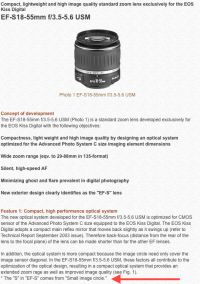
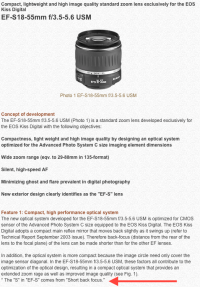
Canon stated that the -S stands for small image circle in the Technical Report for the first such lens, the EF-S 18-55mm f/3.5-5.6 USM, which was released as the kit lens for the Digital Rebel / 300D / Kiss back in 2003. I ran across that report in 2012 (link to old CR post).

Unfortunately, Canon took all of their older technical reports offline in late 2013 - which was quite rude of them!

However, there's the internet wayback machine, and when I searched for archived versions of the 2004-1 technical report it turns out that while I was correct based on the the report that was current before they removed all the older ones (first image below), the original report indiciated that the -S meant short back focus (second image below). They edited their own report in early 2006 (love those multiple wayback machine snapshots!), which coincides with the release of the EF-S 17-55/2.8. I suspect that's because the 17-55 does not acutally have a short backfocus distance (unlike the previously released EF-S lenses), whereas all the EF-S lenses have a small image circle relative to EF lenses.

So, I was incorrect that 'small image circle' was the original designation, but I do think it's the best designation, and I infer from Canon's edit of their own report that they think so, too.
 

Attachments

  • EF-S more recent.png
    EF-S more recent.png
    213.6 KB · Views: 653
  • EF-S older.png
    EF-S older.png
    214.4 KB · Views: 676
Upvote 0
A 600 f/5.6L IS with IQ similar to or better than the old 400 f/5.6L, with fast AF response, and with adequate weather resistance would hit the sweet spot in weight and usability for birders with recent FF bodies. However, it wouldn't be inexpensive, just less expensive by a good bit than the 600 f/4. Something in the $4,000.00 to $5,000.00range? The budget birder still starts out with some APS-C body and the 400 f/5.6L or 100-400II. I can see a mid-level birder going for 5D3/4 and 600 f/5.6L IS. Pros will still go for the 500 or 600 f/4 plus 1DX1/2.
 
Upvote 0
dilbert said:
NancyP said:
A 600 f/5.6L IS with IQ similar to or better than the old 400 f/5.6L, with fast AF response, and with adequate weather resistance would hit the sweet spot in weight and usability for birders with recent FF bodies. However, it wouldn't be inexpensive, just less expensive by a good bit than the 600 f/4. Something in the $4,000.00 to $5,000.00 range?

That's not what I'd call "affordable" and if it is to you then I wish I had your budget problems :)

The budget birder still starts out with some APS-C body and the 400 f/5.6L or 100-400II.

No, the budget birder starts out with a rebel and either gets the 55-250 or a 70-300 of some sort.

I can see a mid-level birder going for 5D3/4 and 600 f/5.6L IS.

that's a rather rich birder. I reckon you're more likely to find them with a 7D2 plus 70-300L.

Pros will still go for the 500 or 600 f/4 plus 1DX1/2.

Don't know about the pro. Reckon I'd go with the 5Ds because there's more pixels to work with, therefore bigger bird on screen. Sure, lose some fps but can't have everything.

Mixed feelings about this! "Affordable" is a totally subjective term, and so perfect for marketing purposes. But I did happen to start out on birds with a "Rebel" (300D) and 70-300... and I agree on the 5Ds - I'm thinking of upgrading. Losing only 1fps (I think?) is no big deal. But I suppose a committed bird photography amateur might start with a 7D and e.g. 300 f/4 IS.
 
Upvote 0
dilbert said:
LDS said:
9VIII said:
I've suggested an EF-S supertelephoto a few times before, it makes sense from a marketing perspective (that you prevent the full frame users from taking advantage of the lens, thus keeping you're stable of $10,000 lenses safe)...

There's a good number of FF users who can't afford the big whites, and will buy competitor's products.
When you also sell a cheaper FF like the 6D maybe an EF-S supertelephoto is not really a good idea.

Pretty much this.

Either Canon comes up with a lens (or lens combination) that can compete with the Sigma & Tamron 150-600 lenses in terms of price or they surrender that segment of the market. Dustin's review of the Sigma 150-600 sport is full of praise.

At 6.3 pounds the Sigma lens is heavier than I would prefer for a hand held day trip. I currently have the 7 pound 500F4 (often attached to 1.4XTC) and the size and weight after a while can still beat you down (though it is not overly heavy for what it is). But the Sigma would not offer me any advantages and I was sorry to see the announced weight as otherwise it would have been a possibility.

An F5.6 super tele prime would make a lot of sense given the weight would be significantly reduced. Those using the 400 F5.6 know just how small and light the lens is, making it great for day trips, especially those when you are in/out of a car all day long.

While I have no idea what Canon will do (they don't seem to often call me to ask what I would prefer!), I just do not see another super L zoom coming out on top of the 100-400L. That lens is their competitor for the Sigma and Tamron offerings even though focal length wise it is much shorter. But a 300-600 F5.6L zoom, while a nice thought, would not be light nor "affordable" per definitions of affordability listed in this thread.

My guess is the lens will be a 500mm F5.6L IS which should remain fairly light. The affordability of such I daresay many won't be happy with. The F4 version now sells for $9K. I would guess am F5.6L would sell for no less than $3K and most likely $4K or even somewhat higher. At $4K it is very "affordable" compared to the F4 version. But the $$ has gained ground compared to the yen so who knows. I was surprised when the 100-400L II came out at $2199.

It will be interesting. I would prefer a 600 F5.6 and if priced decently would be tempted to buy it if the lens were under 5 pounds. An "affordable" 500mm F5.6 I might consider but more doubtful given I have the F4 version already (MkII). But either lens would be desirable by many people and if the price were truly affordable even better.
 
Upvote 0
NancyP said:
A 600 f/5.6L IS with IQ similar to or better than the old 400 f/5.6L, with fast AF response, and with adequate weather resistance would hit the sweet spot in weight and usability for birders with recent FF bodies. However, it wouldn't be inexpensive, just less expensive by a good bit than the 600 f/4. Something in the $4,000.00 to $5,000.00range? The budget birder still starts out with some APS-C body and the 400 f/5.6L or 100-400II. I can see a mid-level birder going for 5D3/4 and 600 f/5.6L IS. Pros will still go for the 500 or 600 f/4 plus 1DX1/2.

Agree though in addition to my 500F4 II (with 5D3) I would be tempted to buy a 600 F5.6 if the weight were significantly less. I can handle the 7 pounds of the 500F4 BUT there are times when a lighter lens would be appreciated. Holding a 10 pound + camera + lens by hand and waiting.. and waiting.. and waiting for a bird to re-position itself isn't always fun!

So when Canon calls to ask me I'll chirp up about a 600 F5.6 lens but my gut says it will be a 500 mm F5.6 instead to replace the 400 f5.6. It will be smaller, lighter and less expensive which marketing wise makes a lot of sense.. and dollars.
 
Upvote 0
scyrene said:
dilbert said:
NancyP said:
A 600 f/5.6L IS with IQ similar to or better than the old 400 f/5.6L, with fast AF response, and with adequate weather resistance would hit the sweet spot in weight and usability for birders with recent FF bodies. However, it wouldn't be inexpensive, just less expensive by a good bit than the 600 f/4. Something in the $4,000.00 to $5,000.00 range?

That's not what I'd call "affordable" and if it is to you then I wish I had your budget problems :)

The budget birder still starts out with some APS-C body and the 400 f/5.6L or 100-400II.

No, the budget birder starts out with a rebel and either gets the 55-250 or a 70-300 of some sort.

I can see a mid-level birder going for 5D3/4 and 600 f/5.6L IS.

that's a rather rich birder. I reckon you're more likely to find them with a 7D2 plus 70-300L.

Pros will still go for the 500 or 600 f/4 plus 1DX1/2.

Don't know about the pro. Reckon I'd go with the 5Ds because there's more pixels to work with, therefore bigger bird on screen. Sure, lose some fps but can't have everything.

Mixed feelings about this! "Affordable" is a totally subjective term, and so perfect for marketing purposes. But I did happen to start out on birds with a "Rebel" (300D) and 70-300... and I agree on the 5Ds - I'm thinking of upgrading. Losing only 1fps (I think?) is no big deal. But I suppose a committed bird photography amateur might start with a 7D and e.g. 300 f/4 IS.

Affordability is a very ambiguous term which is why the original rumor posting is a little misleading. A 600 F5.6L IS for $4800 would be very affordable compared to the F4 version but nearly $5K for any leans is not something most will buy. I saved for an extensive period of time to buy the 500F4 II and it still made me queasy to buy it. I am not poor but neither am I rich and birds are a hobby not a business.

By the way I have seen gray market 7D2's for $1100 or slightly less. Compared to what DSLRs once cost that is very affordable though compared to a $650 rebel it may not be. Still seems to be a good price for anyone interested.

Time will provide the answer on this rumor. I am still guessing it will be a 500mm F5.6 as it would logically replace the 400 F5.6. Canon has the 100-400L and adding a lighter 500mm prime would make sense if they can hold the cost down. Just not sure it will be "affordable" by many definitions and Canon is certainly not going to produce a smaller lighter version of the current 500F4 at a price significantly less (like $2000).

I would hate to have to blance out marketing drives, production costs and what people think they want! has to be a hard job because you won't please the majority.
 
Upvote 0
LSeries said:
I would like to see a 500 f/5.6L or 600 f/5.6L and would probably buy one in a heartbeat. I consider 40-50% the price of the f/4 versions "affordable" enough.
But would you also consider 40-50% the price of the f/4 versions as "realistic" or "possible" for Canon?
Sorry, I don't think so. Maybe not even for SigRon (@ f/5.6).
And I also wouldn't call a price of 40-50% - still meaning > 4.000 $/€/£ - "affordable".
It surely would be a really good price for such a lens, but affordable?

To me "affordable" is something that any mainstream enthusiast with an average income could afford without saving for a long time.
And although opinions might differ here I see a lot of enthusiast I know are not able or willing to go north of 2.000 $/€/£.
And this leads me back to my first post in this thread here (Reply #9) where I stated this rumor as
"interesting and strange at the same time" and it will be very interesting to see what Canon respectively the rumor source is defining as "affordable". Hopefully we'll see soon ;)
 
Upvote 0